PMHNP placement across South Carolina's mental health map
South Carolina is worth knowing for one thing above all: it built one of the country's most established statewide telepsychiatry systems, which reshapes how a psychiatric-mental health student reaches clinical hours. It is also a restricted-practice state, so the practice agreement matters for who can precept you. We place students at any university across telepsychiatry, community mental health, hospital psychiatry, and addiction care, and this page starts where the state is strongest.
Telepsychiatry, South Carolina's signature setting
South Carolina runs a nationally recognized statewide emergency-department telepsychiatry program through its state mental health authority, connecting psychiatrists to a large share of the state's hospital emergency rooms, plus broad clinic-based telepsychiatry. The state agency is the largest telepsychiatry provider in South Carolina, which means real psychiatric encounters are reachable even in the rural Lowcountry and Pee Dee.
For a South Carolina rotation, the current program decides whether telehealth or simulation is permitted and how either is classified, supervised, documented, and applied. Confirm the current program rule and any applicable state requirements before relying on either format. That makes a telepsychiatry-inclusive plan one of the most realistic ways to complete the psychiatric lifespan here. More on PMHNP clinical hours.
The community mental health backbone
The state operates roughly sixteen to seventeen accredited community mental health centers and dozens of affiliated clinics through its office of mental health, serving children, adolescents, adults, and families, alongside state psychiatric hospitals and a range of private practices. These centers are dependable homes for outpatient medication management and case-loaded care.
Realistic training cities include Columbia, Charleston, Greenville, Spartanburg, Rock Hill, Florence, Myrtle Beach, Anderson, and Sumter. Your outpatient and inpatient hours will usually anchor in or near these hubs.
Crisis stabilization units, mobile crisis teams, and school-based mental health services extend the network into acute and younger-population care, and they often sit under the same community centers. That mix means a South Carolina rotation does not have to be a single repetitive setting, which matters when you are trying to touch several stages of the lifespan in one term.
Restricted practice and your preceptor
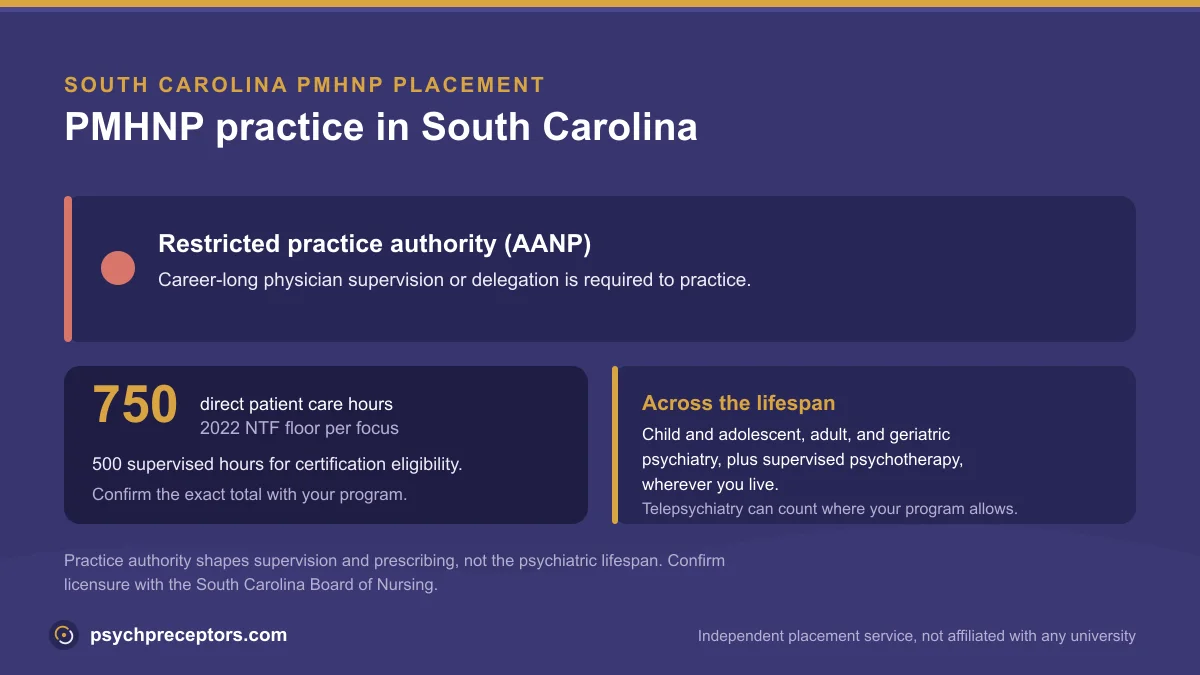
South Carolina is a restricted-practice state. A nurse practitioner without full authority works under a written practice agreement with a physician who must be readily available for consultation, and the agreement is reviewed on a set schedule. Prescriptive authority requires board approval and the agreement lists the permitted drug categories. Controlled-substance prescribing is conditioned, with Schedule II tightly limited within the agreement, and a DEA registration is required.
In practice a supervising or collaborating psychiatrist is usually part of the setting where a PMHNP precepts. This shapes the supervising and prescribing arrangement, not the preceptor's core credential, which stays a board-certified PMHNP or a psychiatrist. Legislation to widen nurse-practitioner independence has been under discussion, so confirm the current rules with the board. See preceptor requirements and the medication management rotation.
Child, adolescent, and geriatric rotations
Child and adolescent psychiatry concentrates in the Charleston academic health system and in the Midlands and Upstate, and it remains the scarcest rotation to secure. Statewide telehealth extends some child access, but a child and adolescent psych rotation still needs the earliest planning.
Geriatric psychiatry is thinner and tends to sit inside community centers, long-term care, and consult services. We treat the geriatric psych rotation as a scarce stage and schedule it deliberately.
Addiction and military behavioral health
County alcohol and drug commissions run a statewide substance use network, with medication-assisted and opioid treatment programs that pair well with a substance use rotation. Veterans and active-duty behavioral health around Charleston, Columbia, and the coast adds another route to strong adult hours.
Because these settings cluster in the metros and along the coast, we often combine them with nearby adult psych or medication management time to keep your schedule efficient.
Placing every stage in South Carolina
We plan the scarce child, adolescent, and geriatric hours first, then build adult, psychotherapy, and substance use around them, using the state's telepsychiatry strength to reach the harder counties. Your program will expect supervised psychotherapy hours in at least two modalities, and we schedule those alongside the medication management blocks. Tell us your program, your city, and what you still need.
You are matched first and pay only when a site is secured. Start at the match form, or read how it works and our flat fee. We are independent and never guarantee your school's approval of any preceptor or site.
Good to know
Is South Carolina a full-practice state?
No. South Carolina is a restricted-practice state. A nurse practitioner without full authority works under a written practice agreement with a physician, and prescriptive authority is board-approved and conditioned. Legislation to expand independence has been discussed, so confirm the current rules with the South Carolina Board of Nursing.
Can my preceptor prescribe controlled substances in South Carolina?
Yes, within the practice agreement and with limits, and Schedule II prescribing is tightly restricted. A DEA registration is required, and a collaborating psychiatrist is often part of the setting. This affects the arrangement, not whether your preceptor is a qualified PMHNP or psychiatrist.
Do telepsychiatry hours count in South Carolina?
Your current program decides whether telehealth or simulation is permitted and how either is classified, supervised, documented, and applied. Confirm the current program rule and any applicable state requirements before relying on either format. Confirm the specifics with your program.
Which rotation is hardest to place in South Carolina?
Child and adolescent psychiatry, since specialists concentrate in Charleston and the larger cities. We plan it earliest and use statewide telehealth to reach the harder areas.
How many clinical hours will I need?
The 2022 NTF Standards recommend at least 750 direct patient care hours per nurse practitioner population focus. ANCC and AANPCB eligibility sources separately use at least 500 faculty-supervised clinical hours. These figures serve different purposes and do not form a typical program range. Named programs vary and control the exact total and distribution, so confirm current requirements with your program.
Cover every rotation, not just the easy ones
Tell us your PMHNP program, your city, and the rotations you still need. We will come back with a plan for the full psych lifespan and a realistic path to placed.