Child and Adolescent Psychiatry Rotation Placement for PMHNP Students
Because the Psychiatric-Mental Health Nurse Practitioner is an across-the-lifespan track, your clinical hours have to include documented experience with children and adolescents, and this is the single hardest rotation to secure on your own. Pediatric behavioral-health preceptors are in short supply, the settings are limited, and every PMHNP student in your region is looking for the same slots. We are an independent placement service that works separately from any university. This page explains what the child and adolescent requirement is, why it is so scarce, who can supervise it, and how we source a qualified preceptor and site so a single pediatric-psych gap does not stall your program.
Why does PMHNP require child and adolescent hours?
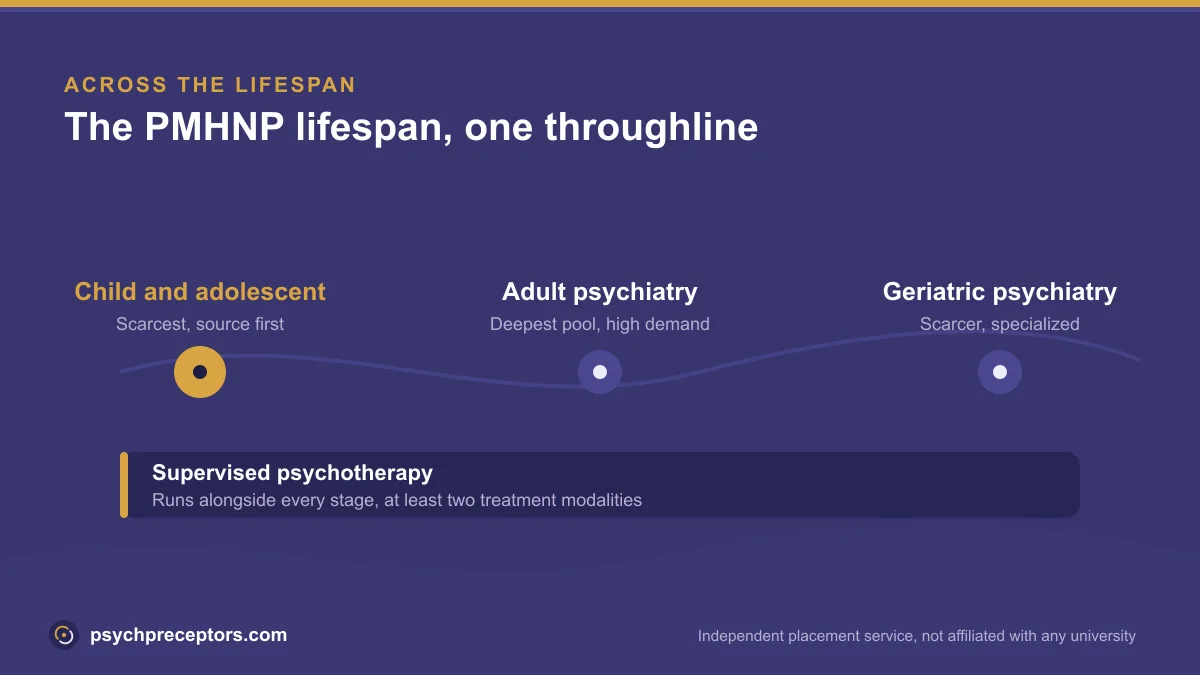
The PMHNP credential certifies you to care for psychiatric patients across the entire lifespan, from young children through older adults. That across-the-lifespan scope is not optional branding, it is what the certification means, so accredited programs build in supervised experience with pediatric and adolescent behavioral-health patients as one of the required population areas.
In practice, most programs distribute your clinical hours across the lifespan so that a defined block sits with children and adolescents, another with adults, and another with older adults, alongside supervised psychotherapy. The exact distribution is set by your school and can differ from one program to the next, so confirm your own program's population breakdown before you plan a placement. What is consistent everywhere is that a documented pediatric or adolescent psychiatric experience has to happen, and it cannot be skipped or fully substituted with adult hours.
Common child and adolescent psychiatric settings include community mental-health centers with youth programs, pediatric behavioral-health clinics, school-based mental-health services, adolescent partial-hospitalization and intensive-outpatient programs, and child-and-family psychiatric practices. Whether a given site fits your program is a school decision, and we match to settings that meet the pediatric intent of the requirement.
Why is the child and adolescent rotation so hard to secure?
This is the rotation students underestimate and then scramble for. The supply of preceptors who both hold the right credentials and work primarily with children and adolescents is genuinely thin, far thinner than the pool of adult-psychiatry preceptors, and youth behavioral-health services are concentrated in fewer settings.
- Few qualified preceptors. Child and adolescent psychiatric specialists, whether PMHNPs with a pediatric caseload or child-and-adolescent psychiatrists, are a small subset of an already stretched behavioral-health workforce.
- Limited settings. Youth psychiatric care clusters in specialty clinics, school programs, and a handful of community centers, so there are simply fewer doors to knock on.
- High demand. Every lifespan PMHNP program requires these hours, so students from many schools compete for the same slots at the same time.
- Extra clearances. Working with minors often adds background-check and onboarding steps that lengthen the timeline.
The students who clear this rotation cleanly are almost always the ones who started early and searched systematically. Left to the last term, a missing pediatric-psych block is one of the most common reasons a PMHNP program slips.
Who can precept your child and adolescent psychiatry hours?
The supervising clinician has to hold the credentials your program accepts and actually work with the pediatric and adolescent population. In practice that generally means an ANCC board-certified PMHNP-BC with a child and adolescent caseload, or a board-certified psychiatrist, and at some programs a child-and-adolescent psychiatrist specifically. Some programs allow other qualified behavioral-health prescribers for select experiences, subject to their own rules.
All hours have to be faculty-supervised within a program accredited by CCNE or ACEN (NLN CNEA also accredits some nursing programs), and the specific preceptor credentials are set by each school rather than by a single national mandate. Confirm your program's exact eligibility rules before you commit to a preceptor. Our preceptor requirements page covers the credentialing in detail, and our clinical hours page explains how the pediatric block fits your total.
How we place your child and adolescent rotation
Because this is the scarcest rotation, it is the one we prioritize sourcing first. You tell us your program, your city, and your timeline, and we run a targeted, local-first search for a qualified pediatric-psych preceptor and an approvable youth behavioral-health setting, early enough that the placement is settled before that term.
- Pediatric-psych first. We start the hardest rotation early, because a late child and adolescent search is the most common cause of a delayed term.
- Credential-matched. We screen preceptors for the pediatric caseload and the credentials your program accepts, not just willingness.
- Setting fit. We target community youth programs, pediatric behavioral clinics, and school-based services that meet the requirement.
- Documentation-ready. We help assemble the CV, agreement, and any minor-safeguarding clearances your program and site need.
Final approval of any preceptor or site rests with your university, not with us, and we do not speak for any school. We do not guarantee hours, certification, or program outcomes, and nothing here is a tuition refund. What we offer is a settled pediatric-psych placement so the hardest rotation does not become the reason your PMHNP program stalls. See how it works or start on the find a preceptor page.
Good to know
Do all PMHNP programs require child and adolescent psychiatry hours?
PMHNP is an across-the-lifespan credential, so accredited programs build in documented supervised experience with children and adolescents as one of the required population areas. The exact number of hours and how they are distributed across the lifespan is set by your individual program, so confirm your own program's population breakdown with your school.
Why is the child and adolescent rotation the hardest to find?
The supply of preceptors who hold the right credentials and work primarily with children and adolescents is thin, youth psychiatric settings are limited, and every lifespan PMHNP program requires these hours, so demand is high and slots are competitive. Working with minors can also add background-check and onboarding steps. Starting early is the single biggest factor in securing it.
Who can supervise my child and adolescent psychiatry hours?
Generally a board-certified PMHNP with a pediatric and adolescent caseload or a board-certified psychiatrist, and at some programs a child-and-adolescent psychiatrist specifically. Some programs allow other qualified behavioral-health prescribers for select experiences. All hours must be faculty-supervised within a CCNE or ACEN accredited program, and the exact credentials are set by your school. Confirm the rules with your program.
Are you affiliated with a university?
No. We are an independent placement service that works separately from any university or certification body. We help PMHNP students at any school secure a qualified pediatric-psych preceptor and site; final approval always rests with the university.
Cover every rotation, not just the easy ones
Tell us your PMHNP program, your city, and the rotations you still need. We will come back with a plan for the full psych lifespan and a realistic path to placed.