Geriatric Psychiatry Rotation Placement for PMHNP Students
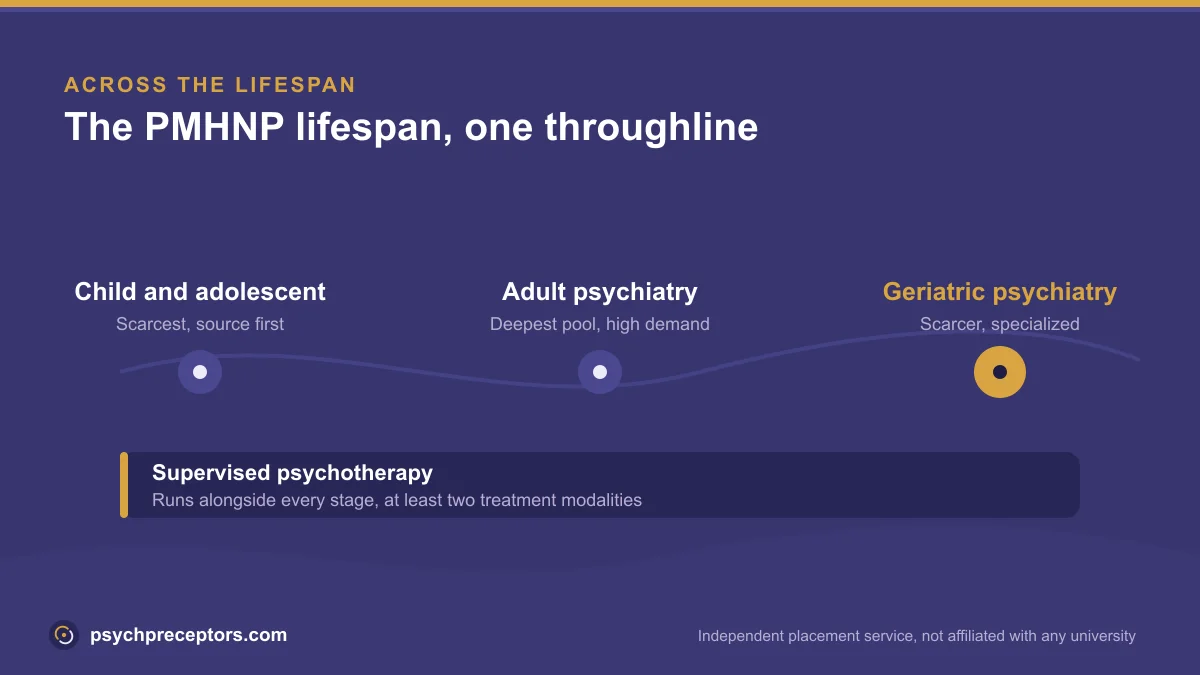
The across-the-lifespan PMHNP scope runs all the way to the oldest patients, so your clinical hours have to include documented experience in older-adult behavioral health. Like the pediatric rotation at the other end of the lifespan, geriatric psychiatry is one of the harder blocks to secure, because the preceptor pool is specialized and the settings are spread across a continuum most students have not mapped. We are an independent placement service that works separately from any university. This page explains the geriatric psychiatry requirement, where those hours happen, who can supervise them, and how we source a qualified preceptor and site so the older-adult block does not stall your program.
What the geriatric psychiatry rotation covers
Older-adult psychiatry is its own clinical world. On top of the mood, anxiety, and psychotic disorders you see across adulthood, the geriatric population brings neurocognitive disorders and dementia-related behavioral symptoms, late-life depression, delirium, grief and adjustment, and the complex interplay of psychiatric medication with the many other medications older adults take. That polypharmacy and medical comorbidity is exactly why the population is treated as a distinct required experience rather than folded into adult psychiatry.
Because the PMHNP credential certifies you across the full lifespan, accredited programs build in supervised experience with older adults as one of the required population areas. How many hours sit specifically with the geriatric population, and how the rest of your lifespan hours distribute, is set by your program and can differ by school, so confirm your own program's breakdown before planning.
Geriatric psychiatric care happens across a continuum: geriatric psychiatry and behavioral-health clinics, memory and neurocognitive clinics, long-term-care and skilled-nursing facilities, geriatric consultation services, and community and home-based older-adult mental-health programs. Whether a given site fits your program is a school decision, and we match to settings that meet the older-adult intent of your requirement.
Why is the geriatric rotation harder to secure?
Geriatric psychiatry sits in the scarcer tier of PMHNP rotations, closer to pediatric than to adult psychiatry in how hard it is to arrange, and for related reasons.
- A specialized preceptor pool. Clinicians who focus on older-adult behavioral health, whether PMHNPs with a geriatric caseload or geriatric psychiatrists, are a smaller subset of the workforce.
- Care spread across settings. Older-adult psychiatric care is delivered across clinics, long-term care, consultation services, and home-based programs, so the search is less centralized than a single clinic.
- Consultative models. A good deal of geriatric psychiatry runs as consultation into medical and long-term-care settings, which can complicate what counts and who supervises.
- Competing demand. Every lifespan PMHNP program needs these hours, so the specialized slots fill early.
As with the pediatric rotation, the students who clear geriatric psychiatry without delay are the ones who identify it early as a harder block and start the search well ahead of the term.
Who can precept your geriatric psychiatry hours?
The supervising clinician generally needs to be an ANCC board-certified PMHNP-BC or a board-certified psychiatrist working with older adults, and at some programs a geriatric psychiatrist. Because PMHNP-BC is a lifespan credential rather than a population-restricted one, a PMHNP-BC with an older-adult caseload is typically an appropriate preceptor. Some programs allow other qualified behavioral-health prescribers for select experiences, subject to their own rules.
All hours have to be faculty-supervised within a program accredited by CCNE or ACEN (NLN CNEA also accredits some nursing programs), and the specific preceptor credentials are set by each school. Confirm your program's eligibility rules before committing. Our preceptor requirements page covers the credentialing, and our clinical hours page shows how the geriatric block fits your total.
How we place your geriatric psychiatry rotation
Because it is one of the scarcer rotations, we source geriatric psychiatry early and deliberately, alongside the pediatric block, as part of one lifespan plan. You tell us your program, your city, and your timeline, and we run a targeted, local-first search for a qualified older-adult psych preceptor and an approvable setting near you.
- Sourced early. We treat geriatric psychiatry as a harder block and start it well ahead of the term.
- Credential-matched. We screen preceptors for the older-adult caseload and the credentials your program accepts.
- Continuum-aware. We search across clinics, long-term care, memory services, and community programs, not just one setting type.
- Documentation-ready. We help assemble the CV, agreement, and clearances your program and site require.
Final approval of any preceptor or site rests with your university, and we do not speak for any school. We do not guarantee hours, certification, or program outcomes, and nothing here is a tuition refund. See how it works or start on the find a preceptor page.
Good to know
Do all PMHNP programs require geriatric psychiatry hours?
Because PMHNP is an across-the-lifespan credential, accredited programs build in documented supervised experience with older adults as one of the required population areas. The exact number of hours and how they distribute across the lifespan is set by your individual program, so confirm your own program's breakdown with your school.
Why is the geriatric rotation harder to find?
The pool of clinicians who focus on older-adult behavioral health is specialized and smaller, geriatric psychiatric care is spread across clinics, long-term care, consultation services, and home-based programs, and much of it runs as consultation, which can complicate what counts. Every lifespan PMHNP program also needs these hours, so slots fill early. Starting the search well ahead of the term is what secures it.
Who can supervise my geriatric psychiatry hours?
Generally an ANCC board-certified PMHNP-BC or a board-certified psychiatrist working with older adults, and at some programs a geriatric psychiatrist. A PMHNP-BC with an older-adult caseload is typically appropriate. All hours must be faculty-supervised within a CCNE or ACEN accredited program, and the exact credentials are set by your school. Confirm the rules with your program.
Are you affiliated with a university?
No. We are an independent placement service that works separately from any university or certification body. We help PMHNP students at any school secure a qualified geriatric-psych preceptor and site; final approval always rests with the university.
Cover every rotation, not just the easy ones
Tell us your PMHNP program, your city, and the rotations you still need. We will come back with a plan for the full psych lifespan and a realistic path to placed.