Who Can Serve as a PMHNP Preceptor?
A willing clinician is not automatically an eligible preceptor. Who can supervise your PMHNP clinical hours is defined by your program, within the boundary that all hours must be faculty-supervised inside an accredited program, and getting the eligibility wrong is one of the most common reasons hours do not count. This page lays out the general eligibility, the accreditation boundary, and the honest fact that specific credentials are set by each school, not by a single national mandate. We are an independent placement service that works separately from any university, and we verify every preceptor against your program before you commit.
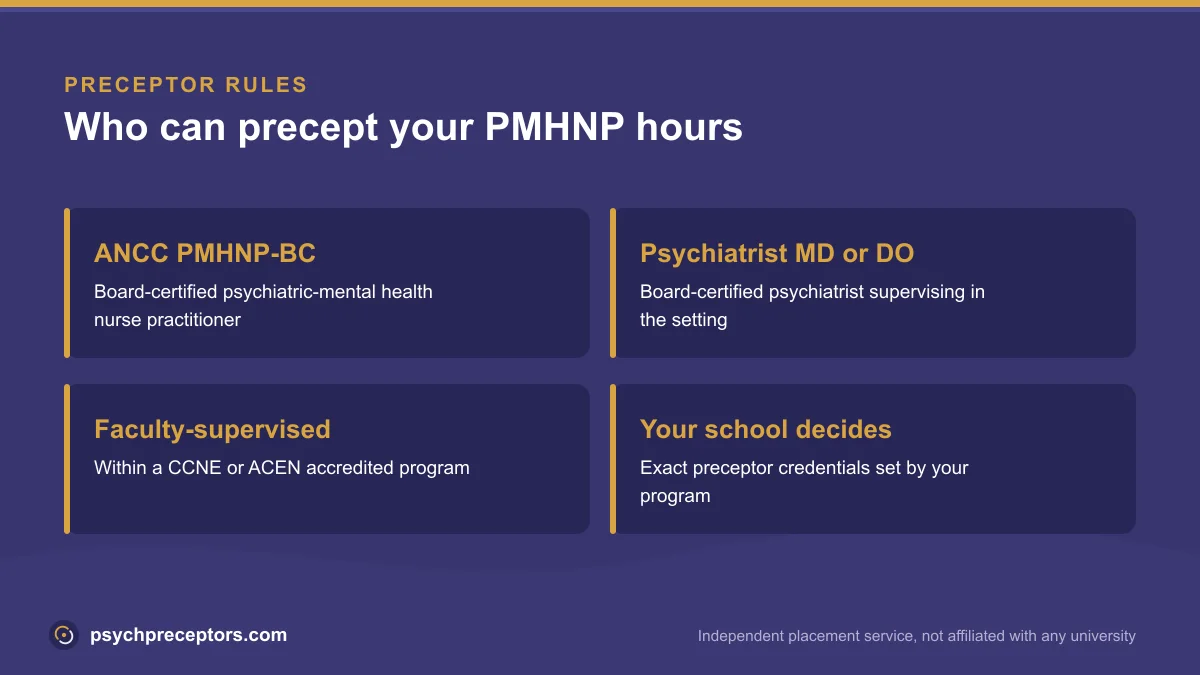
Who can serve as a PMHNP preceptor?
The core eligibility is consistent across most programs, and it comes down to a small set of qualified clinicians:
- A board-certified Psychiatric-Mental Health Nurse Practitioner (PMHNP-BC). A lifespan-certified PMHNP is the most direct fit, since they hold the credential you are earning.
- A board-certified psychiatrist (MD or DO). A physician specialist in psychiatry is broadly accepted as a qualified preceptor.
- Some hours may be supervised by other qualified behavioral-health prescribers or clinicians. Depending on the program, this can include a psychiatric physician assistant, and at some programs licensed clinical social workers or licensed professional counselors for select experiences such as supervised psychotherapy, subject to individual program and school rules.
- All clinical hours must be faculty-supervised within a CCNE- or ACEN-accredited program. The NLN CNEA also accredits some nursing programs. Specific preceptor credentials are set by each program, not by a single national mandate.
That last point is the one to internalize. There is no single national list of who may precept a PMHNP student. The accreditation boundary is national; the specific credential rules are your program's. Always verify a prospective preceptor against your own program before you rely on them.
Why the preceptor has to match the experience
Eligibility is not only about credentials in the abstract, it is about the fit between the preceptor and the specific experience. A preceptor can hold the right board certification and still be the wrong preceptor for a given block if their practice does not match.
The clearest example is prescribing versus therapy. Medication-management and psychopharmacology hours require a prescriber, a PMHNP or a psychiatrist, or another qualified behavioral-health prescriber where your program allows. Supervised psychotherapy hours, by contrast, are the one area where some programs permit a non-prescribing licensed clinician to supervise select experiences. A therapy-only supervisor cannot build your psychopharmacology hours, and assuming otherwise is a common planning error.
The population also has to match. A lifespan-certified PMHNP is broadly qualified, but for a child and adolescent block you want a preceptor with a pediatric caseload, and for geriatric hours you want one who works with older adults. Matching credential, prescribing authority, and population to each experience is exactly the vetting we do before you commit.
What approval and documentation involve
Beyond who a preceptor is, an eligible placement has to be documented and approved. Even a perfectly qualified preceptor cannot be used until the program has what it needs, which commonly includes the preceptor's CV or credentials, a signed preceptor or affiliation agreement, and sometimes a site-level agreement for larger organizations, along with your own clearances such as background checks and immunization records.
The precise requirements come from your program, and they take time, which is why a willing preceptor identified late can still fail to clear approval before a deadline. When we source a preceptor, we screen the credentials against your program's rules and help assemble the documentation early, so a qualified candidate actually clears review. See how it works for the full process, and our find a preceptor page for how the search runs.
Good to know
Who can serve as a PMHNP preceptor?
Generally a board-certified Psychiatric-Mental Health Nurse Practitioner (PMHNP-BC) or a board-certified psychiatrist (MD or DO). Some hours may be supervised by other qualified behavioral-health prescribers, such as a psychiatric physician assistant, and at some programs licensed clinical social workers or counselors for select experiences, subject to individual program rules. All clinical hours must be faculty-supervised within a CCNE- or ACEN-accredited program. Specific preceptor credentials are set by each program, not a single national mandate.
Can a therapist or counselor be my PMHNP preceptor?
Only in a bounded way. Some programs permit a non-prescribing licensed clinician, such as a licensed clinical social worker or licensed professional counselor, to supervise select supervised-psychotherapy experiences, subject to their own rules. A non-prescriber cannot supervise your medication-management or psychopharmacology hours, which require a prescriber. Confirm what your program allows before relying on any non-prescribing supervisor.
Is there a single national rule for who can precept?
No. The national boundary is that all clinical hours must be faculty-supervised within a CCNE- or ACEN-accredited program (the NLN CNEA also accredits some nursing programs). But the specific preceptor credentials are set by each program, not by a single national mandate, so you must verify a prospective preceptor against your own program's rules.
Are you affiliated with a university?
No. We are an independent placement service that works separately from any university or certification body. We verify every preceptor against your program's eligibility rules; final approval of any preceptor or site rests with the university.
Cover every rotation, not just the easy ones
Tell us your PMHNP program, your city, and the rotations you still need. We will come back with a plan for the full psych lifespan and a realistic path to placed.