Planning Your Across-the-Lifespan PMHNP Clinical Placement
The defining feature of the Psychiatric-Mental Health Nurse Practitioner credential is that it certifies you across the entire lifespan, from the youngest patients through older adults. That is a strength in practice and a logistical challenge in training, because your clinical hours cannot sit in one comfortable clinic. They have to settle onto every stage of life, and the scarcest of those stages, pediatric and geriatric psychiatry, are exactly the ones students leave too late. We are an independent placement service that works separately from any university. This page explains what the lifespan requirement means, why it needs to be planned as a whole, and how we build one placement plan that covers every stage.
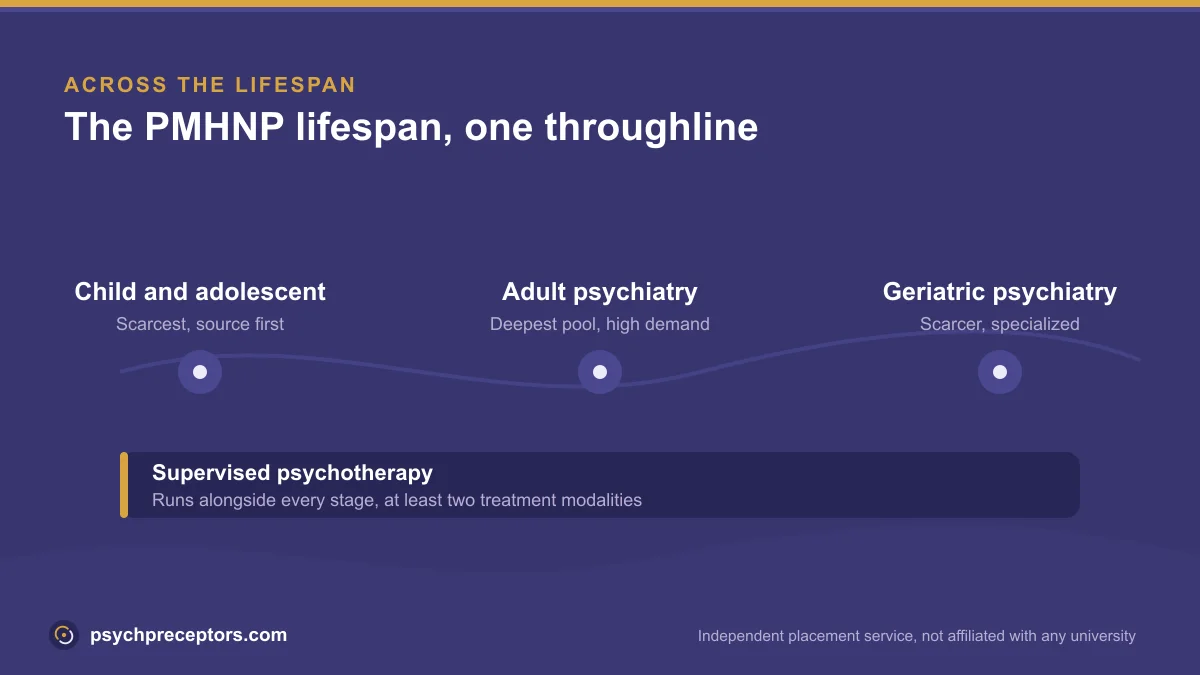
What does across-the-lifespan mean for PMHNP training?
When the PMHNP replaced the older adult and family psychiatric NP tracks, the population focus became the full lifespan by design. Your certification does not restrict you to adults or to a single age band, it spans infants and young children through adolescents, adults, and older adults. To earn that scope, your program has to expose you, under supervision, to psychiatric care across those stages.
That is why a PMHNP clinical plan is not one rotation but a set of them: a documented child and adolescent experience, a large adult block, an older-adult experience, and supervised psychotherapy that runs alongside every stage. Programs commonly distribute hours across these population areas, and many also route students through settings such as outpatient and inpatient psychiatry, substance use, and medication management. The exact distribution is your program's to set, and it varies by school, so confirm your own breakdown before planning.
The practical consequence is simple: you cannot satisfy a lifespan credential with a single preceptor in a single setting. Each stage is a distinct search, and the whole set has to come together on your program's timeline.
Why plan the whole lifespan at once?
The most common way a PMHNP program slips is not a lack of effort, it is sequencing. Students line up the easy, deep-pool rotation first, usually adult psychiatry, feel reassured, and then discover late that the scarce rotations, pediatric and geriatric psychiatry, have no available slots left in their area for the term they need.
Planning the lifespan as a whole flips that. When you map every stage from the start, you can begin the scarce searches earliest, protect your timeline with backups where your program allows, and avoid the situation where a single missing block, at one end of the lifespan or the other, holds up an otherwise complete plan.
| Population block | Typical difficulty to secure |
|---|---|
| Child and adolescent psychiatry | Scarcest, source first |
| Adult psychiatry | Deepest pool, but high demand |
| Geriatric or older-adult psychiatry | Scarcer, specialized preceptors |
| Supervised psychotherapy | Runs alongside every stage, at least two modalities |
Treat that ordering as a planning guide, not a rule. Your program's specific distribution and any additional required settings come from your school, and we plan to your actual requirement.
Who can precept across the lifespan?
Because PMHNP-BC is a lifespan credential, an ANCC board-certified PMHNP-BC is broadly qualified to precept across the population stages, and a board-certified psychiatrist can supervise as well. In practice, though, you will often work with more than one preceptor, because the clinician who sees children all day is rarely the same one who runs an older-adult memory clinic. Matching the preceptor to the population is the point.
Some programs allow certain hours to be supervised by other qualified behavioral-health prescribers, subject to their own rules. All hours have to be faculty-supervised within a program accredited by CCNE or ACEN (NLN CNEA also accredits some nursing programs), and the exact credentials are set by each school. Our preceptor requirements page covers this in detail.
How we build your lifespan placement plan
Our whole model is built around the lifespan problem. Instead of finding you one rotation and wishing you luck on the rest, we plan and source the full set, starting with the scarce ends first.
- One plan, every stage. We map your child and adolescent, adult, geriatric, and psychotherapy hours together, plus any additional settings your program requires.
- Scarce first. We start the pediatric and geriatric searches earliest, because those are the blocks most likely to delay you.
- Population-matched preceptors. We source a qualified preceptor and approvable site for each stage, verified to your program's rules.
- On your timeline. We work to have each placement settled before its term, so no single stage becomes the bottleneck.
Final approval of any preceptor or site rests with your university, and we do not speak for any school. We do not guarantee hours, certification, or program outcomes, and nothing here is a tuition refund. See how it works or start on the find a preceptor page.
Good to know
What does across-the-lifespan mean for a PMHNP?
The PMHNP credential certifies you to care for psychiatric patients across the entire lifespan, from young children through older adults, rather than a single age band. To earn that scope, your program requires supervised experience across the population stages: a child and adolescent block, an adult block, an older-adult block, and supervised psychotherapy alongside them. The exact distribution is set by your program.
Do I need a different preceptor for each population?
Often, yes, in practice. A board-certified PMHNP is broadly qualified across the lifespan, but the clinician who works all day with children is rarely the same one who runs an older-adult clinic, so students commonly work with more than one preceptor to cover the stages. Matching the preceptor to the population is the goal, and we source each one to your program's rules.
Why should I plan all the rotations at once?
Because the most common cause of a delayed PMHNP program is sequencing, lining up the easy adult rotation first and discovering late that the scarce pediatric or geriatric slots are gone. Planning the whole lifespan from the start lets you begin the scarce searches earliest and keep a single missing block from stalling an otherwise complete plan.
Are you affiliated with a university?
No. We are an independent placement service that works separately from any university or certification body. We help PMHNP students at any school plan and secure preceptors and sites across the full lifespan; final approval always rests with the university.
Cover every rotation, not just the easy ones
Tell us your PMHNP program, your city, and the rotations you still need. We will come back with a plan for the full psych lifespan and a realistic path to placed.