Sourcing PMHNP preceptors from Philadelphia to rural Pennsylvania
Pennsylvania splits into two large behavioral health systems around Philadelphia and Pittsburgh and a wide rural middle that runs on telepsychiatry. For a psychiatric-mental health student, the practical questions are where the hours are and how the state's collaborative agreement shapes who precepts you. We place students at any university across community behavioral health, hospital psychiatry, addiction care, and telehealth, and this page lays out both.
Two big systems and a wide rural middle
In Philadelphia, Medicaid behavioral health is organized through a single citywide payer that contracts with dozens of community mental health agencies, which makes the region dense with outpatient and community placement options. Pittsburgh anchors the west with a certified community behavioral health clinic model and a large academic psychiatric hospital. Between and around the two metros, much of central and northern Pennsylvania is rural and short on local prescribers.
Realistic training cities include Philadelphia, Pittsburgh, Allentown, Erie, Scranton, Reading, Harrisburg, Bethlehem, and Lancaster. Your outpatient hours have the widest choice in the metros, while rural blocks often mix a regional community center with supervised telehealth.
Beyond the two anchors, suburban Philadelphia and the Lehigh Valley add outpatient capacity, and crisis and mobile response services carry acute work statewide. Veterans' behavioral health in Philadelphia, Pittsburgh, and Coatesville is a reliable source of adult hours, and school-based programs in the larger districts support younger-population contact. That spread lets us assemble a varied caseload rather than repeating one setting.
The CRNP collaborative agreement
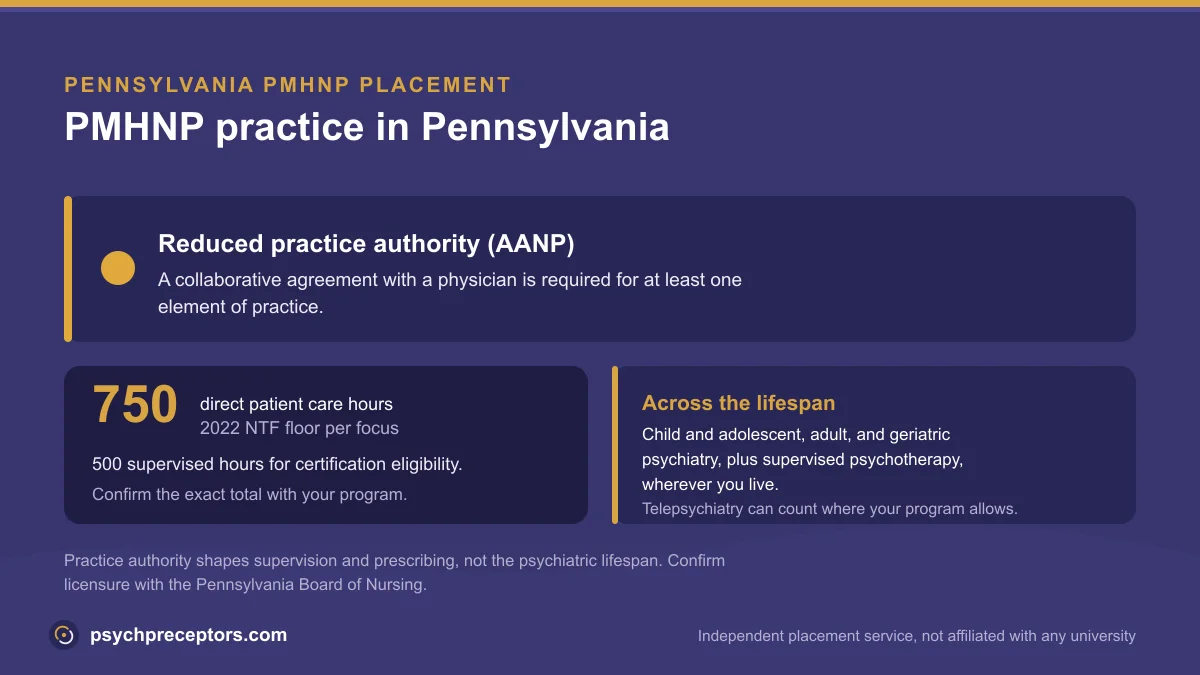
Pennsylvania is a reduced-practice state. A certified registered nurse practitioner with prescriptive authority keeps a career-long collaborative agreement that names a collaborating physician plus at least one substitute physician, and it is reviewed on a set schedule. Controlled-substance prescribing is permitted within the agreement, subject to limits, and a DEA registration is required.
For your placement, this usually means a collaborating physician, often a psychiatrist, is already part of the practice where a PMHNP works and precepts. It shapes the supervising and prescribing arrangement, not the preceptor's core credential, which remains a board-certified PMHNP or a psychiatrist. See preceptor requirements and the medication management rotation.
Telepsychiatry across Appalachia
Academic telepsychiatry programs reach deep into rural Pennsylvania. One western program covers seventeen counties with well over ten thousand encounters a year, and child-focused telephonic consult services support primary care across the central and northeastern counties. For students outside the metros, this infrastructure is often the difference between a partial and a complete record.
For a Pennsylvania rotation, the current program decides whether telehealth or simulation is permitted and how either is classified, supervised, documented, and applied. Confirm the current program rule and any applicable state requirements before relying on either format. We use that to build a realistic lifespan plan when you live far from a hub. More on PMHNP clinical hours.
Child, adolescent, and geriatric rotations
Pennsylvania is among the many states with a severe child and adolescent psychiatrist shortage, and it is worse in rural areas. Most pediatric psychiatric capacity sits in the children's hospitals of Philadelphia and Pittsburgh, so a child and adolescent psych rotation needs the earliest lead time of any stage.
Geriatric psychiatry is also limited and often delivered inside community programs, long-term care, and hospital consult services rather than dedicated clinics. We treat the geriatric psych rotation as a scarce block to plan around.
Addiction and inpatient hours
Pennsylvania was hit hard by the opioid epidemic, so medication-assisted treatment and opioid treatment programs are widespread, and county behavioral health systems fund a large share of care. That gives strong access to a substance use rotation with co-occurring psychiatric depth.
Inpatient and acute hours are available through health-system psychiatric units and the state hospital network, which pairs well with medication management. See the inpatient psych rotation for how we structure those weeks.
Placing your full psychiatric lifespan in Pennsylvania
We line up the scarce child, adolescent, and geriatric hours first, then arrange adult, psychotherapy, and substance use around them so a single missing block does not hold up your term. Your program will also expect supervised psychotherapy hours in at least two modalities, which we schedule alongside the prescribing-focused settings. Tell us your program, your city, and what you still need.
You are matched first and pay only when a site is secured. Start at the match form, or read how it works and our flat fee. We are independent and never guarantee your school's approval of a preceptor or site.
Good to know
Is Pennsylvania a full-practice state?
No. Pennsylvania is a reduced-practice state. A certified registered nurse practitioner with prescriptive authority keeps a career-long collaborative agreement naming a collaborating physician and at least one substitute. Confirm the current requirements with the Pennsylvania State Board of Nursing.
Does the collaborative agreement affect my preceptor search?
Usually a collaborating physician, often a psychiatrist, is already part of the practice where a PMHNP precepts. The agreement shapes the supervising and prescribing arrangement, not the preceptor's core credential, which is still a board-certified PMHNP or psychiatrist licensed in Pennsylvania.
How do rural Pennsylvania students get psychiatric hours?
Through a mix of regional community behavioral health centers and academic telepsychiatry programs that serve many rural counties. Your current program decides whether telehealth or simulation is permitted and how either is classified, supervised, documented, and applied. Confirm the current program rule and any applicable state requirements before relying on either format.
Which rotation is hardest to place in Pennsylvania?
Child and adolescent psychiatry, since most pediatric capacity is in the Philadelphia and Pittsburgh children's hospitals and rural supply is thin. We plan it earliest, sometimes blending an in-person site with supervised telehealth.
How many clinical hours will I need?
The 2022 NTF Standards recommend at least 750 direct patient care hours per nurse practitioner population focus. ANCC and AANPCB eligibility sources separately use at least 500 faculty-supervised clinical hours. These figures serve different purposes and do not form a typical program range. Named programs vary and control the exact total and distribution, so confirm current requirements with your program.
Cover every rotation, not just the easy ones
Tell us your PMHNP program, your city, and the rotations you still need. We will come back with a plan for the full psych lifespan and a realistic path to placed.