Placing PMHNP students across Oklahoma's psychiatric settings
Oklahoma is a demanding state to finish a psychiatric-mental health program in without help, because prescribers cluster in Oklahoma City and Tulsa while most of the state's 77 counties have little local specialty care. We source preceptors and clinical sites for students at any university, across community behavioral health, inpatient units, addiction programs, and telepsychiatry. This page maps where those hours actually happen and how Oklahoma's prescribing rules decide who can sign on as your preceptor.
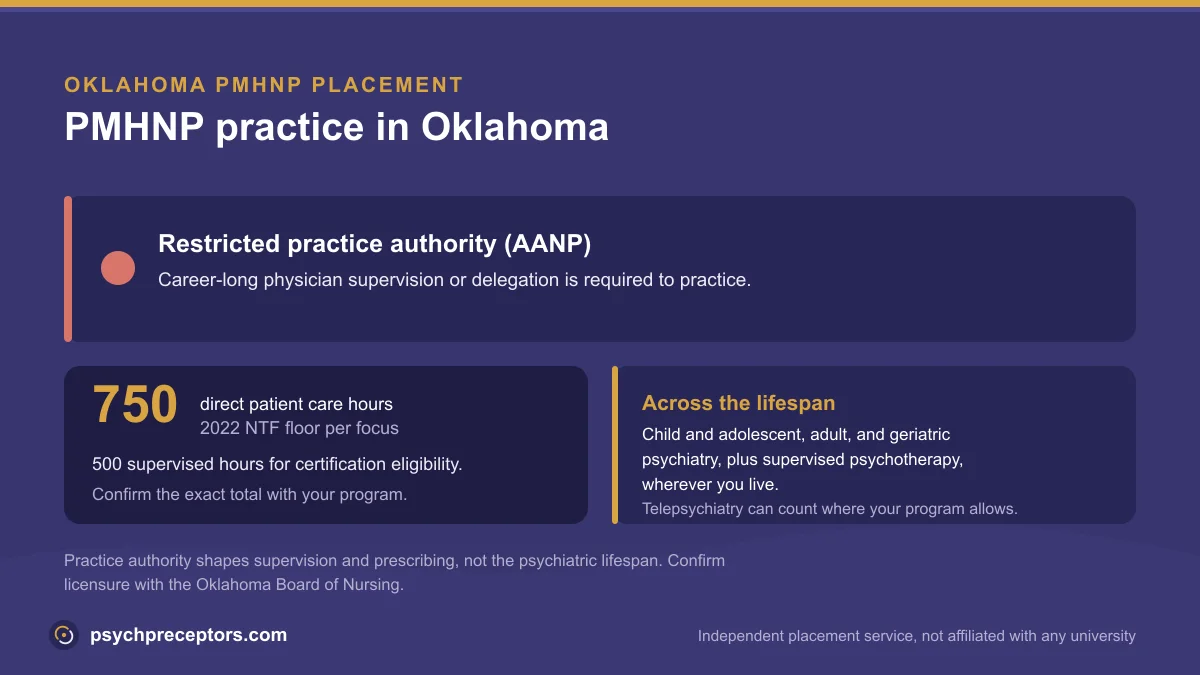
How Oklahoma's prescribing rules shape your preceptor
Oklahoma has long been a restricted-practice state, and that label is really about prescribing. Historically an advanced practice nurse needed a supervising physician to hold prescriptive authority. As of November 1, 2025, House Bill 2298 lets experienced advanced practice nurses who have completed 6,240 supervised clinical hours apply for independent prescriptive authority for Schedules III through V, which removes the physician-supervision requirement for those who qualify. The law did not otherwise change scope of practice, so newer nurse practitioners still prescribe under supervision. Confirm the current category with the board before you rely on it.
One detail matters for psychiatry specifically. Advanced practice nurses in Oklahoma cannot prescribe Schedule II drugs, which includes most stimulant medications used for attention concerns. In practice a collaborating psychiatrist often handles those prescriptions, or non-stimulant options are used, so you still learn the full workup during a medication management rotation. A DEA registration is required to prescribe any controlled substance.
For your search, this mostly decides who serves as preceptor: an experienced nurse practitioner with independent prescriptive authority, a board-certified psychiatrist, or a supervised nurse practitioner inside a physician-led group. The core credential a program looks for, a board-certified PMHNP or a psychiatrist, does not change. See preceptor requirements for the specifics your school will check.
Where psychiatric hours happen, from the metros outward
The state mental health agency runs a statewide network of certified community behavioral health clinics, which are strong homes for outpatient medication management, case-loaded adult care, and crisis work. Add county community mental health centers, private psychiatric practices, and the state psychiatric hospitals near Norman and in the northeast for acute care. The two metros carry most inpatient and specialty capacity.
Realistic training cities include Oklahoma City, Tulsa, Norman, Lawton, Enid, Stillwater, and Muskogee. Your outpatient and inpatient blocks will usually anchor in or near these hubs, with community clinics reaching into the surrounding counties.
The child and adolescent gap
Child and adolescent psychiatry is the scarcest rotation in Oklahoma by a wide margin. Only a handful of the state's 77 counties have a practicing child and adolescent psychiatrist, and the pediatric psychiatric beds sit mostly in the Oklahoma City metro, which holds a majority of them while serving a minority of the state's children. Tulsa and the rural counties carry far fewer beds relative to their child populations.
That means a child and adolescent psych rotation concentrates in the metros or arrives by telehealth, so it needs the earliest planning of any stage. Geriatric psychiatry is thinner too, and often sits inside community centers and senior units rather than dedicated clinics. See the geriatric psych rotation for how we cover it.
Telepsychiatry and rural Oklahoma
Most of rural Oklahoma is a designated mental health shortage area, so telepsychiatry and tele-behavioral health carry a large share of care. Statewide programs and academic groups deliver child and adult psychiatry into counties that have no local prescriber. Tribal and Indian Health Service behavioral health is also a real training setting across the state, given Oklahoma's large Native population.
For an Oklahoma rotation, the current program decides whether telehealth or simulation is permitted and how either is classified, supervised, documented, and applied. Confirm the current program rule and any applicable state requirements before relying on either format. If you live away from the metros, a blended plan of local community clinic time plus supervised telepsychiatry is often the most realistic route to a full lifespan record. Read more on PMHNP clinical hours.
Addiction and substance use rotations
Oklahoma funds a broad substance use system through the state mental health agency, including opioid treatment and medication-assisted treatment clinics that are frequently integrated with the community behavioral health network. These sites pair well with medication management and give you exposure to co-occurring psychiatric and substance use care.
A substance use rotation here can often be combined with adult outpatient hours, which helps you build depth without stacking too many separate placements.
Lining up the full lifespan in Oklahoma
Because the scarce stages are child, adolescent, and geriatric psychiatry, we plan those first and build the adult, psychotherapy, and substance use hours around them. Tell us your program, your city, and the rotations you still need, and we come back with a route that fits Oklahoma's real supply.
You are matched first and pay only when a placement is secured. Start at the match form, or see how it works and our flat fee. We are independent and never guarantee a school's approval of any site.
Good to know
Is Oklahoma a full-practice state for nurse practitioners?
No. Oklahoma has been a restricted-practice state, tied to a physician-supervised prescribing requirement. Since November 1, 2025, experienced advanced practice nurses with 6,240 supervised hours can apply for independent prescriptive authority for Schedules III through V, but scope of practice was not otherwise changed and newer nurse practitioners still prescribe under supervision. Confirm the current rules with the Oklahoma Board of Nursing.
Can my PMHNP preceptor prescribe ADHD stimulants in Oklahoma?
Advanced practice nurses in Oklahoma cannot prescribe Schedule II medications, which includes most stimulants. In many settings a collaborating psychiatrist handles those, or non-stimulant options are used. You will still learn the assessment and prescribing decisions during your medication management hours.
Do telepsychiatry hours count toward my PMHNP requirement?
Your current program decides whether telehealth or simulation is permitted and how either is classified, supervised, documented, and applied. Confirm the current program rule and any applicable state requirements before relying on either format. Always confirm the specifics with your own program.
Which psychiatric rotation is hardest to place in Oklahoma?
Child and adolescent psychiatry, because so few counties have a practicing child psychiatrist and the beds concentrate in the Oklahoma City metro. We plan that rotation earliest, often blending an in-person site with supervised telehealth.
How many clinical hours will I need?
The 2022 NTF Standards recommend at least 750 direct patient care hours per nurse practitioner population focus. ANCC and AANPCB eligibility sources separately use at least 500 faculty-supervised clinical hours. These figures serve different purposes and do not form a typical program range. Named programs vary and control the exact total and distribution, so confirm current requirements with your program.
Cover every rotation, not just the easy ones
Tell us your PMHNP program, your city, and the rotations you still need. We will come back with a plan for the full psych lifespan and a realistic path to placed.