Your PMHNP clinical placement in New York
New York gives full practice authority to seasoned nurse practitioners, but with a twist that matters for who can precept you: independence turns on an experience threshold. Once you understand that rule, the bigger question is geography, because psychiatric supply runs from dense in the five boroughs to sparse across the North Country. Here is how PMHNP hours actually come together in New York, and where we help.
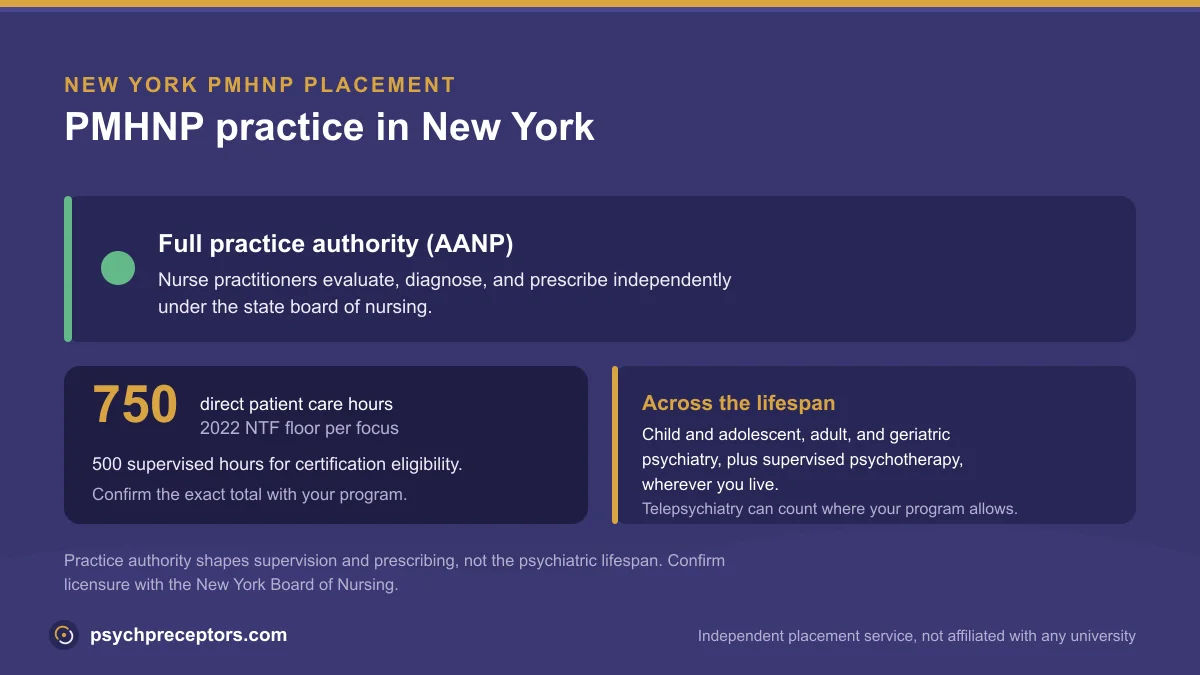
How New York's practice rules affect your preceptor
New York grants full practice authority to nurse practitioners who have completed more than 3,600 hours of qualifying practice; those NPs work without a written agreement or a required collaborating physician. NPs below that threshold keep a collaborative relationship with a physician in the relevant specialty. The state continued this framework past its 2026 sunset, with the current provision set to run to 2030, so confirm the present status with the state board.
- An experienced, board-certified PMHNP can precept your psychiatric hours independently, including controlled-substance prescribing under a DEA registration
- A newer PMHNP may still precept while maintaining their own collaborative relationship, which mostly affects their paperwork, not yours
- A board-certified psychiatrist (MD or DO) can serve as preceptor in any arrangement
Practice authority changes the supervision and prescribing arrangement, not a preceptor's core qualifications. Our preceptor requirements page covers what your school will check.
Where PMHNP students rotate, boroughs to North Country
New York holds more psychiatric infrastructure than almost any state, but it is unevenly spread. New York City, Long Island, and the lower Hudson Valley concentrate academic psychiatry, specialty clinics, and inpatient beds, while the Capital Region, Central New York, the Finger Lakes, Western New York, the Southern Tier, and the North Country grow steadily thinner.
- State-licensed outpatient mental health clinics (Article 31) and addiction clinics (Article 32) that host much of the routine training
- State-operated adult and children's psychiatric centers for higher-acuity inpatient exposure
- Veterans Affairs behavioral health across the downstate and upstate systems
- Correctional and forensic psychiatry in state and city facilities
- Private practices, telepsychiatry groups, and college counseling centers
The lifespan rotations and child-psych scarcity
Your PMHNP hours have to span child and adolescent, adult, and geriatric psychiatry, plus supervised psychotherapy in at least two modalities. Even in a state this deep, the same rotations run short.
- Child and adolescent psychiatry is the hardest to place, clustered in downstate academic centers and children's hospitals, with telehealth extending it upstate
- Geriatric psychiatry is thin outside the metros and often sits in long-term care and consultation services
- Adult psychiatry is broadly available across clinics, inpatient units, and integrated primary care
- Lifespan planning matters most here, because a single site rarely covers every age band
Telepsychiatry and the upstate gap
Telepsychiatry is central to psychiatric care and training in New York, and it is how the North Country, the Adirondacks, and rural upstate counties reach a prescriber at all. For a New York rotation, the current program decides whether telehealth or simulation is permitted and how either is classified, supervised, documented, and applied. Confirm the current program rule and any applicable state requirements before relying on either format.
- A telehealth block can supply child, geriatric, or rural adult exposure that is scarce near you
- Downstate demand is high enough that many outpatient visits are already delivered by video
- Your preceptor supervises a telehealth encounter the same way as an in-person one
Addiction, crisis, and inpatient care
New York integrates mental health and addiction treatment more tightly than most states, which makes co-occurring care easy to find and clinically rich for a PMHNP.
- Opioid treatment programs and office-based buprenorphine for substance use and medication-assisted treatment hours
- Comprehensive psychiatric emergency programs and mobile crisis teams for acute work
- Inpatient psychiatry in general hospitals and state psychiatric centers
- Medication management clinics where much of the prescribing volume lives
How we help you get placed
We are an independent placement service for PMHNP students at any university, unaffiliated with any school. Give us your program, your borough or region, and the rotations you still need, and we source a preceptor and site that fit New York's rules and your school's requirements. We assist with matching; we do not guarantee placement or your school's approval of a given preceptor or site.
- Start with the match form or reach us through contact
- We line up in-person and telehealth options across downstate and upstate
- We help assemble the affiliation and preceptor documents your program needs
See how it works to understand the steps before you commit.
Good to know
Can a PMHNP precept me independently in New York?
Yes, if that PMHNP has completed more than 3,600 hours of qualifying practice, they hold full practice authority and can precept and prescribe independently. A PMHNP below that threshold can still precept while keeping their own collaborative relationship with a physician. A board-certified psychiatrist can precept in any case.
Is New York still a full practice state in 2026?
Yes. New York continued its full practice authority for experienced nurse practitioners past the 2026 sunset, with the current provision extended toward 2030. Because this area has changed before, confirm the present rule with the New York State Board for Nursing.
How many supervised hours does a PMHNP program require?
The 2022 NTF Standards recommend at least 750 direct patient care hours per nurse practitioner population focus. ANCC and AANPCB eligibility sources separately use at least 500 faculty-supervised clinical hours. These figures serve different purposes and do not form a typical program range. Named programs vary and control the exact total and distribution, so confirm current requirements with your program.
Where is child and adolescent psychiatry easiest to place?
In the downstate academic centers and children's hospitals around New York City and Long Island, with some capacity in the larger upstate cities. Telehealth helps students in rural and North Country areas reach child-psych supervision that is not available locally.
Do you guarantee a placement?
No. We source preceptors and clinical sites and help with the paperwork, but we cannot guarantee a match or that your school will approve a specific preceptor or site. Your program makes the final approval.
Cover every rotation, not just the easy ones
Tell us your PMHNP program, your city, and the rotations you still need. We will come back with a plan for the full psych lifespan and a realistic path to placed.