PMHNP psychiatric rotations across Arizona
Arizona trains PMHNP students inside a large, publicly organized behavioral health system and gives nurse practitioners full practice authority, so an experienced psychiatric NP can precept and prescribe independently. The catch is supply: every county in the state carries a mental health workforce shortage, and child psychiatry is especially scarce. We help PMHNP students at any Arizona program find preceptors and sites across the metros, the tribal nations, and the rural counties that lean on telepsychiatry.
Where PMHNP students rotate in Arizona
Most of Arizona's public behavioral health runs through the state Medicaid program and its regional behavioral health authorities, which contract networks of clinics across the state. Mercy Care covers the central region around Maricopa County, and Arizona Complete Health covers the north and south, so the community mental health clinics where students log outpatient hours usually sit inside one of those networks. The Arizona State Hospital, the state psychiatric facility in the capital, anchors long-term inpatient care, and general hospitals in the larger metros keep acute psychiatric units.
- Community mental health clinics across Maricopa County, the Tucson area in Pima County, and smaller networks in Flagstaff and Yuma, for an outpatient rotation.
- Tribal and Indian Health Service behavioral health across the Navajo Nation and communities such as the Gila River, Salt River, and Ak-Chin, which run their own mental health and substance use programs.
- Inpatient and crisis care, including the state hospital and metro crisis centers, for an inpatient rotation.
- Telepsychiatry groups that cover rural and border counties statewide.
- Correctional and forensic psychiatry, plus veterans' mental health through the VA.
Full practice authority, and your preceptor
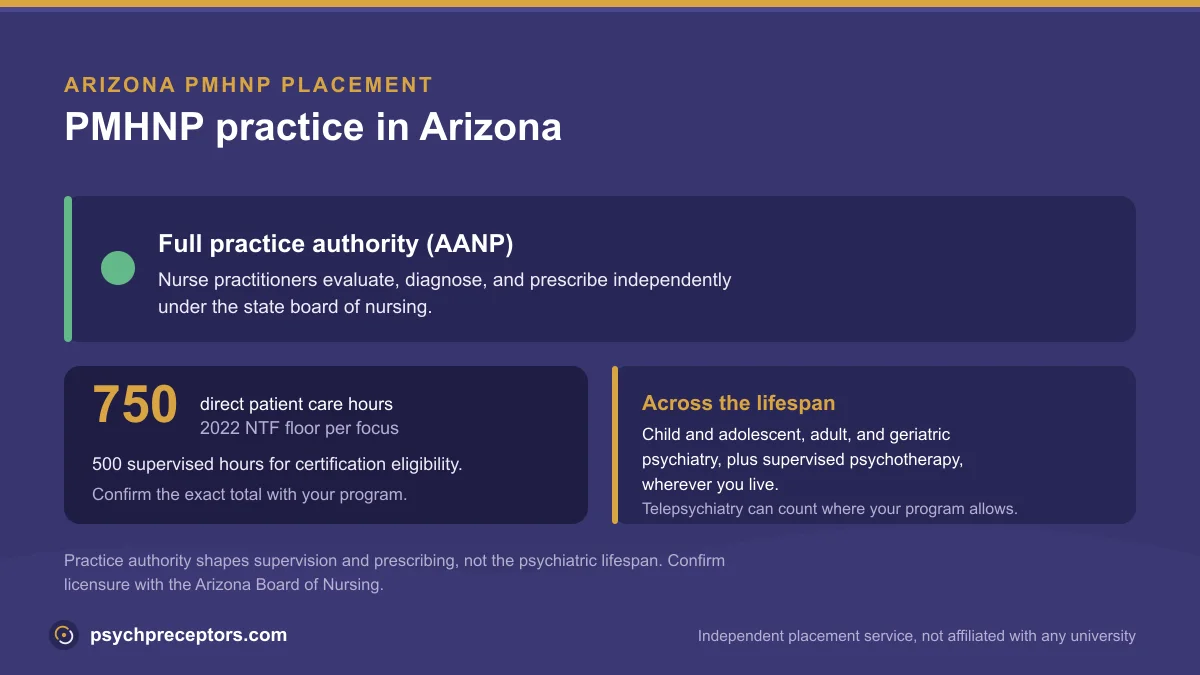
Arizona is a full practice authority state. Nurse practitioners are licensed and regulated by the Arizona State Board of Nursing, practice without a collaborative agreement, and prescribe within their population focus, including controlled substances once they hold a DEA registration and are enrolled in the state prescription monitoring program. For a PMHNP that independence is meaningful, because psychiatric care depends on controlled prescriptions, and it means an experienced board-certified psychiatric NP can precept you on their own authority. A preceptor is still generally a board-certified PMHNP or a psychiatrist, and your program sets the final requirements, so verify them with your school and the board.
Child psychiatry is the shortage inside the shortage
Arizona has fewer psychiatrists per resident than the country as a whole, and the state's own workforce analyses find a shortage in every county. Child and adolescent psychiatry is the sharpest gap: even in the Maricopa metro there are only about a dozen child and adolescent psychiatrists for every hundred thousand children, and the numbers thin out fast in rural areas. Most child psychiatric capacity sits in the metro children's hospital systems and a handful of academic clinics, so this is the rotation to secure first. Geriatric psychiatry also runs short, though the state's large retiree population supports more of it than you might expect, much of it inside primary care and long-term care.
Telepsychiatry, tribal nations, and the rural map
Arizona is mostly rural once you leave the two big metros, and a lot of that land is tribal. For an Arizona rotation, the current program decides whether telehealth or simulation is permitted and how either is classified, supervised, documented, and applied. Confirm the current program rule and any applicable state requirements before relying on either format. Tribal and Indian Health Service behavioral health deserves its own mention: these systems provide a large share of psychiatric and substance-use care in rural Arizona, frequently as the only option for a community, and a rotation there shows how psychiatry actually reaches people far from the metros. Placement in tribal systems depends on each nation's own agreements.
Psychotherapy and medication management
PMHNP training has to include supervised psychotherapy with at least two modalities, not only prescribing. Because the workforce is stretched, many Arizona psychiatric visits are built around medication management, so we look for preceptors and sites that also give you real therapy exposure, whether in a community clinic, a private practice, or a telehealth group, so your lifespan hours stay balanced.
How placement works in Arizona
We are independent and work statewide, for students at any Arizona program. Tell us your city or region, your school's requirements, and the rotations you still need, and we will source a board-certified PMHNP or psychiatrist preceptor and a site, and factor in how much of your training can run by telehealth. Read how it works and check PMHNP clinical hours, then use get matched and we will begin with your hardest rotation, usually child and adolescent.
Good to know
Is Arizona a full practice authority state for PMHNPs?
Yes. Nurse practitioners practice without a collaborative agreement and prescribe within their population focus, including controlled substances with a DEA registration and prescription-monitoring enrollment. That lets an experienced board-certified PMHNP precept you on their own license.
Why is child and adolescent psychiatry so hard to arrange here?
Arizona has a mental health workforce shortage in every county, and child psychiatry is the thinnest specialty, with most capacity in the metro children's hospitals and a few academic clinics. Start that search early, and expect telehealth to help fill it.
Can I rotate in tribal or Indian Health Service behavioral health?
Sometimes, and it can be excellent experience, since these systems provide much of the psychiatric and substance-use care in rural Arizona. Placement depends on each tribal nation's or facility's own agreements and capacity, which we work through case by case.
How many supervised hours will I need?
The 2022 NTF Standards recommend at least 750 direct patient care hours per nurse practitioner population focus. ANCC and AANPCB eligibility sources separately use at least 500 faculty-supervised clinical hours. These figures serve different purposes and do not form a typical program range. Named programs vary and control the exact total and distribution, so confirm current requirements with your program.
Does precepted telehealth count in Arizona?
Your current program decides whether telehealth or simulation is permitted and how either is classified, supervised, documented, and applied. Confirm the current program rule and any applicable state requirements before relying on either format.
Related
Cover every rotation, not just the easy ones
Tell us your PMHNP program, your city, and the rotations you still need. We will come back with a plan for the full psych lifespan and a realistic path to placed.