Finding a PMHNP preceptor in Alaska
In Alaska the hard part of a PMHNP placement is not the law, it is the geography. The state gives nurse practitioners full practice authority, so an experienced psychiatric NP can precept and prescribe on their own license, but psychiatric prescribers are concentrated in a few cities while most of Alaska relies on telepsychiatry. We help PMHNP students at any program find preceptors and sites that work across that distance, from Anchorage clinics to village behavioral health by video.
Distance is the real constraint
Alaska has one of the thinnest psychiatric workforces in the country, and most of its prescribers practice in Anchorage or Fairbanks. Hundreds of smaller communities have no psychiatric provider of their own, so a large share of the state's mental health care, and a large share of PMHNP training, is delivered over video. That reality is central to how you plan your hours here. For an Alaska rotation, the current program decides whether telehealth or simulation is permitted and how either is classified, supervised, documented, and applied. Confirm the current program rule and any applicable state requirements before relying on either format.
Where PMHNP rotations happen
The urban hubs carry most of the state's structured psychiatric settings. Anchorage holds the Alaska Psychiatric Institute, the state's inpatient psychiatric hospital, along with community behavioral health clinics, and Fairbanks and the Matanuska-Susitna area around Wasilla add more. Juneau and the Kenai Peninsula round out the road-and-ferry system. These are the usual sites for an outpatient or inpatient rotation.
- Community behavioral health clinics in Anchorage, Fairbanks, and Wasilla, with statewide telehealth arms.
- Tribal and Alaska Native health organizations, which run much of the behavioral health care in rural regions and the Bush and often integrate substance use treatment.
- The Alaska Psychiatric Institute for acute inpatient experience.
- Veterans' mental health through the VA in Anchorage and its community clinics.
- Correctional and crisis services, including mobile and stabilization programs in the larger cities.
Full practice authority, and what it means for your preceptor
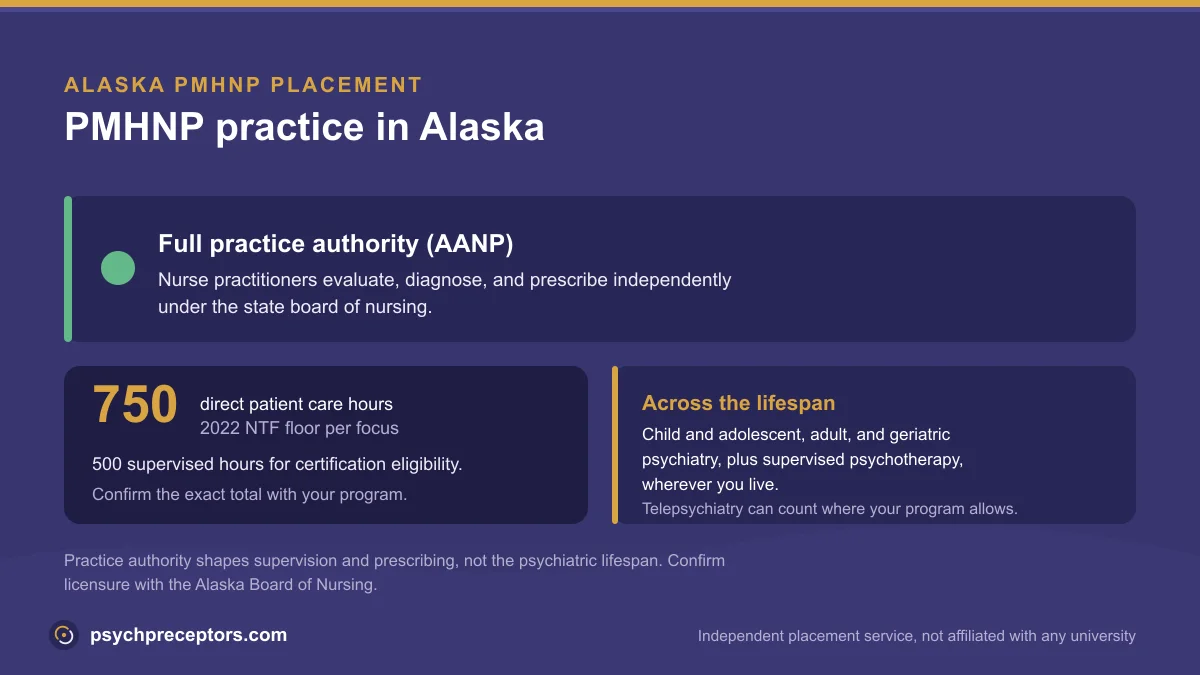
Alaska is a full practice authority state. Nurse practitioners are licensed through the Alaska Board of Nursing and practice without a required collaborative agreement, and they hold their own prescriptive authority, including controlled substances once a federal DEA registration is in place. For your search this is an advantage: an experienced board-certified PMHNP can serve as your preceptor on their own license, without a supervising psychiatrist attached, which widens the pool of people who can legally take a student. Psychiatric prescribing leans heavily on controlled medications, so that independent authority is not a small detail.
Full practice does not lower the bar for who teaches you. A preceptor is still generally a board-certified PMHNP or a board-certified psychiatrist, and your program sets the final requirements, so confirm them with your school and the state board of nursing.
The lifespan, and the scarce rotations
Your hours must cover child and adolescent, adult, and geriatric psychiatry, plus supervised psychotherapy in at least two modalities. Adult psychiatry is the most available, since it fills the urban clinics and the inpatient institute. Child and adolescent psychiatry is the scarcest by a wide margin in Alaska, concentrated in Anchorage and reached elsewhere almost entirely by telehealth, so it is the rotation to arrange first. Geriatric psychiatry is limited too and often handled inside primary care and tribal health systems rather than dedicated clinics.
Alaska Native and veteran mental health
Two systems shape behavioral health here in ways you will not see in most states. Tribal and Alaska Native health organizations deliver a large part of rural and village care, often blending psychiatric treatment with substance-use services and culturally grounded support, and they are frequently the only behavioral health presence for a region. The VA also covers a widely dispersed veteran population by a mix of in-person and telehealth care. Rotations in either system give a PMHNP student a realistic picture of how psychiatry actually reaches rural Alaska, and both can anchor lifespan experience.
How we place PMHNP students in Alaska
We work statewide and independently, for students at any program. Because so much of Alaska's psychiatric care runs on telehealth, we pay close attention to which of your hours can be precepted by video and which your school wants in person, and we build a plan around your location. Tell us your city or region and the rotations you still need, and we will source a preceptor and site and start with the hardest one. See how it works, review preceptor requirements, and use get matched to begin.
Good to know
Does full practice authority make it easier to find a PMHNP preceptor in Alaska?
It helps. Because nurse practitioners practice without a required collaborating physician, an experienced board-certified PMHNP can precept you on their own license, which widens the pool. The limit in Alaska is supply and distance, not the practice rules.
Can most of my psychiatric hours be done by telehealth?
Your current program decides whether telehealth or simulation is permitted and how either is classified, supervised, documented, and applied. Confirm the current program rule and any applicable state requirements before relying on either format.
How do Alaska Native health systems fit into PMHNP training?
Tribal and Alaska Native health organizations run much of the behavioral health care outside the cities, often integrating substance-use treatment and community support. Rotations there can be valuable, and placement depends on each organization's own agreements and capacity.
How many clinical hours will I need?
The 2022 NTF Standards recommend at least 750 direct patient care hours per nurse practitioner population focus. ANCC and AANPCB eligibility sources separately use at least 500 faculty-supervised clinical hours. These figures serve different purposes and do not form a typical program range. Named programs vary and control the exact total and distribution, so confirm current requirements with your program.
Which rotation is hardest to place in Alaska?
Child and adolescent psychiatry, which sits mostly in Anchorage and reaches the rest of the state by telehealth. Start looking for it first, and treat geriatric psychiatry as the next priority.
Cover every rotation, not just the easy ones
Tell us your PMHNP program, your city, and the rotations you still need. We will come back with a plan for the full psych lifespan and a realistic path to placed.