Psychiatric-mental health preceptors across Alabama
If you are earning your psychiatric-mental health nurse practitioner hours in Alabama, most of them will come from outpatient behavioral health: the state's community mental health centers and the certified community behavioral health clinics they are becoming. Alabama is a reduced-practice state, so a collaborating physician sits inside the prescribing arrangement, and that shapes who can serve as your preceptor rather than what they teach you. We help PMHNP students at any Alabama program line up preceptors and clinical sites across child, adult, and geriatric psychiatry.
Where PMHNP students actually rotate
The backbone of psychiatric training in Alabama is public outpatient care. The Alabama Department of Mental Health has spent the last several years turning its community mental health centers into certified community behavioral health clinics, which by design accept anyone who asks for help regardless of ability to pay. That mandate keeps their schedules full of depression, bipolar disorder, psychosis, post-traumatic stress, and co-occurring substance use, which is exactly the case mix a PMHNP needs. You will find these clinics in and around Birmingham, Montgomery, Mobile, Huntsville, Tuscaloosa, and Dothan, and they are the usual home for an outpatient rotation.
- Inpatient and acute care. Bryce Hospital in Tuscaloosa is the state's long-standing adult psychiatric hospital, and general hospitals in the larger cities keep short-stay psychiatric units for an inpatient rotation.
- Addiction and opioid treatment. Medication-assisted treatment and substance-use programs fit a substance use rotation.
- Private psychiatry and telepsychiatry groups that reach counties with no local prescriber.
- Correctional and forensic psychiatry, plus veterans' mental health through the VA in Birmingham and Montgomery.
- Campus and school-based counseling in the college towns.
Alabama's practice rules, kept short
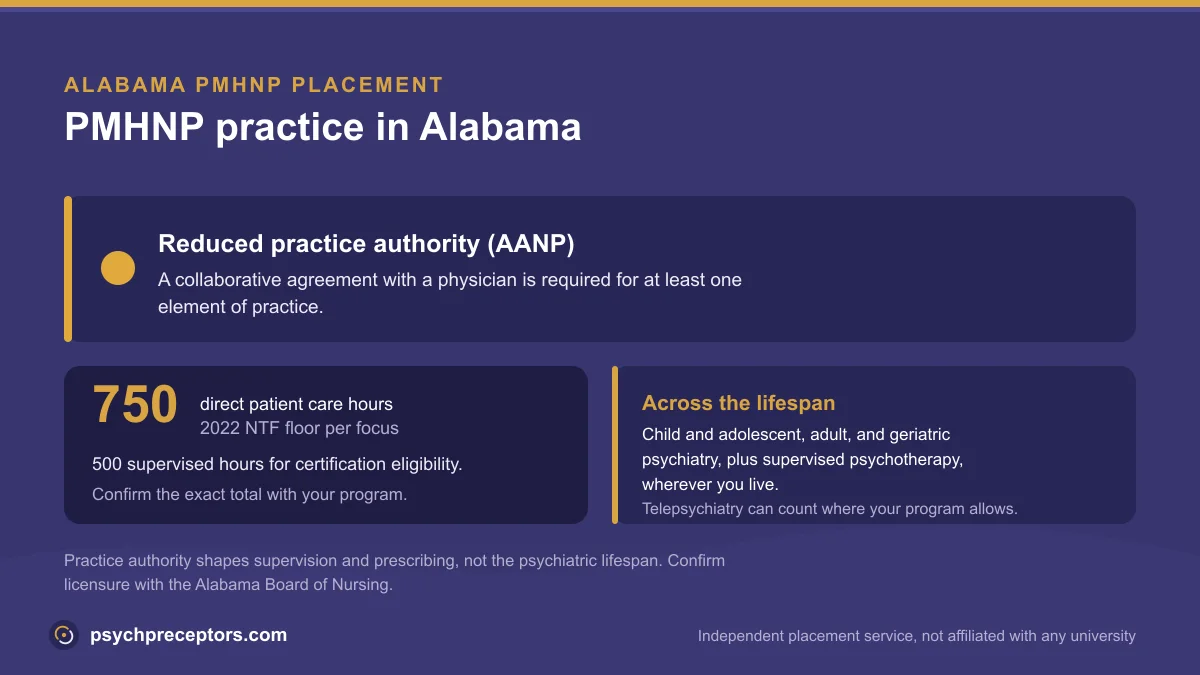
Alabama is a reduced-practice state under the AANP framework. A certified registered nurse practitioner practices under a collaborative agreement with a physician, filed with the Alabama Board of Nursing, with the collaborating physician also recognized by the state's Board of Medical Examiners. The agreement carries a standard protocol and a quality-assurance plan. For psychiatric work this matters in a specific way: PMHNPs prescribe controlled medications every day, from stimulants and mood stabilizers to buprenorphine for opioid use disorder, and controlled prescribing always requires a federal DEA registration on top of state authority.
What this does not change is who teaches you. A preceptor is generally a board-certified PMHNP or a board-certified psychiatrist, and some programs accept other qualified behavioral-health prescribers. Reduced practice shapes the supervision and prescribing structure around that preceptor, not the clinical hours you log. Because your school sets the final rules, confirm the current details with your program and the state board of nursing.
The lifespan, and what runs short in Alabama
PMHNP is an across-the-lifespan specialty, so your hours have to span child and adolescent, adult, and geriatric psychiatry, along with supervised psychotherapy in at least two modalities. Adult psychiatry is the easiest to arrange here, since it fills the community clinics and the inpatient units. Child and adolescent psychiatry is the hard one: much of the state's child capacity clusters in Birmingham's academic and children's hospital settings, and Alabama contracts out a share of its child and adolescent inpatient care to a regional medical center in the eastern part of the state, so rural families often wait months for an appointment.
Geriatric psychiatry is thin as well, and a lot of it lives inside primary care, nursing homes, and general clinics rather than standalone geriatric offices. Because these two ends of the lifespan are the bottleneck, they are the first rotations we work to secure.
Telepsychiatry and the rural map
Most of Alabama is a federally designated mental health professional shortage area, and the shortage is deepest in the rural counties of the Black Belt and the southern part of the state. Telepsychiatry has become the way many of those residents see a prescriber at all, and it is now a large part of PMHNP training. For an Alabama rotation, the current program decides whether telehealth or simulation is permitted and how either is classified, supervised, documented, and applied. Confirm the current program rule and any applicable state requirements before relying on either format.
Psychotherapy and medication management together
Psychiatric training is not only writing prescriptions. Your program will expect supervised psychotherapy hours with training in at least two approaches, such as cognitive behavioral work alongside supportive or motivational methods, together with the medication management that fills most psychiatric visits. When we build your placement we look for preceptors and sites that let you do both, so you leave with therapy exposure and not only a prescribing log.
How placement works in Alabama
We are an independent service, not tied to any school, and we place PMHNP students at any Alabama program. Tell us your city, the paperwork your school requires, and which rotations you still need, and we will source a board-certified PMHNP or psychiatrist preceptor and a clinical site, and sort out the collaborative-agreement details that come with a reduced-practice state. You can see how it works and what we charge on the cost page. When you are ready, use the form under get matched and we will start on your hardest rotation first.
Good to know
Does Alabama's reduced-practice status limit my psychiatric clinical hours?
No. Reduced practice changes the supervision and prescribing arrangement, meaning a collaborating physician is part of the picture, but it does not cap the hours you can earn or the settings where you can train. Your preceptor still needs to be licensed in Alabama and working in psychiatry.
Can I complete psychiatric hours by telehealth in Alabama?
Your current program decides whether telehealth or simulation is permitted and how either is classified, supervised, documented, and applied. Confirm the current program rule and any applicable state requirements before relying on either format. Confirm the mix your program will accept.
How many clinical hours will I need?
The 2022 NTF Standards recommend at least 750 direct patient care hours per nurse practitioner population focus. ANCC and AANPCB eligibility sources separately use at least 500 faculty-supervised clinical hours. These figures serve different purposes and do not form a typical program range. Named programs vary and control the exact total and distribution, so confirm current requirements with your program.
Who can serve as my PMHNP preceptor in Alabama?
Generally a board-certified PMHNP or a board-certified psychiatrist, and some programs allow other qualified behavioral-health prescribers. In a reduced-practice state the preceptor's own practice usually involves a collaborating physician, but that is separate from their qualifications to teach you.
Which rotation should I try to lock down first?
Child and adolescent psychiatry. It is the scarcest rotation in Alabama and almost everywhere else, so starting early gives you the best chance of a strong site. Geriatric psychiatry is the next hardest and worth arranging soon after.
Related
Cover every rotation, not just the easy ones
Tell us your PMHNP program, your city, and the rotations you still need. We will come back with a plan for the full psych lifespan and a realistic path to placed.