PMHNP rotations, placed across rural Vermont
Vermont is a full practice authority state once you are past its transition-to-practice period, and it runs an unusually organized public mental-health system for such a rural place. A statewide network of designated community agencies carries much of the psychiatric caseload, Burlington holds the main hospital hub, and the Northeast Kingdom and southern hills lean on telepsychiatry. We help PMHNP students at any university line up preceptors for every stage of the lifespan.
The designated agencies: Vermont's public mental-health backbone
Vermont organizes public mental health through a network of regional nonprofit designated agencies, one or more for every part of the state, and together they carry much of the psychiatric, substance-use, and crisis caseload. For a PMHNP student, that network is a genuine advantage: it means most communities, even small ones, have an established behavioral-health organization rather than a scattering of solo clinics. These agencies deliver outpatient psychiatry, therapy, community support, and crisis services, and they are often where lifespan psychiatric hours are most reachable outside the Burlington hospitals.
The settings that host PMHNP students in Vermont include:
- the regional designated community mental-health agencies,
- an academic medical center in Burlington and other designated hospitals for inpatient and acute hours,
- the state psychiatric hospital in central Vermont,
- a psychiatric hospital in the south that provides much of the state's child and youth inpatient care,
- medication assisted treatment sites, private and telepsychiatry practices, and Veterans Affairs behavioral health.
Burlington, the regions, and the Northeast Kingdom
Burlington in the northwest is Vermont's largest community and its main hospital hub, including inpatient psychiatry. Beyond it, Rutland, the Montpelier and Barre area, Brattleboro in the south, and Bennington each anchor their regions, while the Northeast Kingdom around St. Johnsbury and Newport is the most rural and hardest to reach.
For a Vermont rotation, the current program decides whether telehealth or simulation is permitted and how either is classified, supervised, documented, and applied. Confirm the current program rule and any applicable state requirements before relying on either format. We plan your mix around where you live so that a rural address does not close off a rotation.
Substance use and the hub-and-spoke model
Vermont built one of the country's best-known systems for treating opioid use disorder, a hub-and-spoke model that links specialty treatment hubs with primary-care spokes across the state. For a PMHNP student, that makes substance-use psychiatry unusually well organized and reachable here, and it pairs closely with the medication-management and psychotherapy training your program requires.
A substance use rotation in Vermont can be a strong, dependable part of a lifespan plan, in both urban and rural settings.
Child, adolescent, and geriatric rotations
Your PMHNP hours must reach children and adolescents, adults, and older adults, plus supervised psychotherapy in at least two modalities. Child and adolescent psychiatry is the scarcest block in Vermont, concentrated around Burlington and the southern psychiatric hospital that provides much of the state's youth inpatient care, so it fills early.
Geriatric psychiatry, by contrast, is in steady demand, since Vermont is one of the oldest states by median age, and it is often reached through long-term care, memory clinics, and rural practices. We lock the child and adolescent block first and plan the rest around it.
Full practice, after transition to practice
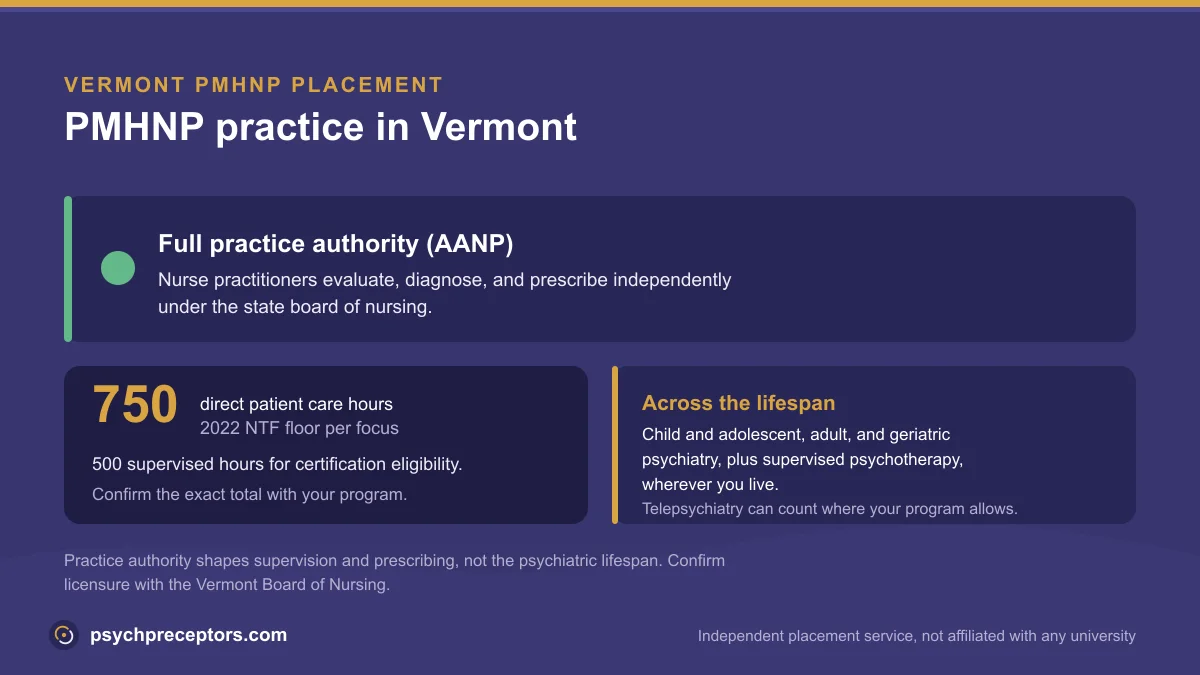
Vermont is a full practice authority state, with a step at the start. A newly licensed nurse practitioner completes a transition-to-practice period, working under a collaborating physician or advanced-practice provider, before moving to full independence. Once past it, a PMHNP can diagnose, treat, and prescribe, including controlled psychiatric medications with a personal DEA registration, under the Board of Nursing.
For you, that means your preceptor is typically an experienced PMHNP well past transition, or a psychiatrist, either of whom can hold independent prescriptive authority. A preceptor is generally a board-certified PMHNP (PMHNP-BC) or a psychiatrist, and your program sets the final rules. Vermont is also standing up certified community behavioral health clinics, which may widen training sites over time.
Placing your Vermont hours
Tell us your PMHNP program, your region, and the rotations you still need, and we will build a plan that uses Vermont's designated-agency network and starts with the scarce child and adolescent and inpatient blocks. We serve students at any university, and our find a preceptor page explains how we source and vet each match. When you are ready, start your placement plan and an advisor with psychiatric background will follow up.
Good to know
What are Vermont's designated agencies, and why do they matter for placement?
They are the regional nonprofit organizations that deliver most of Vermont's public mental-health, substance-use, and crisis care, covering every part of the state. Because they exist in even small communities, they give PMHNP students a real base for lifespan psychiatric hours outside the Burlington hospitals.
Is Vermont full practice for PMHNPs?
Yes, after a transition-to-practice period. New nurse practitioners first work under a collaborating physician or advanced-practice provider; once past that stage, a PMHNP practices and prescribes independently, including controlled medications with a DEA registration. That is why most preceptors are experienced clinicians.
Where can I get child and adolescent psychiatric hours in Vermont?
Mostly around Burlington and the southern psychiatric hospital that handles much of the state's youth inpatient care. That capacity is limited, so we plan the child and adolescent block first and build the rest of your schedule around it.
Are addiction rotations easy to find here?
Relatively, yes. Vermont's hub-and-spoke system for opioid use disorder is well organized statewide, so substance-use psychiatry is one of the more reachable rotations, in both urban and rural settings, and it strengthens your medication-management experience.
Do you guarantee a placement in Vermont?
No. We source, vet, and secure qualified preceptors and sites, and we are honest about what Vermont's small system can support. We never promise a placement a site has not agreed to, and only your program can approve a preceptor or site.
Cover every rotation, not just the easy ones
Tell us your PMHNP program, your city, and the rotations you still need. We will come back with a plan for the full psych lifespan and a realistic path to placed.