Placing PMHNP students in Rhode Island's compact system
Rhode Island changes the placement math simply by being small. Nearly the whole state sits within an hour of Providence, so its psychiatric capacity is concentrated rather than scattered, and it is a full-practice state where an experienced psychiatric nurse practitioner can precept you independently. We place students at any university across community mental health, hospital psychiatry, addiction care, and telehealth, and this page explains how a compact map helps and where it still gets tight.
A small state with concentrated hubs
Rhode Island's psychiatric infrastructure clusters in greater Providence. The state's only freestanding nonprofit psychiatric hospital, serving adults and seniors, and the long-established children's psychiatric hospital both sit in the Providence area, and a network of six private nonprofit community mental health centers covers the state under the state behavioral health authority.
Useful training areas include Providence, Warwick, Cranston, Pawtucket, Woonsocket, and Newport, with more rural stretches in Washington County to the south. Because distances are short, a single term can realistically touch several settings, which helps when you need both outpatient and inpatient exposure.
The six community mental health centers carry much of the daily work, from general and intensive outpatient care to case management, crisis response, and assertive community treatment for people with serious mental illness. The Providence-area veterans' medical center adds adult psychiatric hours, and campus and school-based programs reach younger patients. With everything close together, we can build a varied caseload without sending you across long commutes.
Full practice authority in Rhode Island
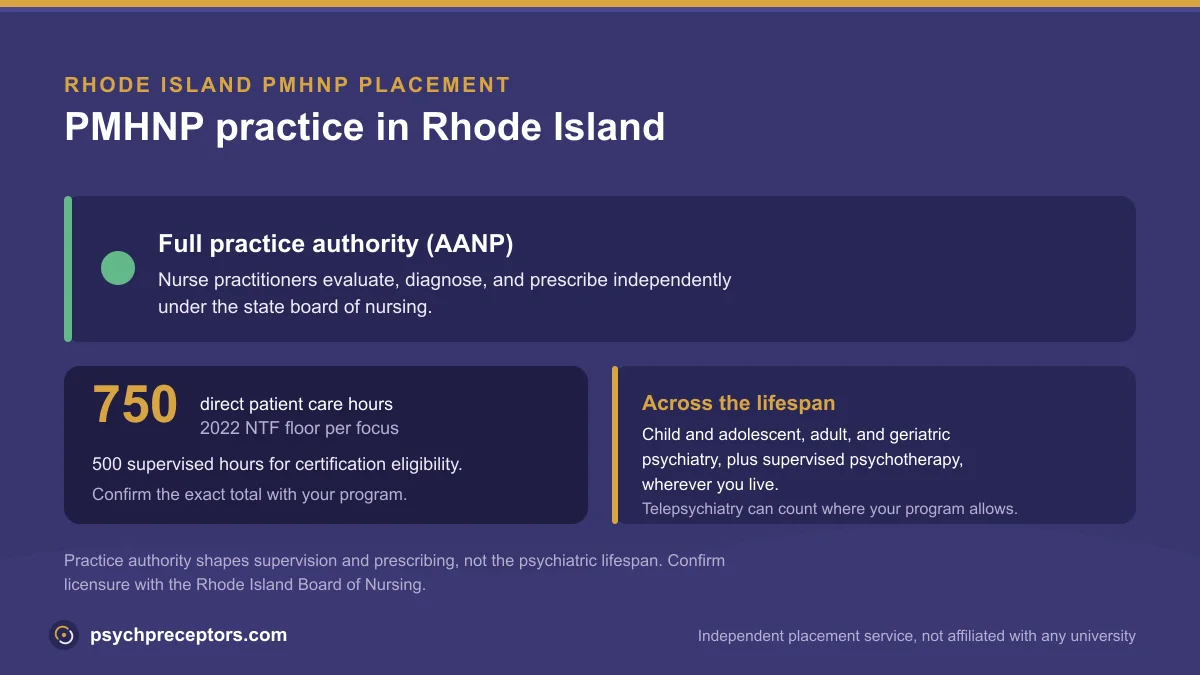
Rhode Island is a full-practice state under the Board of Nurse Registration and Nursing Education, which sits within the state Department of Health. An experienced psychiatric nurse practitioner can diagnose, treat, and prescribe independently, including controlled substances with a DEA registration, without a collaborative agreement. The state also rejoined the Nurse Licensure Compact in 2024.
That independence widens your preceptor pool to include nurse-practitioner-led psychiatric and telehealth practices, not only psychiatrist-led clinics. The core credential is unchanged: a board-certified PMHNP or a psychiatrist licensed in Rhode Island. Full authority mainly changes the supervising and prescribing arrangement, so an experienced PMHNP can carry your controlled-substance teaching without a physician co-signer, provided they hold their own DEA registration. See preceptor requirements and the medication management rotation.
Child, adolescent, and geriatric rotations
Child and adolescent psychiatry in Rhode Island concentrates at the Providence-area children's psychiatric hospital and the region's academic system, which makes it strong when you can secure it but still the scarcest rotation to schedule. A child and adolescent psych rotation deserves your earliest planning.
Geriatric psychiatry runs mostly through the community mental health centers and senior care settings. We build the geriatric psych rotation from those, and use the short travel times to combine it with nearby adult hours.
Telepsychiatry, even in a small state
Short distances do not erase access gaps. High demand and long waits mean a large share of psychiatric care in Rhode Island is delivered by telehealth, and the Providence adult psychiatric hospital extends telepsychiatry into rural pockets and into nearby southeastern Massachusetts.
For a Rhode Island rotation, the current program decides whether telehealth or simulation is permitted and how either is classified, supervised, documented, and applied. Confirm the current program rule and any applicable state requirements before relying on either format. That flexibility helps you fill a specific stage without adding a long commute. More on PMHNP clinical hours.
Addiction and correctional psychiatry
Rhode Island was hit hard by the opioid crisis and responded with strong medication-assisted treatment and recovery services, including an early statewide model for full medication-assisted treatment inside its correctional system. That correctional and forensic angle is a distinctive training setting you will not find everywhere.
Opioid treatment programs operate across the state, so a substance use rotation is very reachable here and pairs well with medication management or supervised psychotherapy hours. Because so many patients present with both a psychiatric diagnosis and a substance use disorder, these placements also strengthen your co-occurring, or dual diagnosis, experience.
Lining up your lifespan hours in Rhode Island
We secure the scarce child, adolescent, and geriatric hours first, then arrange adult, psychotherapy, and substance use around them, using the state's short distances to keep your schedule tight. Rhode Island programs expect supervised psychotherapy hours in at least two modalities, and we plan those next to the medication-focused blocks so nothing in the record is left thin.
You are matched first and pay only when a site is secured. Start at the match form, or read how it works and our flat fee. We are independent and never guarantee a school's approval of any preceptor or site.
Good to know
Is Rhode Island a full-practice state?
Yes. Under the Board of Nurse Registration and Nursing Education, within the Department of Health, nurse practitioners diagnose, treat, and prescribe independently, including controlled substances with a DEA registration, without a collaborative agreement. So an experienced PMHNP can precept you on their own.
Does a small state make placement easier?
Short distances help, since one term can touch several settings, but psychiatric capacity is concentrated and demand is high. Child and adolescent rotations still need early planning even though the state is compact.
Do telehealth hours count in Rhode Island?
Your current program decides whether telehealth or simulation is permitted and how either is classified, supervised, documented, and applied. Confirm the current program rule and any applicable state requirements before relying on either format. Confirm the specifics with your own program.
Where can I get addiction hours in Rhode Island?
Through medication-assisted treatment and opioid treatment programs statewide, plus a notable correctional treatment model. We usually pair a substance use rotation with medication management or supervised psychotherapy.
How many clinical hours will I need?
The 2022 NTF Standards recommend at least 750 direct patient care hours per nurse practitioner population focus. ANCC and AANPCB eligibility sources separately use at least 500 faculty-supervised clinical hours. These figures serve different purposes and do not form a typical program range. Named programs vary and control the exact total and distribution, so confirm current requirements with your program.
Cover every rotation, not just the easy ones
Tell us your PMHNP program, your city, and the rotations you still need. We will come back with a plan for the full psych lifespan and a realistic path to placed.