Lining up your PMHNP hours in Ohio
Ohio has a dense behavioral-health system built around county boards, community clinics, and one of the heaviest addiction caseloads in the country, which makes it a strong state to train in. It is also a reduced practice state, so your preceptor works under a collaboration agreement with a physician. This page explains how that arrangement affects your placement and where the psychiatric rotations actually sit.
The Ohio behavioral-health system
Ohio organizes public behavioral health through county Alcohol, Drug Addiction, and Mental Health boards that plan services across all 88 counties, so the delivery network is broad and easy to rotate into. Columbus, Cleveland, and Cincinnati hold the deepest supply, with Dayton, Toledo, Akron, and Youngstown anchoring their regions and the Appalachian southeast running much leaner.
- Community mental health providers and Certified Community Behavioral Health Clinics that fold therapy, prescribing, crisis, and addiction care into one site
- Six state-run regional psychiatric hospitals for acute inpatient exposure
- Children's hospitals in Columbus, Cincinnati, and Cleveland that concentrate pediatric psychiatry
- Private practices, integrated primary care, Veterans Affairs behavioral health, and telepsychiatry groups
Reduced practice and the Standard Care Arrangement
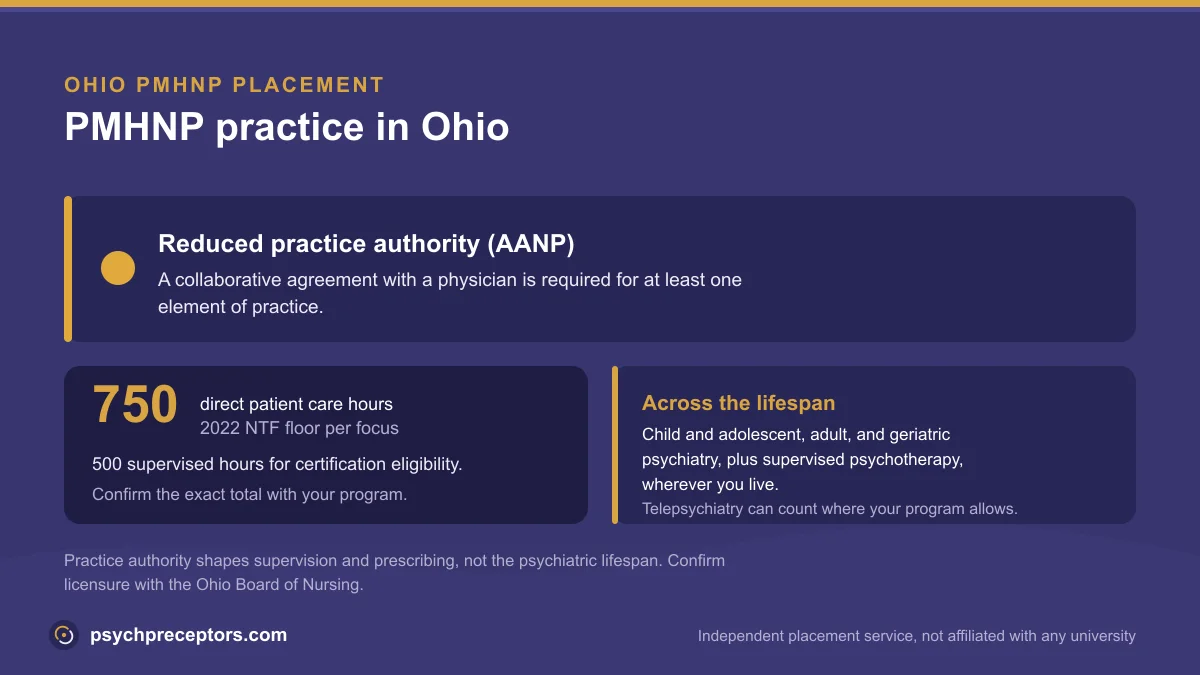
Ohio is a reduced practice state. A nurse practitioner practices under a Standard Care Arrangement, a written collaboration agreement with each physician the NP works with; recent law also lets an experienced APRN serve as the collaborator in some cases. A PMHNP's controlled-substance prescribing is exercised within that agreement.
- The arrangement shapes who can serve as your preceptor and how prescribing is overseen, not the preceptor's clinical qualifications
- Your preceptor is still a board-certified PMHNP (ANCC PMHNP-BC) or a board-certified psychiatrist
- Some programs accept other qualified behavioral-health prescribers; your school decides
- Every controlled-substance prescriber holds a DEA registration, which Ohio requires like every state
Our preceptor requirements page lists what your program will check.
Opioids, MAT, and substance-use rotations
Ohio sat at the center of the opioid epidemic, and its treatment infrastructure grew to match, which makes substance-use training unusually rich here. For a PMHNP, co-occurring mental health and addiction care is some of the most useful experience you can log.
- Opioid treatment programs and office-based buprenorphine clinics for substance use and medication-assisted treatment hours
- Certified community clinics that pair addiction care with psychiatric prescribing and peer support
- Medication management settings where much of the prescribing volume lives
Lifespan rotations and the child-psych hubs
PMHNP hours must span child and adolescent, adult, and geriatric psychiatry, plus supervised psychotherapy in at least two modalities. Ohio serves the age bands unevenly.
- Child and adolescent psychiatry concentrates in the children's hospitals of Columbus, Cincinnati, and Cleveland, with telehealth extending it elsewhere
- Geriatric psychiatry runs thin outside the metros and often sits in long-term care and consultation roles
- Adult psychiatry is broadly available across the county-board clinics and hospital units
- Psychotherapy hours pair with prescribing so you develop both skill sets
Telepsychiatry and the rural southeast
Ohio's metros are well supplied, but the Appalachian southeast and other rural counties depend on telepsychiatry to reach a prescriber. For an Ohio rotation, the current program decides whether telehealth or simulation is permitted and how either is classified, supervised, documented, and applied. Confirm the current program rule and any applicable state requirements before relying on either format.
- A telehealth block can supply child, geriatric, or rural adult exposure that is scarce near you
- Community clinics increasingly deliver routine follow-up care by video
- Your preceptor supervises a telehealth encounter the same way as an in-person visit
How we match you in Ohio
We are an independent placement service for PMHNP students at any university, not a school and not a certifying board. Tell us your program, your city, and the rotations you still need, and we source a preceptor and site that fit Ohio's collaboration rules and your school's paperwork. We assist with matching; we do not guarantee placement or that your school will approve a given preceptor or site.
- Send your program and location through the match form
- We map in-person and telehealth options across the metros and the rural counties
- We help package the collaboration and affiliation documents your school needs
Read how it works and our cost page before you commit.
Good to know
Does Ohio require a physician in my preceptor arrangement?
For practice, yes. Ohio nurse practitioners work under a Standard Care Arrangement, a written collaboration with a physician, though an experienced APRN can now be the collaborator in some cases. Your preceptor can be a board-certified PMHNP or a psychiatrist; the arrangement governs oversight, not the preceptor's qualifications.
How many clinical hours does a PMHNP program need?
The 2022 NTF Standards recommend at least 750 direct patient care hours per nurse practitioner population focus. ANCC and AANPCB eligibility sources separately use at least 500 faculty-supervised clinical hours. These figures serve different purposes and do not form a typical program range. Named programs vary and control the exact total and distribution, so confirm current requirements with your program.
Where is substance-use training strongest in Ohio?
Across the state, because Ohio's opioid response built out opioid treatment programs, buprenorphine clinics, and certified community behavioral health clinics that pair addiction care with psychiatric prescribing. It is one of the richer states for co-occurring and medication-assisted treatment experience.
Which rotation is hardest to place here?
Child and adolescent psychiatry, which concentrates in the children's hospitals of Columbus, Cincinnati, and Cleveland. Geriatric psychiatry is also thin outside the metros. Telepsychiatry helps students reach both when local supervision is unavailable.
Do you guarantee a placement?
No. We source preceptors and clinical sites and help with the paperwork, but we cannot guarantee a match or that your school will approve a specific preceptor or site. Your program makes the final decision.
Cover every rotation, not just the easy ones
Tell us your PMHNP program, your city, and the rotations you still need. We will come back with a plan for the full psych lifespan and a realistic path to placed.