Psychiatric preceptor matching across North Carolina
North Carolina pairs fast-growing metros with wide rural stretches that see almost no psychiatrist, and it is one of the states that still ties nurse practitioner practice to a supervising physician. For a PMHNP student that means two things shape your search: where the psychiatric capacity sits, and how the supervision arrangement is written. This page walks through both and where we can help.
The North Carolina behavioral-health map
Psychiatric capacity concentrates in the urban crescent and a few academic centers, then falls off sharply toward the coastal plain and the mountains. Charlotte and the Research Triangle of Raleigh, Durham, and Chapel Hill hold the deepest supply, with the Triad of Greensboro and Winston-Salem, plus Asheville, Wilmington, Fayetteville, and Greenville anchoring their regions.
- Community mental health providers and Certified Community Behavioral Health Clinics that combine therapy, prescribing, and crisis services
- Three state psychiatric hospitals, in Butner, Morganton, and Goldsboro, for acute inpatient exposure
- Private psychiatric practices, integrated primary care, and telepsychiatry groups
- Veterans Affairs behavioral health and campus counseling centers in the university towns
Restricted practice and who supervises your preceptor
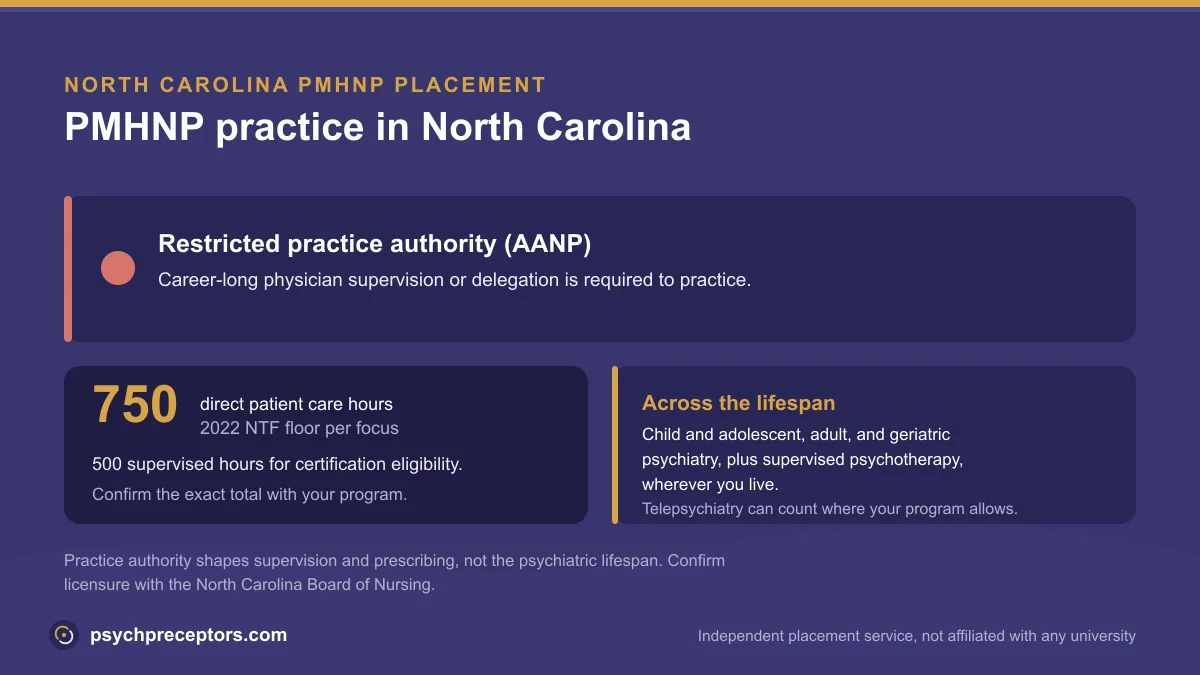
North Carolina is a restricted practice state. A nurse practitioner works under a collaborative practice agreement with a primary supervising physician, approved jointly by the Board of Nursing and the Medical Board through their shared subcommittee. In psychiatry that usually puts a supervising or collaborating psychiatrist in the arrangement, and a PMHNP's controlled-substance prescribing is exercised within it.
- This shapes who can serve as your preceptor and how prescribing is signed off, not the preceptor's clinical skill
- Your preceptor is still a board-certified PMHNP (ANCC PMHNP-BC) or a board-certified psychiatrist
- Some programs accept other qualified behavioral-health prescribers; your school decides
- Every controlled-substance prescriber holds a DEA registration, which North Carolina requires like every state
See our preceptor requirements for the documents your program will expect.
Telepsychiatry and the statewide network
North Carolina built one of the country's earliest statewide telepsychiatry programs to reach emergency departments and rural clinics that have no psychiatrist on site. For a North Carolina rotation, the current program decides whether telehealth or simulation is permitted and how either is classified, supervised, documented, and applied. Confirm the current program rule and any applicable state requirements before relying on either format.
- Statewide telepsychiatry has handled tens of thousands of emergency psychiatric assessments across dozens of hospitals
- A telehealth block can supply child, geriatric, or rural adult exposure that is scarce near you
- Your preceptor supervises a video encounter the same way as an in-person visit
Lifespan rotations, and the scarce ones
PMHNP hours must cover child and adolescent, adult, and geriatric psychiatry, plus supervised psychotherapy in at least two modalities. In North Carolina the age bands are unevenly served.
- Child and adolescent psychiatry is the scarcest, clustered in the Triangle and Charlotte academic and children's settings, with telehealth reaching the rest
- Geriatric psychiatry runs thin in rural counties and often sits in long-term care and consultation roles
- Adult psychiatry is the most available, across clinics, inpatient units, and addiction programs
- Psychotherapy hours sit alongside prescribing so you build both skill sets
Addiction, crisis, and inpatient work
North Carolina's opioid and stimulant burden makes substance-use rotations both available and valuable, and its crisis and inpatient settings show the acuity outpatient clinics do not.
- Opioid treatment programs and office-based buprenorphine for substance use and medication-assisted treatment hours
- Mobile crisis teams, facility-based crisis centers, and 988 response
- Inpatient psychiatry in general hospitals and the state hospitals
- Outpatient community clinics where most ongoing care happens
How we match you in North Carolina
We are an independent placement service for PMHNP students at any university, not a school and not a certifying board. Tell us your program, your city, and the rotations you still need, and we source a preceptor and site that fit North Carolina's supervision rules and your school's paperwork. We assist with matching; we do not guarantee placement or that your school will approve a given preceptor or site.
- Send your program and location through the match form
- We map in-person and telehealth options across the metros and the rural stretches
- We help package the supervision and affiliation documents your school needs
Read how it works and our cost page before you decide.
Good to know
Does North Carolina require a physician in my preceptor arrangement?
For practice, yes. North Carolina nurse practitioners work under a collaborative practice agreement with a supervising physician, so a psychiatrist is often part of the arrangement. Your actual preceptor can be a board-certified PMHNP or a psychiatrist; the supervision rule shapes prescribing sign-off, not the preceptor's qualifications.
How many clinical hours does a PMHNP program need?
The 2022 NTF Standards recommend at least 750 direct patient care hours per nurse practitioner population focus. ANCC and AANPCB eligibility sources separately use at least 500 faculty-supervised clinical hours. These figures serve different purposes and do not form a typical program range. Named programs vary and control the exact total and distribution, so confirm current requirements with your program.
Which rotation is hardest to find in North Carolina?
Child and adolescent psychiatry, which is concentrated in the Triangle and Charlotte academic and children's settings. Geriatric psychiatry is also thin in rural areas. Telepsychiatry helps students reach both when local supervision is unavailable.
Can telehealth psychiatric hours count here?
Your current program decides whether telehealth or simulation is permitted and how either is classified, supervised, documented, and applied. Confirm the current program rule and any applicable state requirements before relying on either format. Confirm the balance your own program will accept.
Do you guarantee a placement?
No. We source preceptors and clinical sites and help with the paperwork, but we cannot guarantee a match or that your school will approve a specific preceptor or site. Your program holds final approval.
Cover every rotation, not just the easy ones
Tell us your PMHNP program, your city, and the rotations you still need. We will come back with a plan for the full psych lifespan and a realistic path to placed.