Lining Up Your Psychiatric Rotation in Minnesota
Minnesota is a full practice authority state, and a longstanding rule that still asks new nurse practitioners to log a stretch of collaborative hours is set to loosen further in 2026. For a PMHNP student that means an experienced psychiatric nurse practitioner can precept you with independent prescriptive authority. The clinical map splits sharply between the Twin Cities and a large, thinly served greater Minnesota. This page covers where students actually place, how the geography and tribal north play out, and which rotations run short.
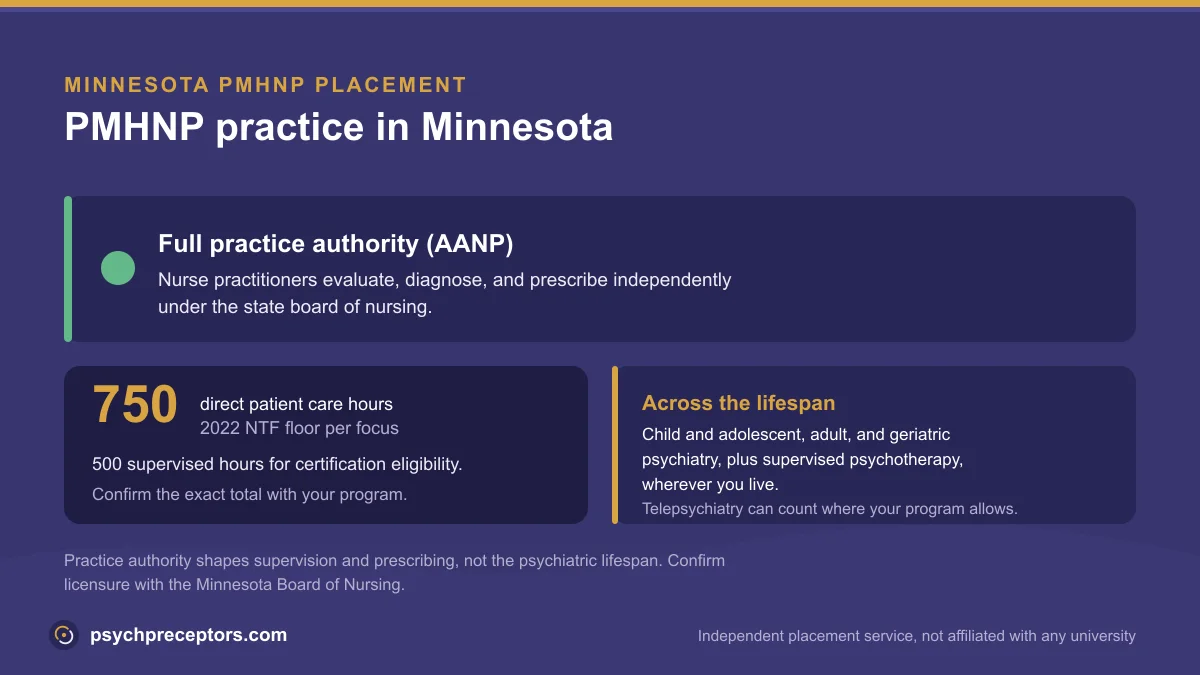
Full practice authority, loosening further in 2026
Minnesota granted full practice authority to nurse practitioners in 2015, so a board-certified PMHNP with enough experience can diagnose, treat, and prescribe on their own license, including controlled substances once a DEA registration is in place. One condition has lingered: nurse practitioners starting out have had to complete a block of practice, commonly cited as 2,080 hours, inside a collaborative arrangement with a physician or another advanced practice nurse before practicing fully on their own. State action set to take effect in 2026 removes that postgraduate collaborative requirement.
For your rotation the takeaway is simple. A qualified PMHNP can serve as your preceptor and hold independent prescriptive and controlled-substance authority, so no supervising psychiatrist has to be attached to the arrangement. The preceptor still has to be licensed in Minnesota and practicing in the population you are logging. Confirm current requirements with the Minnesota Board of Nursing rather than any summary, since transition dates matter.
Where PMHNP hours actually happen
Minnesota leaned hard into the Certified Community Behavioral Health Clinic model, and certified organizations now cover clusters of counties from the Twin Cities out through central and western Minnesota. A clinic of this kind is a strong home for a PMHNP rotation because it is required to serve anyone who asks, across ages, and to combine mental health and substance use care with crisis services in one place.
- Certified Community Behavioral Health Clinics and county mental health centers across the metro and greater Minnesota.
- Inpatient psychiatric units in the large Twin Cities and Rochester hospital systems, plus community hospital units.
- Substance use and opioid treatment programs, including office-based medication treatment.
- Tribal and Indian Health Service behavioral health on the northern reservations, such as the White Earth, Red Lake, and Leech Lake communities, for students who clear the added credentialing.
- Private psychiatric groups and telepsychiatry practices, plus assertive community treatment and mobile crisis teams.
- College counseling centers in the university towns.
The Twin Cities hold the specialty seats
Minneapolis and St. Paul, with Rochester to the south, hold most of the inpatient beds, nearly all of the child and adolescent psychiatry, and the teaching-hospital rotations. Duluth anchors the northeast, St. Cloud the center, and Mankato and Moorhead cover the south and the Red River valley. Those regional hubs carry adult psychiatry well.
Greater Minnesota is the challenge. Wide rural stretches in the north and west have few psychiatric prescribers, and a student living in Bemidji or along the Iron Range will find far fewer in-person seats than a student in Hennepin County. That is where a telepsychiatry block and a willing local preceptor matter most, and where we spend the most effort on a rural search.
Lifespan rotations and the ones that run short
PMHNP hours must cross child and adolescent, adult, and geriatric psychiatry, plus supervised psychotherapy with at least two modalities. Adult hours come readily through the community behavioral health and hospital systems. Geriatric psychiatry is thinner and tends to sit in memory clinics and long-term care around the metros and Rochester.
Child and adolescent psychiatry is the scarcest seat, as it is almost everywhere, concentrated in the Twin Cities children's and academic hospitals. We generally build that block on its own rather than expecting a general site to supply it, and telehealth often fills the gap for families outside the metro. See the child and adolescent psych rotation and geriatric psych rotation pages.
Telepsychiatry and psychotherapy hours
For a Minnesota rotation, the current program decides whether telehealth or simulation is permitted and how either is classified, supervised, documented, and applied. Confirm the current program rule and any applicable state requirements before relying on either format. A remote block can pair you with a metro preceptor while you reach patients on the range or in the western counties.
Supervised psychotherapy is its own requirement. Community behavioral health clinics and private practices are usually the most reliable places to log therapy hours across two modalities. Our psychotherapy hours page walks through what programs expect.
How we help with a Minnesota search
We are independent, we work with PMHNP students at any university, and we work independently of any school. We do not guarantee placement or your program's approval of a preceptor or site. What we do is find and vet psychiatric preceptors in the part of Minnesota you can reach, confirm they are licensed and practicing in the population you still need, and hand clean paperwork to your clinical office. Tell us your city, your remaining rotations, and your start date on the form here (start here) or through contact. Pricing is on the cost page.
Good to know
Is Minnesota a full practice authority state?
Yes. AANP places Minnesota in the full practice category. A board-certified PMHNP can diagnose, treat, and prescribe independently, including controlled substances with a DEA registration, and a longstanding postgraduate collaborative-hours requirement for new nurse practitioners is being removed in 2026. Confirm the current transition details with the Minnesota Board of Nursing.
Does full practice authority mean any PMHNP can precept me?
It means a qualified PMHNP can precept you without a supervising psychiatrist on the arrangement. The preceptor still must hold a current Minnesota license, be board certified as a PMHNP or psychiatrist, and practice in the population you are logging. Whether your program accepts a given clinician is its decision, not the state's.
Which psychiatric rotation is hardest to place in Minnesota?
Child and adolescent psychiatry, concentrated in the Twin Cities children's and academic hospitals. Geriatric psychiatry runs thin too. In greater Minnesota both are scarce in person, so telehealth often fills the gap. We usually place the child block as its own site.
I live in greater Minnesota. Can I still find a placement?
Usually yes, though it takes more planning. Rural counties in the north and west have few psychiatric prescribers, so a telepsychiatry block paired with a willing local preceptor is often the realistic route. Your current program decides whether telehealth or simulation is permitted and how either is classified, supervised, documented, and applied. Confirm the current program rule and any applicable state requirements before relying on either format. Start early and treat travel time as part of the cost.
Cover every rotation, not just the easy ones
Tell us your PMHNP program, your city, and the rotations you still need. We will come back with a plan for the full psych lifespan and a realistic path to placed.