Where Indiana PMHNP students find psychiatric rotations
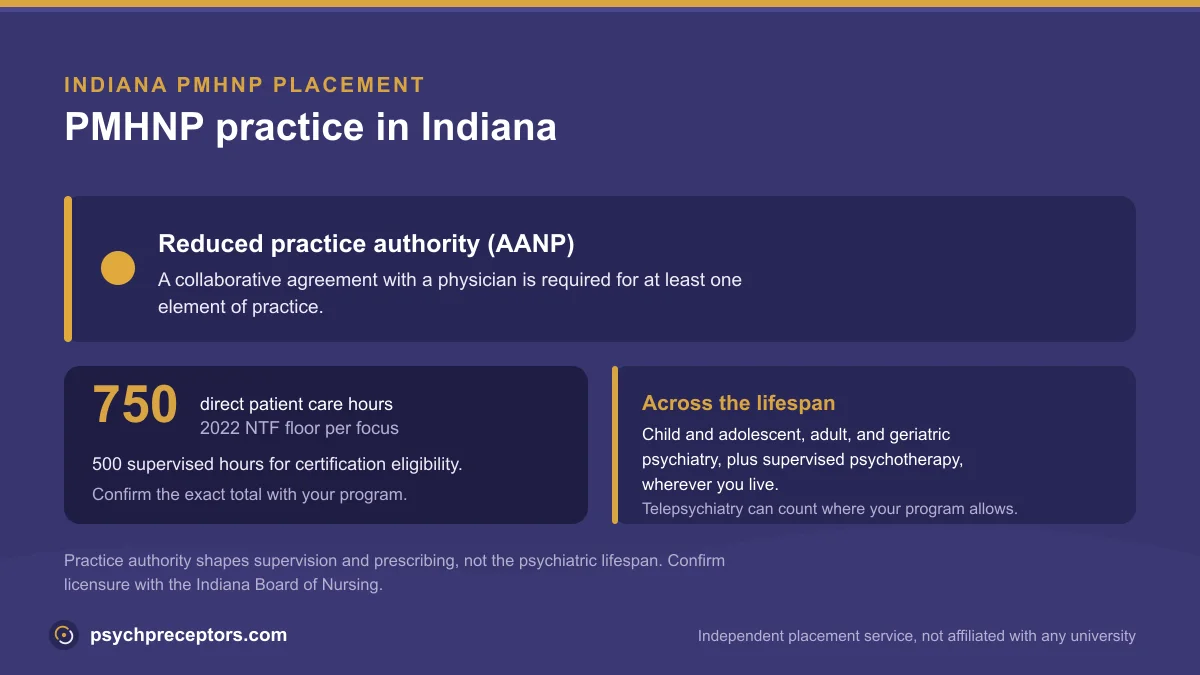
Indiana is a reduced practice state, so a PMHNP typically prescribes under a collaborative agreement with a physician, which shapes how your rotation is supervised more than it changes a preceptor's core skill. The state runs a broad public system, six state psychiatric hospitals and two dozen community mental health centers, that anchors psychiatric training well beyond Indianapolis. This page maps where PMHNP rotations actually happen in Indiana and how the prescribing arrangement affects who can precept you.
Where Indiana PMHNP students actually rotate
Indiana's Division of Mental Health and Addiction certifies two dozen community mental health centers that cover the whole state, and they are the workhorses of PMHNP training here. Regional providers serving Indianapolis, the Wabash Valley, southern Indiana, the northwest lakeshore, and the north-central region deliver medication management, therapy, crisis, and addiction care, and a growing number carry certified community behavioral health clinic status.
For inpatient and acute hours, the state operates six psychiatric hospitals: the NeuroDiagnostic Institute in Indianapolis, Evansville State Hospital and the Evansville Psychiatric Children's Center, Logansport State Hospital, Madison State Hospital, and Richmond State Hospital. Psychiatric units inside general hospitals, private practices, telepsychiatry groups, and substance use and medication-assisted treatment programs fill out the settings that document your hours.
The collaborative agreement and your prescribing arrangement
The American Association of Nurse Practitioners classifies Indiana as reduced practice, and the Indiana State Board of Nursing, part of the Professional Licensing Agency, oversees APRN practice. To hold prescriptive authority, a nurse practitioner maintains a written collaborative agreement with a licensed physician who periodically reviews a sample of the prescribing. That means a psychiatrist is usually part of the picture for a PMHNP rotation, either as your preceptor or as the collaborating physician behind a PMHNP preceptor.
Because PMHNPs prescribe controlled psychiatric medications, this arrangement carries weight: prescribing scheduled drugs requires the collaborative agreement to cover it, a DEA registration, and use of the state prescription monitoring program. Lawmakers have considered easing the collaboration requirement, so check the current rule with the board before you rely on it. Either way, your program sets who may precept you; most accept a board-certified PMHNP (PMHNP-BC) or a board-certified psychiatrist. See our preceptor requirements.
Indianapolis and the regions
Indianapolis holds the deepest bench of psychiatric settings, from the NeuroDiagnostic Institute to large hospital systems and community providers. Fort Wayne, Evansville, South Bend and the northern tier, the Gary and Hammond lakeshore, Bloomington, Lafayette, Terre Haute, and Muncie carry regional capacity. Outside those hubs, rural Indiana thins out fast and sits largely within federally designated shortage areas.
We plan an honest search around that map. If you are outside a metro, we weigh drive time and telehealth rather than promising a nearby site, and we sequence the scarce rotations first so your timeline holds.
Child, adolescent, and geriatric seats
As an across-the-lifespan credential, the PMHNP asks for child and adolescent, adult, and geriatric psychiatry plus supervised psychotherapy in at least two modalities. Adult hours are the easiest to line up statewide. Child and adolescent psychiatry is the hardest, concentrated in Indianapolis academic and children's programs and at the Evansville Psychiatric Children's Center, with rural families often waiting or turning to telehealth.
Geriatric psychiatry is frequently thin and comes through consultation in long-term care and general hospitals. We book those blocks first so a shortage does not stall you. Our child and adolescent and geriatric rotation pages explain each one.
Telepsychiatry, addiction, and psychotherapy hours
For an Indiana rotation, the current program decides whether telehealth or simulation is permitted and how either is classified, supervised, documented, and applied. Confirm the current program rule and any applicable state requirements before relying on either format. A regional placement often mixes on-site community work with supervised telehealth blocks. Substance use hours are straightforward given the state's opioid treatment and medication-assisted treatment programs.
Supervised psychotherapy, in at least two modalities, usually comes from outpatient community mental health and private caseloads. Medication management runs through almost every setting, so those hours accumulate quickly. If your program wants a distinct substance use or psychotherapy block, say so early so we can target sites that record it separately.
Start your Indiana preceptor search
Tell us your program's hour requirements, your region of Indiana, and your timeline. We map the requirements onto real sites and start sourcing preceptors. We are an independent placement service; we assist with matching and never guarantee a placement or a school's approval of any preceptor or site.
Begin with the match form on this page or through contact, and note whether you are near Indianapolis or in a smaller market so we can plan around distance.
Good to know
Does Indiana require a psychiatrist to be involved in my rotation?
Often in some form. Because Indiana is a reduced practice state, a nurse practitioner prescribes under a collaborative agreement with a physician, so a psychiatrist is usually your preceptor or stands behind a PMHNP preceptor. Your program sets the specific requirement, so confirm it.
Do telehealth psychiatry hours count in Indiana?
Your current program decides whether telehealth or simulation is permitted and how either is classified, supervised, documented, and applied. Confirm the current program rule and any applicable state requirements before relying on either format. Check the exact mix your program allows.
Where are child and adolescent rotations found?
Mostly in Indianapolis academic and children's programs and at the Evansville Psychiatric Children's Center. Those seats are limited, so we schedule the block early and can pair on-site time with supervised telehealth.
How many clinical hours will my program want?
The 2022 NTF Standards recommend at least 750 direct patient care hours per nurse practitioner population focus. ANCC and AANPCB eligibility sources separately use at least 500 faculty-supervised clinical hours. These figures serve different purposes and do not form a typical program range. Named programs vary and control the exact total and distribution, so confirm current requirements with your program.
Cover every rotation, not just the easy ones
Tell us your PMHNP program, your city, and the rotations you still need. We will come back with a plan for the full psych lifespan and a realistic path to placed.