PMHNP rotations from Chicago to downstate Illinois
Illinois is a reduced practice state with a built-in path to independence: after 4,000 qualifying hours a nurse practitioner can earn full practice authority and drop the collaborative agreement. The bigger story for a PMHNP student is geography, because most of the state's psychiatric providers work in metro Chicago while much of downstate is severely underserved. This page shows where psychiatric rotations actually happen in Illinois and how the prescribing arrangement shapes who can precept you.
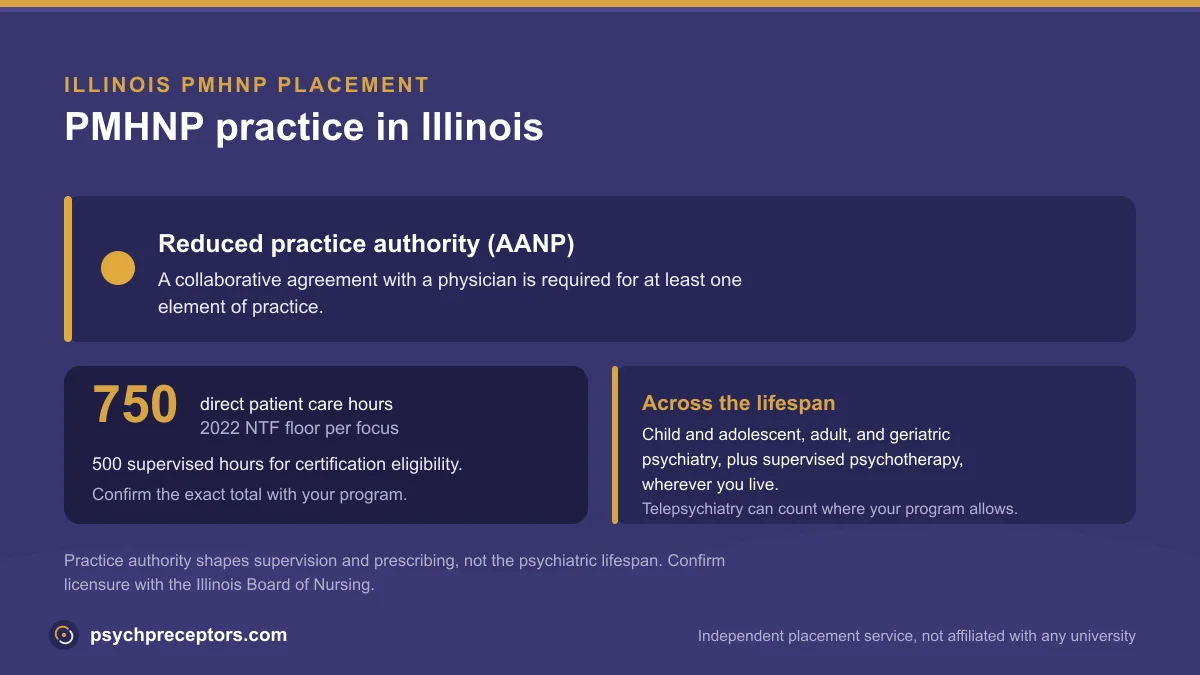
How Illinois practice authority shapes the prescribing arrangement
The American Association of Nurse Practitioners classifies Illinois as reduced practice, and the Illinois Department of Financial and Professional Regulation licenses nurses. Early in an APRN's career a written collaborative agreement with a physician sets the scope of practice, including which controlled substances the APRN may prescribe. APRNs practicing in a hospital, hospital affiliate, or ambulatory surgical treatment center work under facility privileges instead.
After completing at least 4,000 clinical hours and 250 hours of continuing education following national certification, an APRN can apply for full practice authority and then practice, including prescribing Schedule II through V medications, without a collaborative agreement. For you, this means a preceptor may be an independent full-authority PMHNP, an APRN working under a collaboration or hospital privileges, or a psychiatrist. Because PMHNPs prescribe heavily controlled medications, that arrangement matters, and a DEA registration is required in every case. It changes the supervision picture, not a good preceptor's core qualifications.
Chicago holds the capacity, downstate leans on telehealth
Metro Chicago, meaning Cook County plus DuPage, Lake, Will, and Kane with cities like Aurora, Naperville, and Elgin, holds most of the state's inpatient beds, academic psychiatry, and child specialists. Rockford, Peoria, Springfield, Champaign and Urbana, Bloomington and Normal, and Carbondale anchor the rest, but the gap is steep: rural counties average far fewer psychiatrists per resident than the state overall, and many downstate counties have no child psychiatrist at all.
That split defines a realistic Illinois search. In and around Chicago the task is matching you to the right subspecialty seat; downstate the task is distance, and telepsychiatry fills much of it. We plan around whichever problem is yours rather than assuming one answer fits the whole state.
The settings that host psychiatric rotations
Community mental health carries most PMHNP training here. Illinois has expanded its certified community behavioral health clinics, which braid psychiatry, therapy, crisis, and addiction services under one roof and make strong training sites. Federally qualified health centers with integrated behavioral health, private psychiatric and telepsychiatry practices, and large nonprofit providers round out the outpatient options.
For inpatient and acute hours, the state operates psychiatric hospitals including Chicago-Read and Madden in the Chicago area and others downstate, alongside psychiatric units inside general hospitals. Forensic and correctional psychiatry, substance use and medication-assisted treatment programs, and Veterans Affairs behavioral health add settings that document distinct parts of your requirement.
Child and adolescent psychiatry, the hardest seat
The PMHNP track is across the lifespan, so you need child and adolescent, adult, and geriatric psychiatry plus supervised psychotherapy in at least two modalities. Adult hours are plentiful in Illinois. Child and adolescent psychiatry is the tight one: the specialists cluster in Chicago's academic and children's hospital programs, and most downstate counties report none, so demand for those rotations runs high.
Geriatric psychiatry is often thin too and tends to arrive through consultation in long-term care and general hospitals. We book the scarce blocks first. Our child and adolescent and lifespan rotation pages describe how the hours fit together.
Psychotherapy, medication management, and addiction hours
Your supervised psychotherapy hours, in at least two modalities, usually come from outpatient community mental health and private practice caseloads, sometimes by telehealth. Medication management threads through nearly every setting, so those hours build quickly once you are placed.
If your program wants a separate psychotherapy or substance use block documented on its own, tell us at the start so we target sites that record them that way. For an Illinois rotation, the current program decides whether telehealth or simulation is permitted and how either is classified, supervised, documented, and applied. Confirm the current program rule and any applicable state requirements before relying on either format.
Start your Illinois preceptor search
Send us your program's requirements, your part of Illinois, and your timeline, and we will map the hours onto real sites and start sourcing preceptors. We are an independent service that assists with matching; we do not guarantee a placement or your school's approval of any preceptor or site.
Start with the match form on this page or reach us through contact, and tell us whether you are searching in the Chicago metro or downstate so we plan the right way.
Good to know
Can a nurse practitioner precept me in Illinois, or do I need a psychiatrist?
Either can work. An APRN with full practice authority can precept and prescribe independently, and an APRN under a collaborative agreement or hospital privileges can too. Your program sets the rule, so confirm whether it accepts a PMHNP preceptor or requires a psychiatrist for part of your hours.
What is the 4,000-hour rule about?
It is the Illinois path from reduced to full practice. After at least 4,000 clinical hours and 250 continuing education hours past national certification, an APRN can apply for full practice authority and then practice without a collaborative agreement. It affects your preceptor's independence, not your eligibility to train.
Do downstate students have to travel to Chicago?
Not necessarily. Metro Chicago holds most subspecialty capacity, but community clinics and telepsychiatry cover much of downstate. We plan around drive time and supervised telehealth so you are not forced into a citywide move.
How many clinical hours does a PMHNP program require?
The 2022 NTF Standards recommend at least 750 direct patient care hours per nurse practitioner population focus. ANCC and AANPCB eligibility sources separately use at least 500 faculty-supervised clinical hours. These figures serve different purposes and do not form a typical program range. Named programs vary and control the exact total and distribution, so confirm current requirements with your program.
Cover every rotation, not just the easy ones
Tell us your PMHNP program, your city, and the rotations you still need. We will come back with a plan for the full psych lifespan and a realistic path to placed.