Match with a PMHNP preceptor in Colorado
Colorado is a full practice authority state, so an experienced psychiatric-mental health nurse practitioner can precept you and hold independent prescriptive authority without a physician on the paperwork. We are an independent service that helps PMHNP students at any university find psychiatric preceptors across the state, and this page maps where those rotations actually happen. We assist with the search; we do not guarantee a placement or your program's approval of any site.
Where PMHNP rotations happen in Colorado
Most psychiatric training capacity sits along the Front Range, the urban strip that runs from Fort Collins and Greeley through Boulder and the Denver metro down to Colorado Springs and Pueblo. This is where you find the deepest pool of outpatient psychiatry, hospital-based units, and the community mental health centers coordinated through the state Behavioral Health Administration.
The settings that most often host PMHNP students here include:
- community mental health centers and Certified Community Behavioral Health Clinics that carry crisis lines, walk-in access, and large Medicaid caseloads;
- inpatient and acute psychiatric units in general hospitals and the state hospital system;
- addiction and substance use programs, including office-based buprenorphine and opioid treatment clinics;
- private and group psychiatric practices, many running hybrid in-person and telehealth panels;
- correctional and forensic psychiatry, veterans' behavioral health, and school or campus counseling services.
The Front Range and everywhere else
Outside the Front Range, the map thins fast. The Western Slope leans on hubs like Grand Junction, Montrose, and Durango; the mountain resort valleys and the Eastern Plains have far fewer prescribers, and much of rural Colorado carries a federal Mental Health Professional Shortage Area designation.
For students, that has two practical effects. Placements are easier to arrange near Denver, and rural rotations frequently run partly or fully by telehealth, with a preceptor who may sit in a metro office while seeing patients hours away.
Lifespan rotations and the child psychiatry squeeze
PMHNP is an across-the-lifespan credential, so your hours need to span child and adolescent, adult, and geriatric psychiatry, plus supervised psychotherapy in at least two modalities. Adult rotations are the easiest to fill in Colorado; the harder ones are predictable.
Child and adolescent psychiatry is the tightest rotation in the state, clustered in Denver-area children's hospital programs and a handful of academic clinics, so early planning matters. Geriatric psychiatry is thinner than adult work and often lives inside memory-care, long-term-care, and consultation settings. Adult and substance use rotations are widely available, the latter reflecting Colorado's ongoing response to fentanyl and stimulant use.
Telepsychiatry and how your hours count
Telepsychiatry is not a side note in Colorado, it is how a large share of care reaches the mountains and the plains. For a Colorado rotation, the current program decides whether telehealth or simulation is permitted and how either is classified, supervised, documented, and applied. Confirm the current program rule and any applicable state requirements before relying on either format.
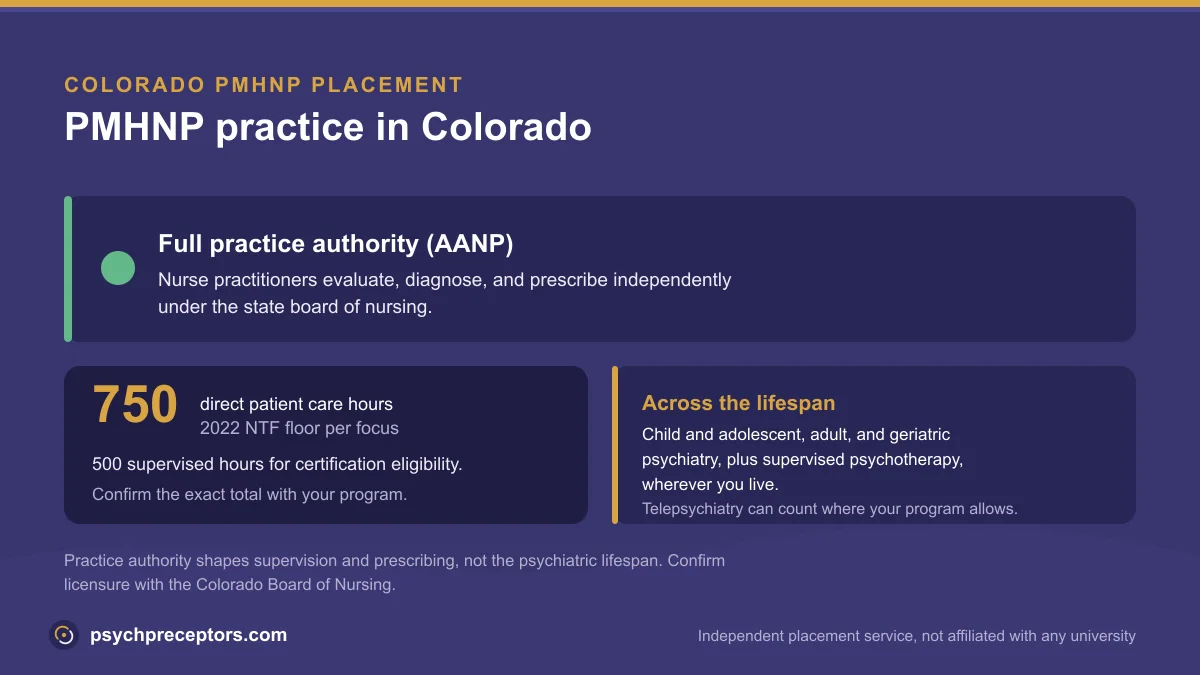
The 2022 NTF Standards recommend at least 750 direct patient care hours per nurse practitioner population focus. ANCC and AANPCB eligibility sources separately use at least 500 faculty-supervised clinical hours. These figures serve different purposes and do not form a typical program range. Named programs vary and control the exact total and distribution, so confirm current requirements with your program. See PMHNP clinical hours for source context.
What full practice authority changes for your preceptor
Colorado grants full practice authority, so an experienced PMHNP who is board certified can serve as your preceptor and hold independent prescriptive authority, including for the controlled psychiatric medications that define this specialty. A separate DEA registration is still required to prescribe controlled substances, as it is in every state.
One Colorado wrinkle is worth knowing: nurse practitioners move from a provisional prescriptive status to full prescriptive authority after a mentored prescribing period, so a preceptor's exact prescriptive standing can vary by career stage. That shapes who can precept independently, not the core qualifications of a preceptor, who is generally a board-certified PMHNP or a board-certified psychiatrist. Licensing sits with the Colorado Board of Nursing within the Department of Regulatory Agencies. See preceptor requirements.
How we match you in Colorado
When you tell us your city, your program's required hours, and the rotations you still need, we search our Colorado contacts for a board-certified psychiatric preceptor who fits, then hand you a match to run past your faculty for approval. We do the legwork and never guarantee placement or your school's sign-off.
Ready to start? Share your details at the match form or through find a preceptor, and see how it works and cost.
Good to know
Do I have to find my own PMHNP preceptor in Colorado?
Many programs put that on the student, which is why we exist. You can search on your own, but we keep psychiatric contacts across the Front Range and rural Colorado and try to match you to a board-certified preceptor with current openings. Your school still approves the final site.
Does full practice authority mean a psychiatrist cannot precept me?
No. Full practice authority is about how a PMHNP can practice independently; it does not narrow who may teach you. A board-certified PMHNP or a board-certified psychiatrist can both serve as your preceptor, and some programs also accept other qualified behavioral-health prescribers.
How many clinical hours will my Colorado program require?
The 2022 NTF Standards recommend at least 750 direct patient care hours per nurse practitioner population focus. ANCC and AANPCB eligibility sources separately use at least 500 faculty-supervised clinical hours. These figures serve different purposes and do not form a typical program range. Named programs vary and control the exact total and distribution, so confirm current requirements with your program.
Do telehealth psychiatry hours count in Colorado?
Your current program decides whether telehealth or simulation is permitted and how either is classified, supervised, documented, and applied. Confirm the current program rule and any applicable state requirements before relying on either format. Confirm the specifics with your program.
Can you place me in child and adolescent psychiatry in Colorado?
We try, though it is the hardest rotation to fill here because pediatric psychiatry concentrates in Denver-area children's and academic settings. Tell us early and we work the child, adolescent, and geriatric pieces first, since those close fastest.
Cover every rotation, not just the easy ones
Tell us your PMHNP program, your city, and the rotations you still need. We will come back with a plan for the full psych lifespan and a realistic path to placed.