PMHNP rotations and preceptors in West Virginia
West Virginia sits at the center of the opioid epidemic, and that shapes its behavioral-health system and the rotations a PMHNP student will find, with abundant addiction care, stretched general psychiatry, and some of the scarcest child psychiatry in the country. This page maps where psychiatric-mental-health nurse practitioner students rotate across the state, which settings host them, and how West Virginia's reduced-practice rules affect your preceptor. We place students from any university.
A behavioral-health landscape shaped by the opioid crisis
No state has been hit harder by opioids, and the treatment system reflects it. Opioid treatment programs and office-based buprenorphine clinics operate in Charleston, Huntington, and other population centers, and substance-use care is woven through nearly every community behavioral health center. For a PMHNP student, that means substance-use and addiction hours are among the easiest to arrange here, and they are some of the most formative training you can get.
Because so many patients present with co-occurring depression, anxiety, trauma, and stimulant or opioid use, addiction settings in West Virginia double as strong general psychiatry and medication-management training, not a narrow niche.
Cities and regions where rotations sit
Clinical capacity clusters in a few anchors. Charleston, the capital in the Kanawha Valley, has the largest concentration of hospitals and behavioral health services. Huntington, on the Ohio River, pairs a medical school and health system with heavy addiction-treatment infrastructure. Morgantown, in the north, is the state's academic medical hub and home to a dedicated psychiatric hospital.
Beyond those, Wheeling in the northern panhandle, Martinsburg in the eastern panhandle with its Veterans Affairs medical center, and smaller centers like Beckley, Parkersburg, and Clarksburg carry regional care. The southern coalfields and the many rural counties between them are among the most underserved in the nation, and reach a prescriber mainly by telehealth.
West Virginia reports that fifty of its fifty-five counties are federally designated mental health professional shortage areas, so outside the anchor cities, supply is genuinely tight.
Which settings host students
PMHNP rotations in West Virginia generally sit in these settings:
- Comprehensive community behavioral health centers, the backbone of public mental health, plus certified community behavioral health clinics
- Opioid treatment programs and office-based medication-assisted treatment
- Inpatient psychiatry, including two state psychiatric hospitals and academic and private units
- Academic psychiatry connected to the medical schools in Morgantown and Huntington
- Veterans Affairs mental health, including the Martinsburg, Huntington, Clarksburg, and Beckley systems
- Telepsychiatry groups serving rural counties
- Correctional and forensic psychiatry
- Crisis services and mobile response
Most students combine an outpatient or community site with an addiction block, and add inpatient exposure where a hospital unit is within reach.
The lifespan span and a real child-psychiatry gap
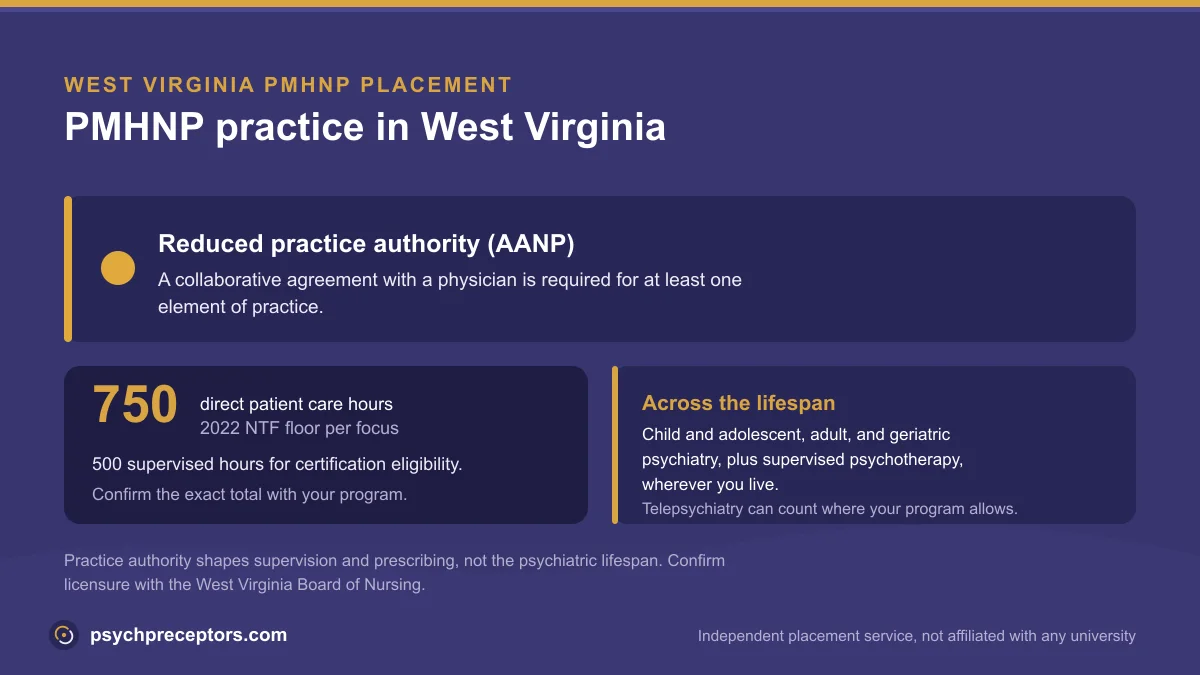
Your hours must cover child and adolescent, adult, and geriatric psychiatry plus supervised psychotherapy. Adult and addiction hours are workable in most regions. The genuine bottleneck is child and adolescent psychiatry: West Virginia has among the lowest per-capita counts of child and adolescent psychiatrists in the country, and families have historically driven two to four hours each way to reach one.
Where a child rotation exists, it tends to sit in the academic programs around Morgantown, Huntington, and Charleston, or it runs by telepsychiatry. Geriatric psychiatry is thin as well and often comes through long-term-care consultation. We plan the youth rotation first, because in this state it is the one most likely to stall a timeline.
Telepsychiatry across the mountains
In a rugged, rural state, telepsychiatry has moved from stopgap to backbone. For a West Virginia rotation, the current program decides whether telehealth or simulation is permitted and how either is classified, supervised, documented, and applied. Confirm the current program rule and any applicable state requirements before relying on either format.
That also lets us bridge distance. A student in a southern county can train with a preceptor based in Charleston or Morgantown by video when licensure and your program's site rules allow, which we confirm before finalizing a match.
How reduced practice shapes your preceptor arrangement
The AANP classifies West Virginia as a reduced-practice state. A nurse practitioner prescribes under a collaborative agreement with a physician, and after at least three years of documented collaborative practice with prescriptive authority, can apply to prescribe without that agreement. Controlled-substance prescribing requires a DEA registration in every case.
For your training, this shapes the arrangement rather than the teaching. Your preceptor is a board-certified PMHNP or a psychiatrist licensed in West Virginia. If the PMHNP is newer, a collaborating physician is part of the practice, which is routine in psychiatric and addiction settings; a more experienced PMHNP may already prescribe independently. See preceptor requirements for details.
Getting matched in West Virginia
Tell us your region, your program's required hours, and the rotations you still need. We work the state's real supply, the comprehensive behavioral health centers, the addiction and opioid-treatment programs, the academic and inpatient units, and the telepsychiatry groups, to find a qualified preceptor. We assist with placement and are honest about what is hard to source, especially child psychiatry; we do not guarantee your school's approval of a site. Start at the match form or read how it works.
Good to know
Is it easy to get an addiction or substance-use rotation in West Virginia?
Comparatively, yes. The state's opioid crisis has built out medication-assisted treatment and opioid treatment programs in Charleston, Huntington, and beyond, and substance-use care runs through most community behavioral health centers. These sites often double as strong general psychiatry and medication-management training because so many patients have co-occurring conditions.
Why is child psychiatry so hard to find here?
West Virginia has among the fewest child and adolescent psychiatrists per capita in the country, and most are clustered in the academic programs near Morgantown, Huntington, and Charleston. Rural families often reach one only by telehealth. Because it is the scarcest rotation, we secure your child and adolescent hours first.
How does reduced practice affect my preceptor?
It affects the prescribing arrangement, not your preceptor's qualifications. A newer PMHNP prescribes under a collaborative agreement with a physician; after three documented years, they can apply to prescribe independently. Your preceptor is a West Virginia-licensed, board-certified PMHNP or a psychiatrist, and controlled-substance prescribing always requires a DEA registration.
Do telepsychiatry hours count toward my requirement?
Your current program decides whether telehealth or simulation is permitted and how either is classified, supervised, documented, and applied. Confirm the current program rule and any applicable state requirements before relying on either format. Confirm the specifics with your own program, since modality and site rules differ by school.
Cover every rotation, not just the easy ones
Tell us your PMHNP program, your city, and the rotations you still need. We will come back with a plan for the full psych lifespan and a realistic path to placed.