Your PMHNP clinical hours, placed across South Dakota
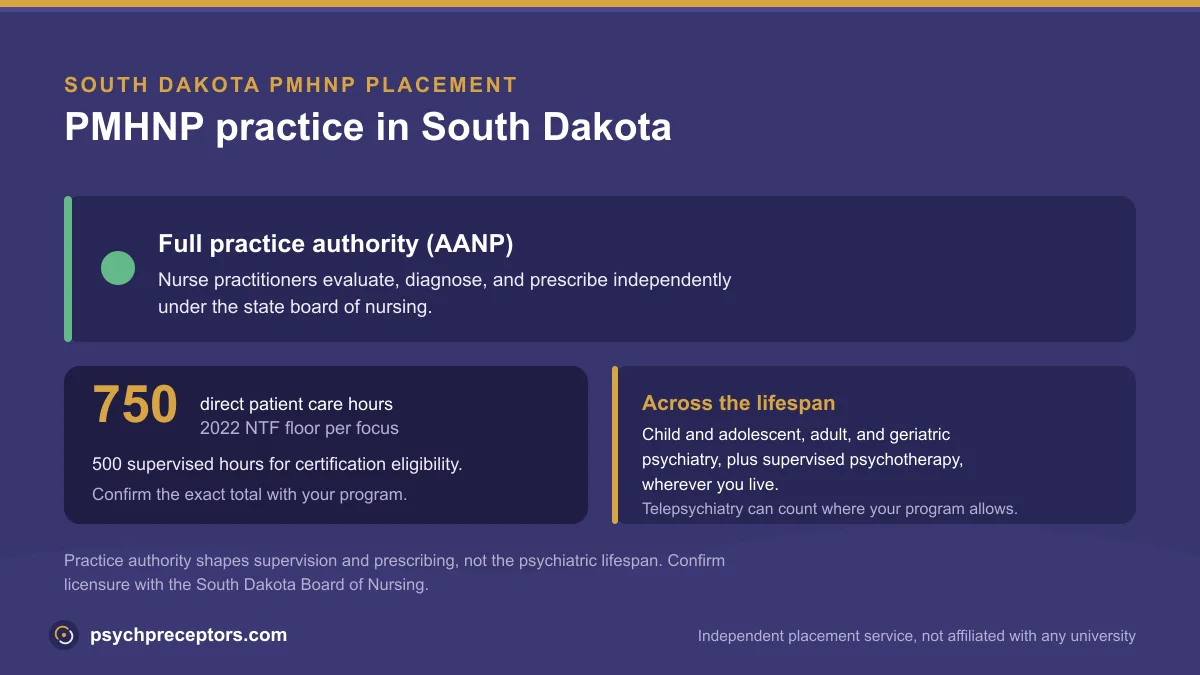
South Dakota gives PMHNP students full practice authority and a small, spread out behavioral-health system, which means your psychiatric hours cluster in a few places and travel a long way in between. The settings that host students here are community mental health centers, the state psychiatric hospital, tribal and Indian Health Service behavioral health, and a growing amount of telepsychiatry. We help you line up each stage of the psychiatric lifespan with a qualified preceptor, wherever in the state you live.
Where PMHNP students actually train in South Dakota
Two cities anchor psychiatric care in South Dakota. Sioux Falls in the east holds most of the inpatient psychiatric beds, the largest concentration of prescribers, and nearly all of the child psychiatry capacity. Rapid City, on the far western side near the Black Hills, is the only other real hub, and the roughly 350 miles between them is some of the emptiest country in the region. The state psychiatric hospital sits in Yankton, in the southeast, and runs one of the few dedicated adolescent inpatient units in the state.
The settings that most often host PMHNP students here include:
- community mental health centers that carry the public caseload across several counties each,
- the state psychiatric hospital and hospital-based psychiatric units for inpatient and acute hours,
- Indian Health Service and tribal behavioral-health programs on the reservations,
- addiction and medication assisted treatment programs, where methamphetamine and alcohol drive much of the demand,
- outpatient private psychiatry, telepsychiatry groups, and Veterans Affairs behavioral health.
The East River and West River divide, and the frontier between
South Dakotans talk about the state in two halves, East River and West River, split by the Missouri River. Nearly every county is federally designated as a mental health professional shortage area, in whole or in part, and the frontier counties in the center and west may have no psychiatric prescriber at all. That is why so much psychiatric care here, and a large share of precepted PMHNP hours, is delivered by telepsychiatry.
For a South Dakota rotation, the current program decides whether telehealth or simulation is permitted and how either is classified, supervised, documented, and applied. Confirm the current program rule and any applicable state requirements before relying on either format. See our overview of PMHNP clinical hours for how the pieces add up.
Tribal and reservation behavioral health
South Dakota is home to nine tribal nations and several of the largest reservations in the country, and their behavioral-health needs are significant. Indian Health Service and tribally operated programs deliver psychiatric assessment, therapy, crisis response, and substance-use care to these communities, often over long distances and with heavy use of telehealth.
A rotation in this setting asks for cultural humility and an understanding of historical trauma, and it can be some of the most meaningful psychiatric training available anywhere in the state. Placements in tribal settings follow the hosting program's own credentialing, so we confirm what each site expects before we propose it, and we never promise access a program has not agreed to.
Child, adolescent, and geriatric rotations across the lifespan
Your PMHNP program is an across-the-lifespan track, so your hours have to reach children and adolescents, adults, and older adults, plus supervised psychotherapy in at least two modalities. Child and adolescent psychiatry is the hardest of these to secure in South Dakota, because that expertise sits almost entirely in Sioux Falls and, to a lesser degree, Rapid City.
Geriatric psychiatry is more findable given the state's aging rural population, often through long-term care, memory clinics, and psychiatry linked to rural primary care. We plan the scarce blocks first, and we treat a child and adolescent psych rotation and your psychotherapy hours as the parts of the calendar to lock down early.
What full practice authority means for your preceptor here
South Dakota is a full practice authority state, so an experienced Psychiatric-Mental Health Nurse Practitioner can diagnose, treat, and prescribe, including controlled psychiatric medications, under the state Board of Nursing rather than under a physician. That matters for you because a seasoned PMHNP can serve as your preceptor and hold independent prescriptive authority, and any controlled-substance prescribing still requires that clinician's own DEA registration.
One local wrinkle: newly licensed nurse practitioners in South Dakota complete a period of collaborative practice before they move to full independence, so most PMHNP preceptors are clinicians well past that early stage, or board-certified psychiatrists. A preceptor is generally a board-certified PMHNP (PMHNP-BC) or a psychiatrist, and your school sets the final rules. Our preceptor requirements page explains what to look for.
How we place your South Dakota rotations
Tell us your PMHNP program, the city or county you can reach, and the rotations you still need, and we will map a realistic path across the whole lifespan, starting with the child and adolescent and inpatient hours that take the longest to secure. We source and vet preceptors and clinical sites for students at any university, and you can see what that costs on our pricing page. When you are ready, start your placement plan and a psychiatric-trained advisor will follow up.
Good to know
Can I complete PMHNP hours in South Dakota mostly by telehealth?
Often a large share, yes. Your current program decides whether telehealth or simulation is permitted and how either is classified, supervised, documented, and applied. Confirm the current program rule and any applicable state requirements before relying on either format. Most students still mix in some in-person time, especially for inpatient and child and adolescent work, but a telepsychiatry rotation can be a dependable backbone. Confirm any telehealth limits with your own program.
Is South Dakota a full practice state for PMHNPs?
Yes. South Dakota grants full practice authority, so an experienced PMHNP can evaluate, diagnose, and prescribe, including controlled substances with a personal DEA registration, under the Board of Nursing. Newly licensed nurse practitioners first complete a period of collaborative practice, which is why most preceptors are established PMHNPs or psychiatrists.
Which rotation should I worry about first here?
Child and adolescent psychiatry. That capacity is concentrated in Sioux Falls and, to a smaller degree, Rapid City, so it fills quickly. We plan those blocks first and build the rest of your lifespan hours around them.
Do you place students on the reservations or in tribal programs?
We can explore it. Indian Health Service and tribal behavioral-health programs are a real part of South Dakota's landscape and can offer rich psychiatric training, but each site sets its own credentialing and access rules. We confirm what a given program expects before proposing it, and we never promise a placement a site has not agreed to.
Do I have to find my own preceptor for a South Dakota program?
Whether you need to identify a preceptor depends on your program. Confirm its current placement process and approval rules. If independent sourcing is permitted, we can help identify candidates and sites for program review, without guaranteeing a match or approval. Reach us through contact to start.
Cover every rotation, not just the easy ones
Tell us your PMHNP program, your city, and the rotations you still need. We will come back with a plan for the full psych lifespan and a realistic path to placed.