PMHNP preceptor planning for University of Pittsburgh
The verified program sources for University of Pittsburgh directly support a current PMHNP pathway. If current instructions permit or require the student to propose a preceptor or site, our independent team can prepare a candidate for program review by University of Pittsburgh. The school remains the approval authority, and no match, approval, hours, course completion, or other outcome is guaranteed.
What PMHNP pathway does University of Pittsburgh currently list?
- Program: Psychiatric-Mental Health Nurse Practitioner (PMHNP)
- School: University of Pittsburgh
- Directory identity: Pennsylvania, Pennsylvania (PA)
- Evidence-bound pathways: MSN
- Evidence checked: July 21, 2026
- Approval authority: University of Pittsburgh
- MSN: official University of Pittsburgh source
This directory entry rests on official current evidence for MSN at University of Pittsburgh. The source is suitable for identifying the PMHNP pathway, not for filling gaps about modality, admission, tuition, length, clinical totals, rotation sequence, authorized states, site eligibility, or student proposals. Those questions need direct confirmation from the active program.
Confirm every unrecorded requirement with the current program. The current program makes every approval decision.
When can independent PMHNP placement support apply?
Programs use different placement processes, and an official PMHNP page does not reveal which process applies to a particular student or course. Ask whether University of Pittsburgh coordinates the placement, permits a student proposal, requires a proposal, or uses another arrangement. Outside outreach should begin only after the student has current written instructions authorizing that step.
Build the request from current documents, not memory. The student should supply the pathway, course, objectives, population, dates, approved area, acceptable candidate role, site criteria, paperwork, and review sequence. When a rule is absent, ask University of Pittsburgh; do not borrow a requirement from a different institution or an earlier term.
Who approves a PMHNP preceptor and clinical site?
A willing clinician is only a possible candidate. University of Pittsburgh must decide whether the person's license, certification, psychiatric practice, patient population, experience, availability, supervision plan, conflicts, and documentation fit the current course. The program must also approve the organization, setting, location, affiliation arrangements, compliance items, and any required agreements.
For many psychiatric practicum searches, a board-certified PMHNP or psychiatrist is a logical candidate to screen, provided the practice fits the course. That is a planning category, not a statement of University of Pittsburgh eligibility. Any other profession, specialty, or role should be considered only when current school instructions expressly permit it.
How should students plan psychiatric care across the lifespan?
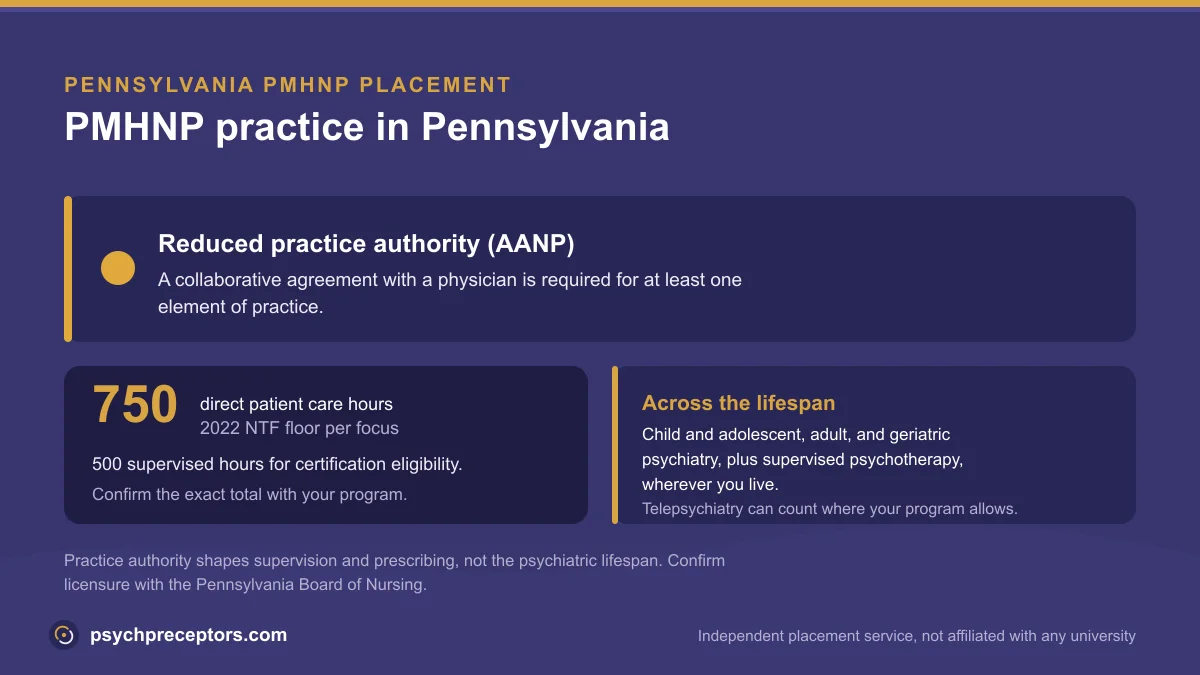
PMHNP preparation is psychiatric care across the lifespan, so planning should test access to child and adolescent, adult, and older-adult populations. Students may also need experiences involving psychotherapy, medication management, substance-use care, acute or inpatient care, outpatient care, or community behavioral health. These are planning categories only; University of Pittsburgh sets the actual sequence and distribution.
Use setting names as search vocabulary, not as approval claims. An outpatient clinic, inpatient service, community behavioral health organization, substance-use program, integrated practice, private office, or telepsychiatry group is merely a possibility until University of Pittsburgh confirms course fit, patient access, supervision, geography, affiliation, and compliance.
These are planning categories: child and adolescent, adult, and older-adult psychiatric care, plus psychotherapy, medication management, substance-use care, inpatient or acute care, outpatient care, and community behavioral health. They are not a claim that every school uses the same requirements, sequence, or distribution.
How should University of Pittsburgh students confirm clinical hours?
The official pathway evidence does not establish clinical hours. The student needs University of Pittsburgh's current requirement for the exact pathway and course, including how the total is distributed and recorded. Avoid estimates drawn from another program, credential, or catalog year. A search brief should use only the figures and categories the active program confirms.
How does location affect a PMHNP proposal in Pennsylvania?
Pennsylvania, Pennsylvania is identity context for University of Pittsburgh, not evidence of delivery or clinical eligibility. Ask the program which locations are permitted for the student's pathway and term. For a broader view of psychiatric settings, read the PMHNP guide for Pennsylvania, then apply only the geography and site criteria University of Pittsburgh confirms.
What belongs in an approval-ready candidate file?
Documentation should show why a candidate appears relevant without calling the candidate approved. Record credentials, psychiatric role, practice population, setting, dates, availability, oversight, conflicts, site participation, and paperwork status. Map those facts to each course objective and use University of Pittsburgh's own forms so reviewers can apply the current requirements efficiently.
How can Psych Preceptors support University of Pittsburgh students?
If the active course permits or requires a student-proposed candidate, see how independent sourcing works. We use the confirmed objectives and eligibility rules to identify a possible person or site and assemble evidence for review. The process does not bypass the school. A prepared student can request planning support here.
Psych Preceptors is an independent service that works separately from, endorsed by, approved by, or acting for University of Pittsburgh. The school name identifies the student's program context. We cannot approve a clinician or site and do not guarantee a match, availability, acceptance, hours, course completion, certification, licensure, graduation, or any other outcome.
Good to know
When can independent PMHNP placement support apply to University of Pittsburgh students?
Only when the student's current PMHNP program permits or requires a student-proposed preceptor or clinical site. Psych Preceptors can identify and document a possible candidate for program review, while University of Pittsburgh makes every approval decision.
Which PMHNP pathways are verified for University of Pittsburgh?
The current compact evidence supports MSN. Follow the visible official source links and confirm the active award, pathway, and requirements directly with the program.
How many PMHNP clinical hours does University of Pittsburgh require?
This page does not assign a total. Confirm the exact current requirement, course distribution, populations, activities, supervision, and documentation with the program's handbook, degree audit, course instructions, and placement office.
Does a PMHNP or psychiatrist automatically qualify as a preceptor?
No. A title or license alone does not establish eligibility. The program must approve the clinician, practice, patient population, setting, location, supervision plan, affiliation documents, compliance items, and paperwork.
Is Psych Preceptors affiliated with University of Pittsburgh?
No. Psych Preceptors is an independent service that works separately from, endorsed by, approved by, or acting for University of Pittsburgh. It does not guarantee a match, approval, hours, course completion, certification, licensure, graduation, or another outcome.
Cover every rotation, not just the easy ones
Tell us your PMHNP program, your city, and the rotations you still need. We will come back with a plan for the full psych lifespan and a realistic path to placed.