PMHNP preceptor planning for Texas State University
Texas State University currently identifies a Psychiatric-Mental Health Nurse Practitioner pathway in official program material. Independent help applies only if the student's active program permits or requires a proposed preceptor or site. We can source and document a candidate for program review, but Texas State University decides whether the person, setting, location, supervision plan, and paperwork satisfy its current requirements.
What PMHNP pathway does Texas State University currently list?
- Program: Psychiatric-Mental Health Nurse Practitioner (PMHNP)
- School: Texas State University
- Directory identity: Round Rock, Texas (TX)
- Evidence-bound pathways: Post-Graduate Certificate
- Evidence checked: July 21, 2026
- Approval authority: Texas State University
- Post-Graduate Certificate: official Texas State University source
Our evidence review found official Texas State University material for Post-Graduate Certificate. Those pathway labels are intentionally narrow and link directly to the pages that support them. Students should use the current catalog, handbook, course instructions, and program contact to confirm every detail that the compact record does not contain, including delivery, eligibility, dates, costs, hours, and placement procedures.
Confirm every unrecorded requirement with the current program. The current program makes every approval decision.
When can independent PMHNP placement support apply?
The first operational question is not who might precept. It is whether the active Texas State University course allows the student to propose anyone. Confirm the placement route, submission method, geography, timing, and required documents directly with the program. Independent sourcing begins only inside that confirmed boundary and never replaces school coordination.
Build the request from current documents, not memory. The student should supply the pathway, course, objectives, population, dates, approved area, acceptable candidate role, site criteria, paperwork, and review sequence. When a rule is absent, ask Texas State University; do not borrow a requirement from a different institution or an earlier term.
Who approves a PMHNP preceptor and clinical site?
Candidate interest does not equal program acceptance. Texas State University reviews the clinician and site against its current academic, credential, population, supervision, geography, compliance, and affiliation standards. Site participation may involve a separate review. Until every required approval is complete, describe the person and location as proposed rather than placed or approved.
Start candidate screening with the exact role named by the program. A board-certified PMHNP or psychiatrist may be possible when the clinician's practice, population, and supervision fit the course, yet Texas State University still controls eligibility. Do not assume that credentials, prior teaching, or willingness alone make a candidate acceptable.
How should students plan psychiatric care across the lifespan?
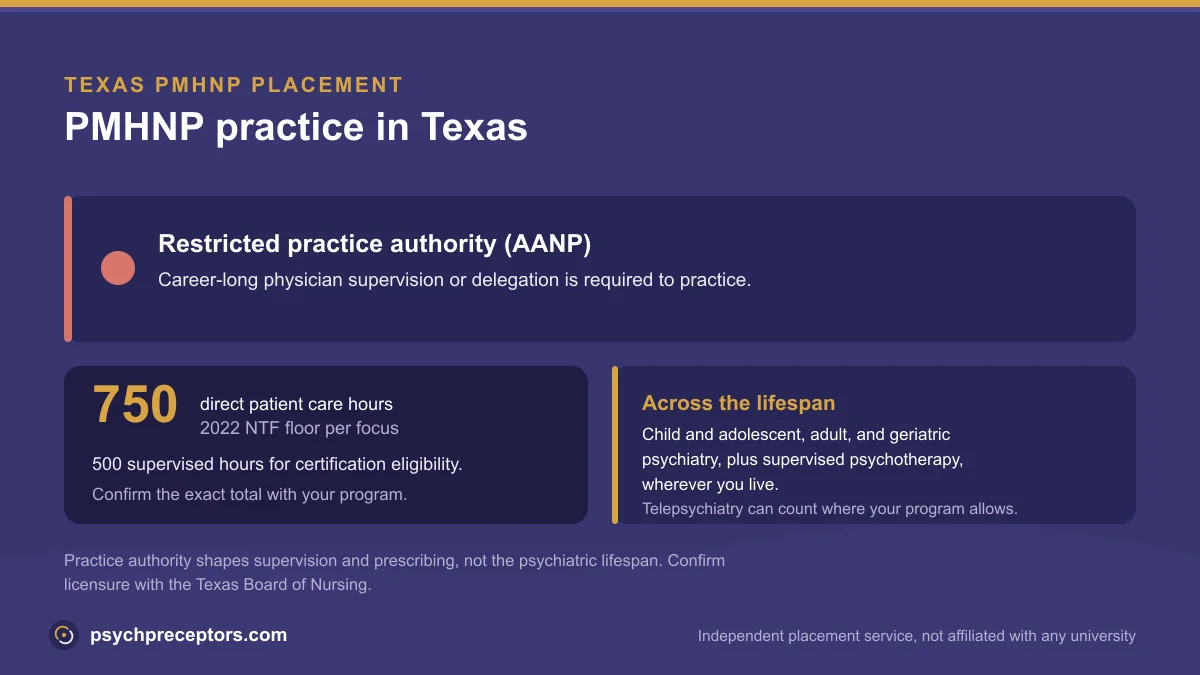
Across-the-lifespan PMHNP planning asks which populations and psychiatric activities the active courses require. That can include children and adolescents, adults, older adults, psychotherapy, medication management, co-occurring substance use, inpatient or acute work, outpatient care, and community settings. This list describes possible planning dimensions, not a promised Texas State University curriculum or rotation order.
Search categories may span acute and inpatient psychiatry, outpatient care, community services, private practice, integrated behavioral health, substance-use treatment, or telepsychiatry. None is represented here as accepted by Texas State University. Current program review must cover the site, patient mix, student activities, supervision, location, agreements, and compliance obligations.
These are planning categories: child and adolescent, adult, and older-adult psychiatric care, plus psychotherapy, medication management, substance-use care, inpatient or acute care, outpatient care, and community behavioral health. They are not a claim that every school uses the same requirements, sequence, or distribution.
How should Texas State University students confirm clinical hours?
The official pathway evidence does not establish clinical hours. The student needs Texas State University's current requirement for the exact pathway and course, including how the total is distributed and recorded. Avoid estimates drawn from another program, credential, or catalog year. A search brief should use only the figures and categories the active program confirms.
How does location affect a PMHNP proposal in Texas?
A school address and a student's approved practicum area are different facts. Although this directory associates Texas State University with Round Rock, Texas, the program must confirm state authorization, licensure, location, affiliation, and site boundaries. The Texas PMHNP overview can support local research but cannot approve a proposal.
What belongs in an approval-ready candidate file?
An approval-ready file connects the current course to a specific clinician and organization. Include the candidate's role, active credentials, specialty certification, relevant practice, patient populations, location, availability, supervision plan, conflicts, and willingness to complete requested forms. Add site contacts, setting details, affiliation status, compliance materials, and the exact Texas State University submission documents.
How can Psych Preceptors support Texas State University students?
Independent support begins after proposal permission and requirements are verified. Through the placement workflow, we search against the program's actual population, role, setting, location, schedule, and document criteria. A candidate remains proposed until the school and site finish review. Start at the request form with the current instructions.
This page is independent of Texas State University and does not speak for its nursing program. Psych Preceptors works independently of the institution, has no approval authority, and cannot waive any requirement. Candidate sourcing never guarantees availability, placement, site participation, school approval, hours, progress, graduation, certification, or licensure.
Good to know
When can independent PMHNP placement support apply to Texas State University students?
Only when the student's current PMHNP program permits or requires a student-proposed preceptor or clinical site. Psych Preceptors can identify and document a possible candidate for program review, while Texas State University makes every approval decision.
Which PMHNP pathways are verified for Texas State University?
The current compact evidence supports Post-Graduate Certificate. Follow the visible official source links and confirm the active award, pathway, and requirements directly with the program.
How many PMHNP clinical hours does Texas State University require?
This page does not assign a total. Confirm the exact current requirement, course distribution, populations, activities, supervision, and documentation with the program's handbook, degree audit, course instructions, and placement office.
Does a PMHNP or psychiatrist automatically qualify as a preceptor?
No. A title or license alone does not establish eligibility. The program must approve the clinician, practice, patient population, setting, location, supervision plan, affiliation documents, compliance items, and paperwork.
Is Psych Preceptors affiliated with Texas State University?
No. Psych Preceptors is an independent service that works separately from, endorsed by, approved by, or acting for Texas State University. It does not guarantee a match, approval, hours, course completion, certification, licensure, graduation, or another outcome.
Cover every rotation, not just the easy ones
Tell us your PMHNP program, your city, and the rotations you still need. We will come back with a plan for the full psych lifespan and a realistic path to placed.