Placing PMHNP rotations across a state the size of Texas
Texas is a restricted practice state and one of the most under-served in the country for mental health, so the challenge is less about rules than about distance and scarcity. Your psychiatric hours will likely center on the big metros, the local mental health authorities, and a large amount of telepsychiatry reaching the border, the Panhandle, and the rural stretches in between. We help PMHNP students at any university line up preceptors for every stage of the lifespan, wherever in Texas they train.
A state the size of a region: metros and the space between
Texas has 254 counties and distances that behave like several states at once. Most psychiatric capacity sits in the four big metros, Houston, Dallas and Fort Worth, San Antonio, and Austin, with El Paso isolated far to the west and the Rio Grande Valley anchoring the south. Almost all of the counties in between are federally designated mental health professional shortage areas, many with no psychiatrist at all.
Where you live decides a great deal, so we plan around your home base rather than assume you can cross the state for a rotation.
Local mental health authorities, state hospitals, and academic hubs
Public behavioral health in Texas is organized through local mental health authorities, and around them sits a wide mix of training settings.
- local mental health authorities and community centers that carry the public caseload region by region,
- the state psychiatric hospital system, including forensic units, for inpatient and acute hours,
- academic medical centers and children's hospitals in the metros, where most child psychiatry lives,
- addiction and opioid treatment programs, and a large correctional and forensic psychiatry system,
- private psychiatry, telepsychiatry groups, and Veterans Affairs behavioral health in several large cities.
The border and the Rio Grande Valley: bilingual psychiatry
The border regions are their own placement world. In the Rio Grande Valley and around El Paso, most patients are more comfortable in Spanish, wait times for psychiatry can run for months, and the shortage of prescribers is among the deepest in the state.
For a bilingual PMHNP student, these are some of the highest-impact rotations in Texas, and the demand is constant. We flag language and community fit when we propose a border placement, because it changes how well a rotation works for both you and the patients.
Child and adolescent psychiatry, the scarcest rotation in Texas
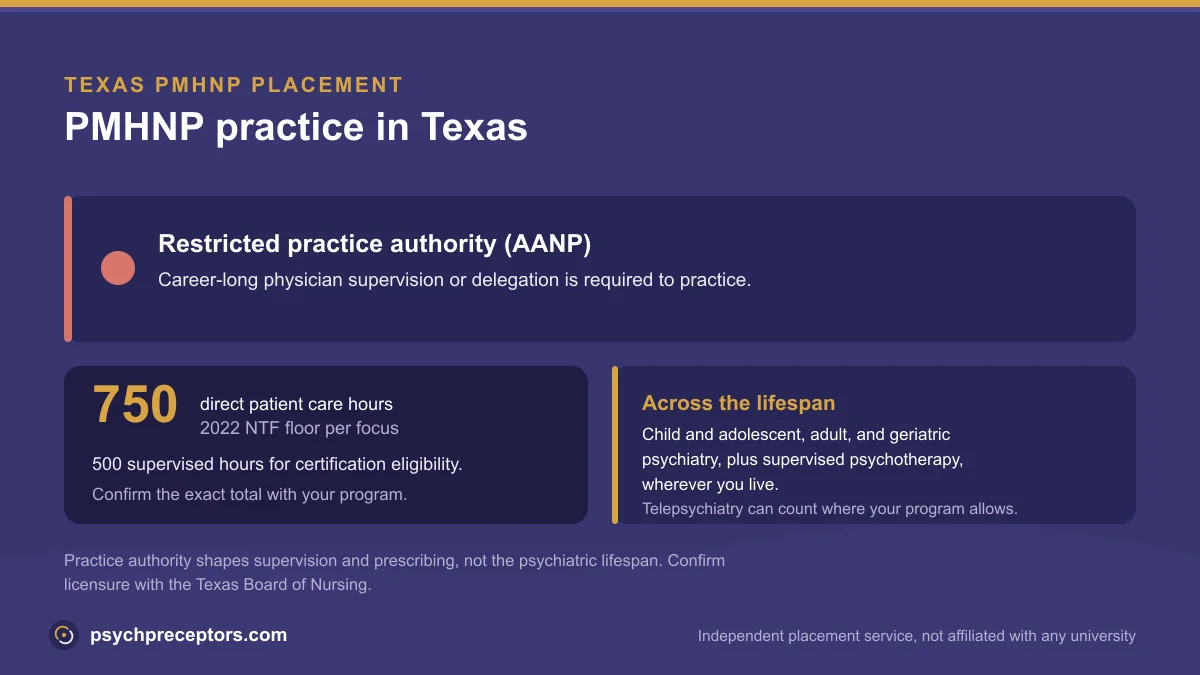
Your PMHNP hours must span children and adolescents, adults, and older adults, plus supervised psychotherapy in at least two modalities, and child and adolescent psychiatry is by far the hardest of these to secure in Texas. The state has only a fraction of the child psychiatrists it needs, and that capacity concentrates in the metro academic and children's-hospital settings.
Geriatric psychiatry is more reachable, through long-term care, geriatric clinics, and rural hospitals serving an aging population. We lock the child and adolescent block down first and plan your psychotherapy hours alongside it.
Telepsychiatry, correctional psychiatry, and addiction
Because so much of Texas is rural, telepsychiatry does a great deal of the work, and the state has invested in telepsychiatry to reach rural hospitals and clinics. For a Texas rotation, the current program decides whether telehealth or simulation is permitted and how either is classified, supervised, documented, and applied. Confirm the current program rule and any applicable state requirements before relying on either format.
Texas also has one of the largest correctional systems in the country, which makes correctional and forensic psychiatry a genuine training route, and the addiction crisis has expanded medication assisted treatment across the state. These widen your options well beyond the obvious outpatient clinic.
Restricted practice and the prescriptive authority agreement
Texas is a restricted practice state. A nurse practitioner prescribes under a prescriptive authority agreement with a delegating physician, and controlled-substance prescribing is limited, with the psychiatric medications a PMHNP uses generally falling in the schedules the agreement allows and tighter limits on the most controlled drugs. A personal DEA registration is still required for any controlled substance.
What this means for you is practical: a physician, often a psychiatrist, is part of the prescribing structure, either as your preceptor or behind a PMHNP preceptor. A preceptor is generally a board-certified PMHNP (PMHNP-BC) or a board-certified psychiatrist, and your program sets the final rules. The Texas Board of Nursing publishes the current requirements.
Building your Texas placement
Tell us your PMHNP program, your metro or region, and the rotations you still need, and we will map a plan that fits Texas practice rules and starts with the child and adolescent and inpatient hours that take longest to arrange. We serve students at any university, and you can see costs on our pricing page. When you are ready, start your placement plan and an advisor with psychiatric background will follow up.
Good to know
Is it hard to find a PMHNP preceptor in Texas?
The rules are manageable; the scarcity is the real challenge. Texas is short of psychiatric prescribers almost everywhere, and child and adolescent capacity especially concentrates in the metros. We plan the scarce blocks first and use telepsychiatry where it fits, so a single rotation does not stall your program.
Do bilingual students have an advantage on the border?
Yes. In the Rio Grande Valley and El Paso, Spanish-language skill makes a rotation far more effective and the need is constant. We note language fit when we propose border placements so the match works for you and for patients.
How does Texas's prescriptive authority agreement affect my preceptor?
It means a delegating physician, often a psychiatrist, is part of the prescribing structure, either as your preceptor or behind a PMHNP preceptor. It shapes the arrangement more than the quality of teaching. Your preceptor still needs to be licensed in Texas and practicing in psychiatry.
Can I do much of my training by telehealth in rural Texas?
Often a meaningful share. Your current program decides whether telehealth or simulation is permitted and how either is classified, supervised, documented, and applied. Confirm the current program rule and any applicable state requirements before relying on either format. Most students still add in-person time for inpatient and child work. Confirm telehealth limits with your school.
Do you promise a placement or my school's approval?
No. We source, vet, and secure qualified preceptors and sites, and we are honest about what each Texas market can support. We do not promise a placement a site has not agreed to, and only your program can approve a preceptor or site.
Cover every rotation, not just the easy ones
Tell us your PMHNP program, your city, and the rotations you still need. We will come back with a plan for the full psych lifespan and a realistic path to placed.