Building Your Psychiatric Rotation in Mississippi
Mississippi is a reduced practice state on the AANP State Practice Environment map, which means a psychiatric nurse practitioner here keeps a formal collaborative agreement with a physician throughout their career. The state's mental health system runs through regional community centers and a small set of state hospitals, and much of the map is rural and short on psychiatric prescribers. This page covers where PMHNP students actually place, how the collaborative agreement shapes supervision, and why telepsychiatry carries so much of the Delta and the rural counties.
The regional centers are the backbone
Public mental health in Mississippi is organized around regional community mental health centers, each run by a commission drawn from the counties it serves, offering outpatient care, crisis services, and substance use treatment. For a PMHNP student these regional centers are the most common home for a rotation, because they carry a broad diagnostic mix and steady medication management in areas where private psychiatry is scarce.
- Regional community mental health centers and their satellite clinics across the state's service areas.
- State psychiatric hospitals, which hold most of the acute and specialty inpatient beds.
- Certified Community Behavioral Health Clinic services, expanding through the regional system.
- Substance use and opioid treatment programs, including medication treatment for opioid use disorder.
- Private psychiatric practices and telepsychiatry groups, weighted toward Jackson and the larger towns.
- Veterans Affairs behavioral health and correctional psychiatry for students who clear the added steps.
State hospitals and where the acute and child beds sit
Mississippi concentrates its acute and specialty psychiatric capacity in a handful of state hospitals. The largest, near Jackson, runs several hundred psychiatric beds and includes adult acute and continued-treatment units, a forensic service, substance use units, and a dedicated child and adolescent building with separate units for younger children and for teenagers. A second state hospital in the east serves the Meridian region.
For a student that concentration cuts both ways. Inpatient and child psychiatry hours exist, but they sit in specific places rather than being spread across the state, so reaching them can mean travel. Jackson's academic medical center also anchors a child psychiatry access program that supports primary care clinicians, a sign of how limited direct child-psychiatry capacity is statewide.
Reduced practice and the collaborative agreement
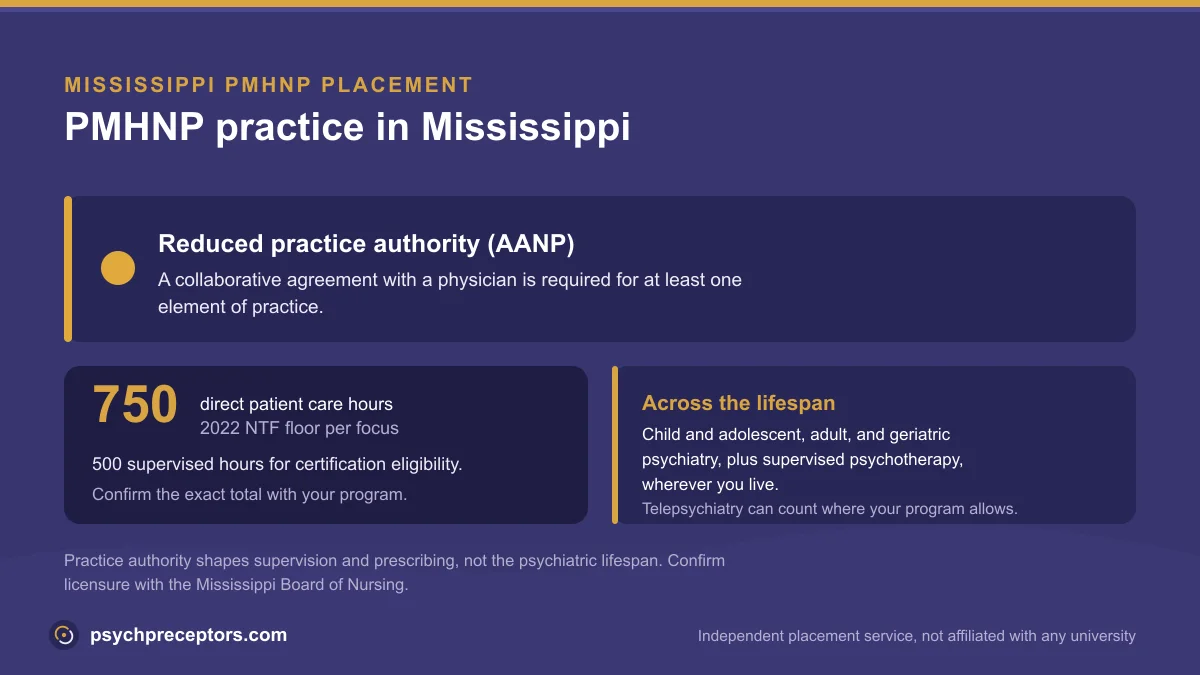
AANP calls Mississippi a reduced practice state because a nurse practitioner must maintain a collaborative agreement with a Mississippi-licensed physician whose practice is compatible with the nurse practitioner's, and must be able to reach that physician reliably. The collaborating physician is listed on the Board of Nursing record, and controlled-substance prescribing, which is central to psychiatry, runs through that arrangement alongside a required federal DEA registration.
What this means for your rotation is that the practice you join is built around a named physician relationship, and an experienced Mississippi PMHNP usually precepts from inside that collaborative structure rather than a solo one. It does not change the core qualification of your preceptor or what you may do as a supervised student, which your program defines. There has been legislative interest in letting seasoned nurse practitioners step out of the agreement after a set number of hours, so confirm the current rule with the Mississippi Board of Nursing.
The Delta problem and telepsychiatry
Mississippi is one of the most rural states in the country for psychiatric care. The Delta counties in the northwest, much of the piney woods, and the smaller towns have few or no local psychiatric prescribers, while Jackson, the Gulf Coast around Gulfport and Biloxi, Hattiesburg, Tupelo, and Oxford hold most of the supply. That maldistribution is why a large share of psychiatric care now runs by telehealth.
For a Mississippi rotation, the current program decides whether telehealth or simulation is permitted and how either is classified, supervised, documented, and applied. Confirm the current program rule and any applicable state requirements before relying on either format. A telehealth block can connect you with a preceptor in Jackson or on the coast while you serve patients in a Delta county that has no psychiatrist of its own. If you live in a rural area, plan around that reality rather than against it.
Child and geriatric hours: the scarce ends
PMHNP hours have to span child and adolescent, adult, and geriatric psychiatry, plus supervised psychotherapy with at least two modalities. Adult hours are the reachable part through the regional centers. Child and adolescent psychiatry is the hardest to secure, sitting mainly in the state hospital's child units and the Jackson academic setting, and geriatric psychiatry is thin outside the larger towns and long-term care.
We generally assemble the child and adolescent block as its own placement and treat geriatric hours the same way, rather than expecting one rural site to cover the whole lifespan. See the child and adolescent psych rotation and psychotherapy hours pages for how the pieces fit.
Hours, preceptors, and how we help
The 2022 NTF Standards recommend at least 750 direct patient care hours per nurse practitioner population focus. ANCC and AANPCB eligibility sources separately use at least 500 faculty-supervised clinical hours. These figures serve different purposes and do not form a typical program range. Named programs vary and control the exact total and distribution, so confirm current requirements with your program.
We are independent, we serve PMHNP students at any university, and we work independently of any school. We do not guarantee placement or program approval of a preceptor or site. What we do is find and vet psychiatric preceptors in the part of Mississippi you can reach, confirm their license and practice population, and pass clean paperwork to your clinical office. Send your city, your remaining rotations, and your start date on the form here (start here) or through contact. Pricing is on the cost page.
Good to know
Is Mississippi a full practice authority state?
No. AANP classifies Mississippi as reduced practice. A nurse practitioner must keep a career-long collaborative agreement with a compatible Mississippi-licensed physician, and controlled-substance prescribing runs through that arrangement with a DEA registration. That shapes how a psychiatric practice is structured, not whether a PMHNP can precept you. Confirm current rules with the Mississippi Board of Nursing.
Where do most PMHNP students place in Mississippi?
In the regional community mental health centers, which are the backbone of public psychiatric care and carry a broad diagnostic mix. Acute and child psychiatry sit mainly in the state hospitals, and private psychiatry and telepsychiatry cluster in Jackson, the Gulf Coast, Hattiesburg, and Tupelo. We often combine settings to cover the lifespan.
How do rural students in the Delta find psychiatric hours?
Often through telepsychiatry paired with a willing local preceptor. Many Delta and rural counties have no local psychiatric prescriber, so a telehealth block connecting you with a preceptor in a larger town is frequently the realistic route. Your current program decides whether telehealth or simulation is permitted and how either is classified, supervised, documented, and applied. Confirm the current program rule and any applicable state requirements before relying on either format.
How many clinical hours will I need in Mississippi?
The 2022 NTF Standards recommend at least 750 direct patient care hours per nurse practitioner population focus. ANCC and AANPCB eligibility sources separately use at least 500 faculty-supervised clinical hours. These figures serve different purposes and do not form a typical program range. Named programs vary and control the exact total and distribution, so confirm current requirements with your program.
Cover every rotation, not just the easy ones
Tell us your PMHNP program, your city, and the rotations you still need. We will come back with a plan for the full psych lifespan and a realistic path to placed.