Getting Placed for Psychiatric Hours in Michigan
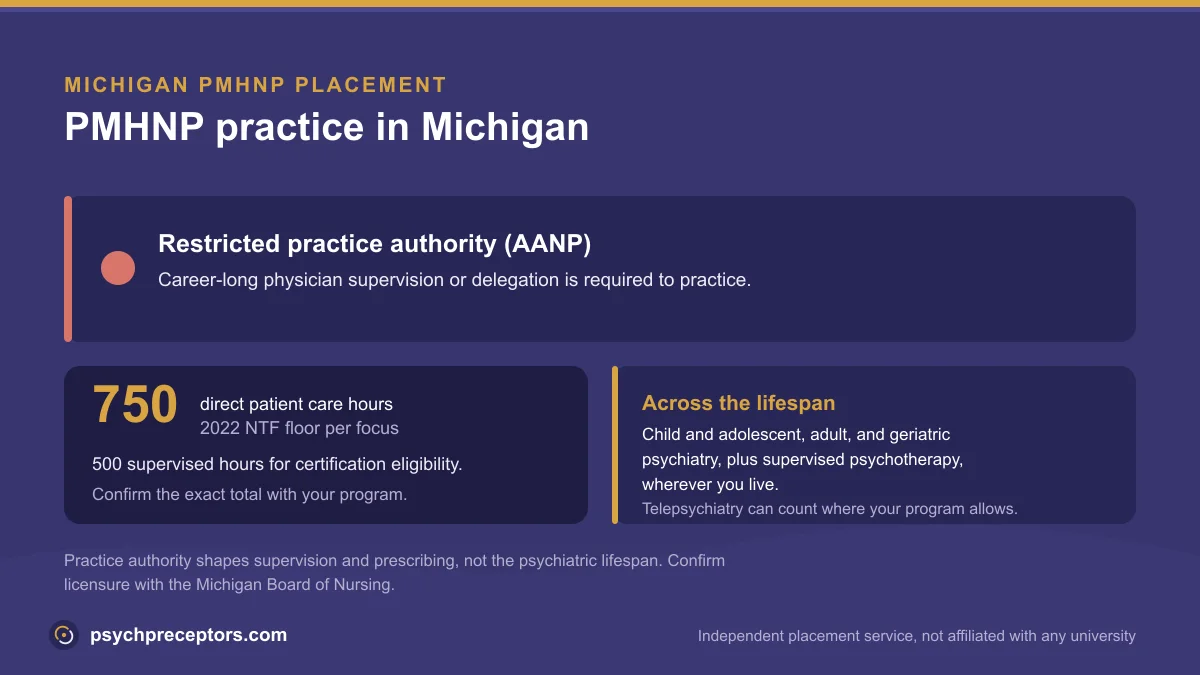
Michigan sits in the restricted practice category on the AANP State Practice Environment map, and for a psychiatric nurse practitioner that label carries more weight than usual, because PMHNPs prescribe controlled medications every day. Public mental health runs through county community mental health programs, and the supply of psychiatric prescribers is thin outside the metros. This page covers the settings that host PMHNP students, what restricted practice changes about prescribing and supervision, and where the scarce rotations sit.
Where psychiatric hours live in Michigan
The backbone of public mental health in Michigan is the network of Community Mental Health Services Programs, which act as the single point of entry to publicly funded care in all 83 counties and run 24-hour crisis response. Layered on top are Certified Community Behavioral Health Clinics, safety-net sites that combine mental health and substance use treatment under one roof. Both are common homes for PMHNP rotations because they carry a wide mix of diagnoses and heavy medication management.
- County community mental health programs and their contracted agencies statewide.
- Certified Community Behavioral Health Clinics offering integrated mental health and addiction care.
- Inpatient psychiatric units in hospital systems, concentrated in Detroit, Grand Rapids, and Ann Arbor, plus state psychiatric hospitals.
- Opioid treatment programs and office-based buprenorphine clinics, a large sector given Michigan's overdose history.
- Assertive community treatment teams, crisis services, and private psychiatric and telepsychiatry practices.
- Veterans Affairs behavioral health and tribal health programs in the northern counties for students who clear the extra steps.
What restricted practice changes when the drugs are controlled
Michigan keeps a physician involved in parts of nurse practitioner practice, which is why AANP calls it restricted. The sharpest edge for psychiatry is controlled substances: a nurse practitioner prescribes Schedule 2 through 5 medications as a delegated act of a physician, and both the nurse practitioner's name and the delegating physician's name, with their DEA numbers, appear in connection with the prescription. Because PMHNP work leans on stimulants, mood stabilizers, and medications for opioid and alcohol use, this shapes which practices can host you.
The practical effect is narrower than it sounds. It usually means the site you join has a physician of record, that a Michigan PMHNP precepts from inside a physician-linked practice rather than a solo one, and that site paperwork names that relationship. It does not change who is qualified to teach you or what you may do as a supervised student, which your program and clinical agreement define. A federal DEA registration is still required. Confirm current rules with the Michigan Board of Nursing, not with any summary including this one.
Metro density against the northern shortage
Southeast Michigan holds most of the state's psychiatric volume, with the Detroit metro across Wayne, Oakland, and Macomb counties, plus Ann Arbor's teaching hospitals. West Michigan around Grand Rapids and Kalamazoo is the second cluster, and mid-Michigan through Lansing, Flint, and Saginaw fills the middle. Those areas hold the inpatient beds and nearly all of the child psychiatry.
North of Clare the arithmetic reverses. Traverse City, Petoskey, and the whole Upper Peninsula from Sault Ste. Marie through Marquette often have willing prescribers and few students competing, but the psychiatric supply is genuinely scarce; state data has counted many counties with no practicing psychiatrist at all. That gap is a large part of why so much rural psychiatric care now runs by telehealth.
Child and adolescent psychiatry: the hardest seat
Your PMHNP hours must cross child and adolescent, adult, and geriatric psychiatry plus supervised psychotherapy. Adult and geriatric hours are reachable through the community mental health system and general-hospital units. Child and adolescent psychiatry is the bottleneck, concentrated in a few children's and academic hospitals in the southern metros, and Michigan runs a statewide child psychiatry access program that supports primary care precisely because direct seats are so scarce.
We usually build the child and adolescent block as its own placement rather than assuming a general site can supply it, and telehealth often fills the gap for families far from those hubs. See our child and adolescent psych rotation and lifespan psych rotation pages.
Telepsychiatry, hours, and what a Michigan preceptor needs
For a Michigan rotation, the current program decides whether telehealth or simulation is permitted and how either is classified, supervised, documented, and applied. Confirm the current program rule and any applicable state requirements before relying on either format. Supervised psychotherapy is a separate requirement, with programs expecting at least two modalities, and community mental health sites are usually the easiest place to log it. Our psychotherapy hours page covers that.
The 2022 NTF Standards recommend at least 750 direct patient care hours per nurse practitioner population focus. ANCC and AANPCB eligibility sources separately use at least 500 faculty-supervised clinical hours. These figures serve different purposes and do not form a typical program range. Named programs vary and control the exact total and distribution, so confirm current requirements with your program.
If you want help searching Michigan
We are independent, we serve PMHNP students at any university, and we work independently of any school. We do not guarantee placement or program approval of a preceptor or site. What we do is locate and vet psychiatric preceptors in the part of Michigan you can reach, confirm they are licensed and practicing in the population you still need, and pass clean paperwork to your clinical office. Send your city, your remaining rotations, and your start date on the form here (start here) or through contact. Pricing is on the cost page.
Good to know
Is Michigan a full practice authority state?
No. AANP classifies Michigan as restricted practice. State law keeps a physician involved in parts of nurse practitioner practice, and controlled substances are prescribed as a delegated act with both the nurse practitioner's and the physician's names on the prescription. That shapes how a psychiatric practice is structured, not whether a PMHNP there can precept you. Confirm details with the Michigan Board of Nursing.
How does restricted practice affect a PMHNP specifically?
More than it affects many other tracks, because psychiatry relies on controlled medications. In Michigan those are prescribed under physician delegation, so your site typically has a physician of record and your PMHNP preceptor works inside a physician-linked practice. A DEA registration is still required. It does not limit what you may do as a supervised student.
Which psychiatric rotation is hardest to place in Michigan?
Child and adolescent psychiatry. The seats concentrate in a few children's and academic hospitals in the Detroit, Ann Arbor, and Grand Rapids areas, and much of the state has no local child psychiatrist at all. Geriatric psychiatry is easier but still thinner than adult. We usually place the child block as its own site.
How many clinical hours will I need in Michigan?
The 2022 NTF Standards recommend at least 750 direct patient care hours per nurse practitioner population focus. ANCC and AANPCB eligibility sources separately use at least 500 faculty-supervised clinical hours. These figures serve different purposes and do not form a typical program range. Named programs vary and control the exact total and distribution, so confirm current requirements with your program.
Cover every rotation, not just the easy ones
Tell us your PMHNP program, your city, and the rotations you still need. We will come back with a plan for the full psych lifespan and a realistic path to placed.