How PMHNP students find psychiatric preceptors in Kentucky
Kentucky is a reduced practice state, so a PMHNP works under a collaborative agreement with a physician, and for psychiatry the detail that matters most is controlled-substance prescribing. The state also gives you a deep place to train: Kentucky built the country's first statewide network of community mental health centers, and those regional centers still anchor psychiatric care from Louisville to the eastern coalfields. Addiction runs through nearly every rotation.
Kentucky invented the community mental health center
Kentucky was the first state to build a statewide network of community mental health centers, and the descendants of that system are still the widest source of PMHNP hours. Fourteen regional nonprofits cover the state: Seven Counties Services anchors Louisville and the surrounding counties, New Vista covers seventeen counties around Lexington, and organizations like Mountain Comprehensive Care and Kentucky River Community Care reach deep into Appalachia.
These centers deliver the exact mix your program wants: medication management, therapy, crisis services, substance use treatment, and coordination in one place, and several now carry Certified Community Behavioral Health Clinic funding that tends to make room for learners. A single center rotation can cover several competencies. See outpatient psychiatry and medication management.
- Community mental health centers and CCBHCs, the widest source of outpatient psychiatric hours.
- Office-based and hospital addiction programs, including medication for opioid use disorder.
- Private and academic psychiatry in Louisville and Lexington.
- Telepsychiatry groups serving the eastern counties.
Louisville and Lexington hold the beds, Appalachia holds the need
Louisville and Lexington carry most of the state's private psychiatry, academic programs, and inpatient capacity, and they are where child and adolescent placements realistically sit. Northern Kentucky across the river from Cincinnati, Bowling Green, Owensboro, and Paducah form a second tier with community centers and hospital psychiatry.
Eastern Kentucky is a different story. The Appalachian counties carry some of the heaviest behavioral health need in the country and the fewest local prescribers, so much of the care there is delivered by the regional centers and by telepsychiatry. If you live in the mountains, we plan around those two sources rather than a private practice that may not exist nearby.
The collaborative agreement, and the controlled-substance catch
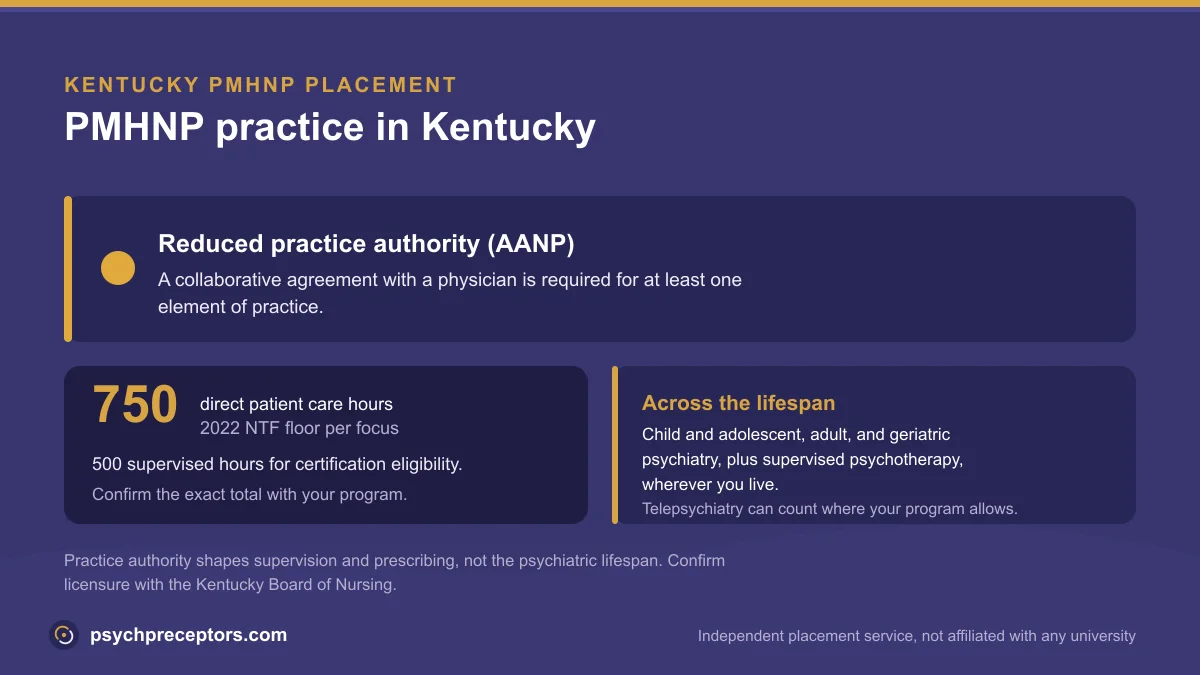
The AANP State Practice Environment lists Kentucky as reduced practice. A nurse practitioner prescribes under a collaborative agreement with a physician, and Kentucky splits that into two documents: one for non-scheduled drugs, which a nurse practitioner in good standing can shed after four years, and a separate agreement for controlled substances that does not go away.
For a PMHNP that second agreement is the important one, because psychiatric practice leans on controlled medications, from stimulants to certain anxiety and sleep drugs. The controlled-substance agreement pairs the nurse practitioner with a same or similar specialty physician and requires a quarterly review of the prescription monitoring report, plus a DEA registration. In practice a collaborating psychiatrist is usually part of a Kentucky psychiatric preceptorship. That shapes the arrangement, not your preceptor's core qualifications; a board-certified PMHNP or psychiatrist can precept you, and your program sets the final rules. See preceptor requirements.
Addiction is woven through every rotation
Kentucky was near the center of the opioid crisis, and medication for opioid use disorder is now embedded across community centers, office-based practices, and hospitals. For a PMHNP that means substance use hours are usually easier to find than child hours, and they overlap with your medication management and psychotherapy work. Co-occurring mental health and addiction is the norm rather than the exception here. Our substance use rotation guide covers what counts toward your total.
Child psych, and the inpatient options
Child and adolescent psychiatry is the scarcest rotation, and in Kentucky it concentrates in Louisville and Lexington, with telepsychiatry filling much of the rest of the state. Geriatric psychiatry runs thin too and is often seen through primary care and long-term care. Booking these blocks early is the whole game; see the child and adolescent rotation.
For acute exposure, Kentucky operates state psychiatric hospitals including Central State in Louisville, Eastern State in Lexington, and Western State in Hopkinsville, alongside community hospital psychiatric units and a psychiatric hospital serving the eastern region. Inpatient blocks are competitive and need lead time for onboarding, so we start that search early. See the inpatient rotation.
Your hours, and how we help
The 2022 NTF Standards recommend at least 750 direct patient care hours per nurse practitioner population focus. ANCC and AANPCB eligibility sources separately use at least 500 faculty-supervised clinical hours. These figures serve different purposes and do not form a typical program range. Named programs vary and control the exact total and distribution, so confirm current requirements with your program. See PMHNP clinical hours for source context.
We are an independent placement service for PMHNP students at any university, so our outreach is not tied to one school's approved list. Tell us your program, your city, and the rotations you still need, and we will map a route across the lifespan and line up the collaborating psychiatrist the controlled-substance rules call for. Use the form at #match or reach us through contact. We assist with placement and cannot guarantee a match or your school's approval. Planning hours elsewhere? Start from the states index.
Good to know
Is Kentucky a full or reduced practice state for PMHNPs?
Reduced. A nurse practitioner prescribes under a collaborative agreement with a physician. Kentucky uses a separate controlled-substance agreement that does not expire, so for psychiatric prescribing a collaborating physician, usually a psychiatrist, is normally part of the arrangement. Confirm the current rules with the Kentucky Board of Nursing.
Why do controlled-substance rules matter so much for PMHNP training in Kentucky?
Because psychiatry relies on controlled medications. Kentucky requires nurse practitioners to hold a controlled-substance collaborative agreement with a same or similar specialty physician, with quarterly review of the prescription monitoring report and a DEA registration. That shapes who serves as your preceptor, not the preceptor's core qualifications.
Which psychiatric rotation is hardest to find in Kentucky?
Child and adolescent psychiatry, which concentrates in Louisville and Lexington, with telepsychiatry covering much of the rest of the state. Geriatric psychiatry is also limited. Substance use hours, by contrast, are widely available because addiction care is embedded across the system. We book the scarce blocks first.
Do telepsychiatry hours count in Kentucky?
Your current program decides whether telehealth or simulation is permitted and how either is classified, supervised, documented, and applied. Confirm the current program rule and any applicable state requirements before relying on either format. In eastern Kentucky, where local prescribers are scarce, telepsychiatry carries much of the care, so we often pair a regional community center with a telehealth preceptor. Confirm the specifics with your program.
How many clinical hours will my PMHNP program require?
The 2022 NTF Standards recommend at least 750 direct patient care hours per nurse practitioner population focus. ANCC and AANPCB eligibility sources separately use at least 500 faculty-supervised clinical hours. These figures serve different purposes and do not form a typical program range. Named programs vary and control the exact total and distribution, so confirm current requirements with your program.
Cover every rotation, not just the easy ones
Tell us your PMHNP program, your city, and the rotations you still need. We will come back with a plan for the full psych lifespan and a realistic path to placed.