Placing PMHNP students throughout Georgia
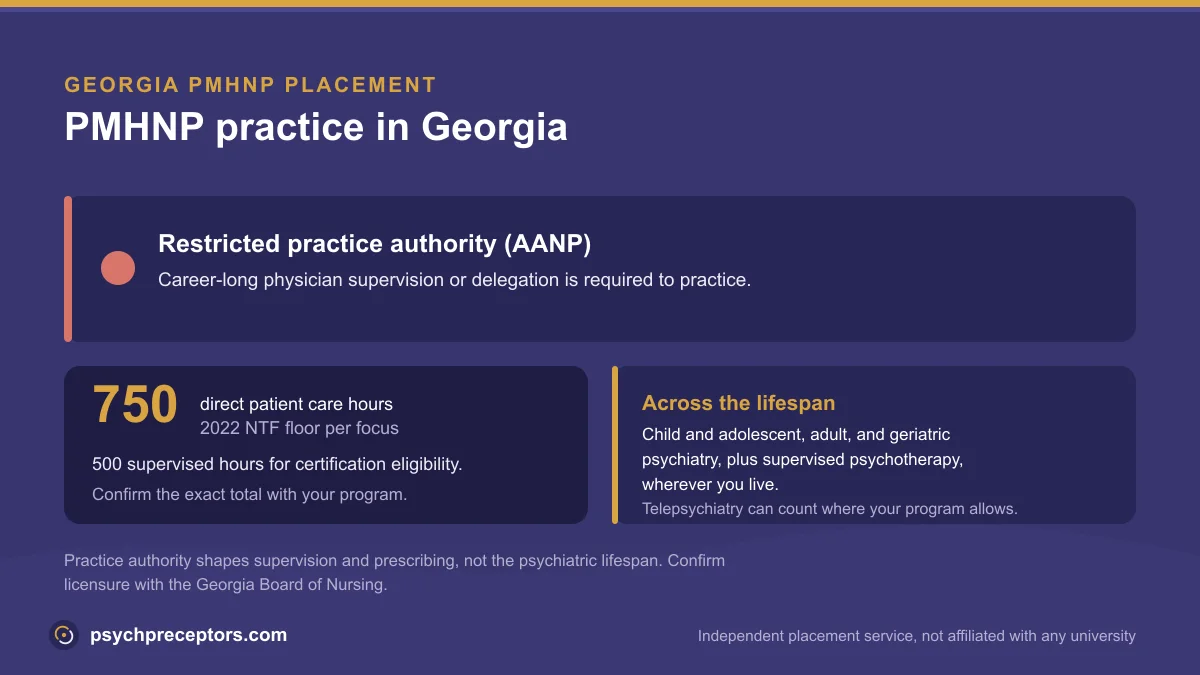
Georgia's psychiatry is concentrated in metro Atlanta while much of the rest of the state, especially South Georgia, has very few prescribers. It is a restricted-practice state, where a PMHNP prescribes under a nurse protocol agreement with a delegating physician, and that arrangement shapes who can precept you. We are an independent service that helps PMHNP students at any university find psychiatric rotations statewide, and we never guarantee placement or your school's approval of a site.
Atlanta's pull and the rural gap
Metro Atlanta holds the lion's share of Georgia's psychiatric capacity, from outpatient practices to inpatient units and most of the child-psychiatry expertise. Beyond it, capacity spreads thin through the secondary cities: Augusta, Columbus, Macon, Savannah, Athens, and further out Albany, Valdosta, Rome, and Gainesville.
Large stretches of South Georgia and the rural middle of the state are federally designated shortage areas, and many counties have no practicing psychiatrist at all. That gap is the single biggest fact about training here, and it is why telehealth matters so much.
Settings that host PMHNP students
Georgia's public safety net runs through Community Service Boards, the regional agencies that act as comprehensive community providers and, increasingly, as Certified Community Behavioral Health Clinics. The Department of Behavioral Health and Developmental Disabilities also operates state psychiatric hospitals in the Atlanta area at Decatur, plus Augusta, Columbus, Milledgeville, and Savannah.
- Community Service Board clinics and CCBHCs carrying crisis, outpatient, and Medicaid caseloads;
- inpatient and forensic psychiatry in the state hospital system and general hospitals;
- addiction and opioid treatment programs, including medication-assisted treatment;
- correctional behavioral health across a large prison system;
- private and group practices, telepsychiatry networks, and campus or school-based mental health.
How restricted practice shapes your preceptor
Georgia is a restricted-practice state. A PMHNP prescribes under a nurse protocol agreement with a delegating physician, and that agreement, once approved by the board, sets what can be prescribed; recent changes allow delegation of certain Schedule II controlled substances under defined conditions. A DEA registration is still required to prescribe controlled substances.
This affects the prescribing and supervision arrangement, not the core qualifications of a preceptor, who is generally a board-certified PMHNP or a board-certified psychiatrist. In restricted states a collaborating or supervising physician is commonly part of the setup, which can influence which PMHNPs are positioned to precept. Licensing runs through the Georgia Board of Nursing under the Secretary of State. See preceptor requirements.
Lifespan rotations and a severe child-psych shortage
PMHNP hours must cover child and adolescent, adult, and geriatric psychiatry plus supervised psychotherapy. Adult rotations are the easiest to arrange, especially in the metros.
Child and adolescent psychiatry is acutely short in Georgia; the expertise sits mostly in Atlanta children's and academic settings, and rural families often wait months or rely on telehealth. Geriatric psychiatry is also limited outside the metros. If you need child, adolescent, or geriatric hours, start the search early, because these close first.
Telepsychiatry and how hours count
Georgia has leaned on telemedicine for years to reach its rural counties, and telepsychiatry is a routine part of both care and training. For a Georgia rotation, the current program decides whether telehealth or simulation is permitted and how either is classified, supervised, documented, and applied. Confirm the current program rule and any applicable state requirements before relying on either format.
The 2022 NTF Standards recommend at least 750 direct patient care hours per nurse practitioner population focus. ANCC and AANPCB eligibility sources separately use at least 500 faculty-supervised clinical hours. These figures serve different purposes and do not form a typical program range. Named programs vary and control the exact total and distribution, so confirm current requirements with your program. See PMHNP clinical hours for source context.
How we match you in Georgia
Tell us your region, your program's hour requirement, and the rotations you still need, and we search our Georgia contacts for a board-certified psychiatric preceptor with room, including the delegating or supervising arrangement the state requires. We hand you the match to take to your faculty for approval.
Start at the match form or contact us, and read how it works. We assist with the search and do not guarantee it.
Good to know
What does restricted practice mean for me as a Georgia student?
It mainly affects prescribing. A PMHNP works under a nurse protocol agreement with a delegating physician, so a supervising physician is usually part of the setup. It does not change who can teach you: board-certified PMHNPs and psychiatrists both precept. Confirm current rules with the Georgia Board of Nursing.
Why is child and adolescent psychiatry so hard to get here?
Because Georgia has a documented shortage of child psychiatrists, concentrated in metro Atlanta. Rural counties often have none. Tell us early and we prioritize child, adolescent, and geriatric placements, which fill far more slowly than adult rotations.
Can I train mostly by telehealth in rural Georgia?
Often a meaningful share, yes. Your current program decides whether telehealth or simulation is permitted and how either is classified, supervised, documented, and applied. Confirm the current program rule and any applicable state requirements before relying on either format. Simulation does not. Your program sets the final policy, so verify before you plan.
Do you guarantee placement?
No. We are an independent search service. We work our psychiatric contacts to find a matching board-certified preceptor with openings and the required delegating arrangement, but your school approves the site and preceptor, and placement is never guaranteed.
How many hours does my Georgia program require?
The 2022 NTF Standards recommend at least 750 direct patient care hours per nurse practitioner population focus. ANCC and AANPCB eligibility sources separately use at least 500 faculty-supervised clinical hours. These figures serve different purposes and do not form a typical program range. Named programs vary and control the exact total and distribution, so confirm current requirements with your program.
Cover every rotation, not just the easy ones
Tell us your PMHNP program, your city, and the rotations you still need. We will come back with a plan for the full psych lifespan and a realistic path to placed.