Getting matched to a PMHNP preceptor in Florida
Florida is a big, uneven state for psychiatry, with deep capacity in the metros and thin coverage across the Panhandle and rural interior. It is a restricted-practice state, so a supervising or collaborating psychiatrist is usually part of a PMHNP's controlled-substance prescribing arrangement, which shapes who can precept you. We are an independent service that helps PMHNP students at any university find psychiatric rotations statewide, and we never guarantee placement or your program's approval of a site.
Florida's behavioral-health geography
Most psychiatric training capacity clusters in the big metros: Miami and Fort Lauderdale in the southeast, the Tampa and St. Petersburg bay area, greater Orlando, and Jacksonville in the north, with secondary hubs in Gainesville, Tallahassee, Sarasota, Fort Myers, and West Palm Beach. Public behavioral health is organized through regional managing entities that contract community providers rather than one state agency running clinics directly.
Coverage falls off fast outside the metros. The Panhandle, the Big Bend, and the agricultural interior are heavily shortage-designated; some rural counties have no psychologist and few if any prescribers, so telepsychiatry does a lot of the work.
The Interstate 4 corridor between Tampa and the Orlando area, and the fast-growing Southwest Florida coast around Fort Myers and Naples, add still more training capacity between the biggest metros.
Settings that host PMHNP students
Florida's involuntary examination law, the Baker Act, shapes acute care, and designated receiving facilities are common inpatient training sites. The addiction treatment sector is unusually large here, spanning detox, residential, and outpatient programs.
- community mental health centers and Certified Community Behavioral Health Clinics under the managing-entity system;
- Baker Act receiving facilities and inpatient units in general and state psychiatric hospitals;
- addiction and opioid treatment programs, including medication-assisted treatment;
- forensic and correctional psychiatry, and Veterans Affairs behavioral health in the major metros;
- private and group practices, large telepsychiatry organizations, and campus mental health.
Assertive community treatment teams, mobile crisis response, and a large seasonal population that swells caseloads in winter all shape what you will see on a Florida rotation.
Lifespan rotations: scarce child psych, strong geriatrics
PMHNP hours must span child and adolescent, adult, and geriatric psychiatry with supervised psychotherapy. Florida's age profile changes the usual math.
Geriatric psychiatry is easier to find here than in most states, because the retiree population is large and concentrated along both coasts and in central Florida. Child and adolescent psychiatry is the opposite: scarce and concentrated in metro children's hospitals and a small number of academic programs, with a state child-telepsychiatry effort trying to close the gap. Ask for child and adolescent placements early.
Adult psychiatry sits everywhere in between, from community clinics to inpatient units, and usually anchors a Florida plan while the child and adolescent hours are arranged.
What restricted practice means for your preceptor
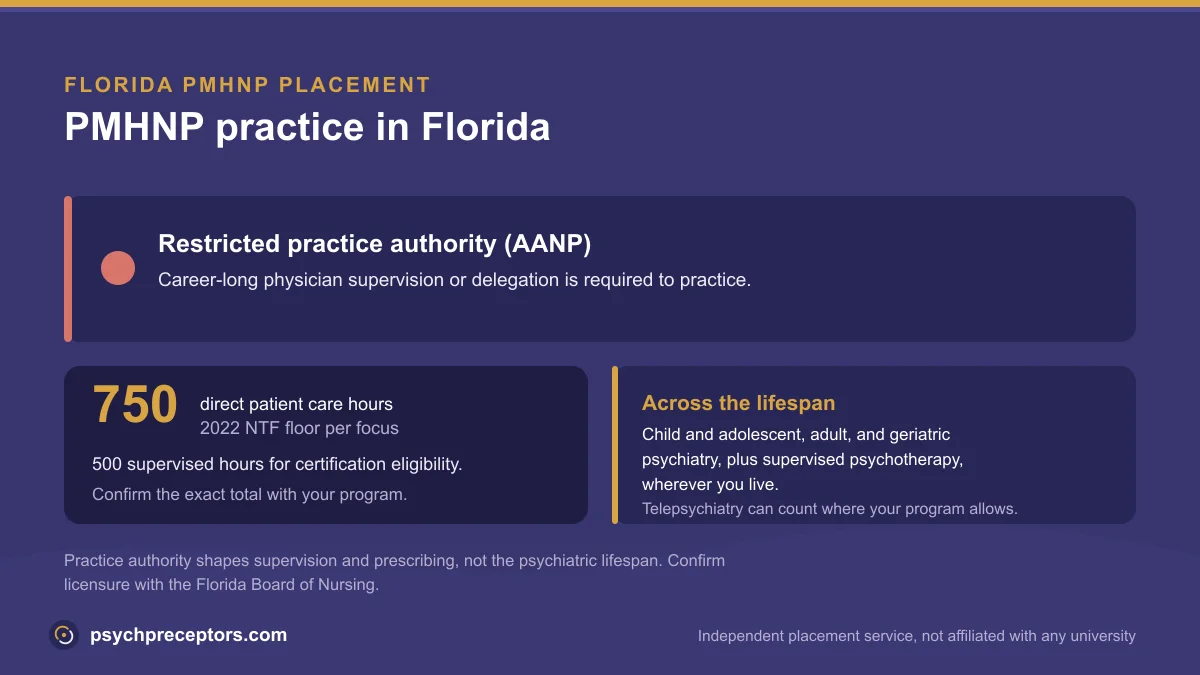
Florida is a restricted-practice state. It does offer an autonomous-registration pathway, but that route covers primary care fields such as family medicine, general pediatrics, and general internal medicine, not autonomous psychiatric prescribing. For psychiatric controlled substances, a PMHNP generally works under a protocol with a psychiatrist, so a collaborating or supervising psychiatrist is usually part of the arrangement.
In practice, that shapes who can precept and how prescriptions are authorized, not the core qualifications of a preceptor, who is generally a board-certified PMHNP or a board-certified psychiatrist. A DEA registration is required to prescribe controlled substances. Because efforts to widen autonomous psychiatric practice have not become law, confirm the current rules with the Florida Board of Nursing. See preceptor requirements.
Telepsychiatry and your clinical hours
Telepsychiatry is central to Florida, both for rural access and for the state's large private tele-mental-health companies. For a Florida rotation, the current program decides whether telehealth or simulation is permitted and how either is classified, supervised, documented, and applied. Confirm the current program rule and any applicable state requirements before relying on either format.
The 2022 NTF Standards recommend at least 750 direct patient care hours per nurse practitioner population focus. ANCC and AANPCB eligibility sources separately use at least 500 faculty-supervised clinical hours. These figures serve different purposes and do not form a typical program range. Named programs vary and control the exact total and distribution, so confirm current requirements with your program. See PMHNP clinical hours for source context.
How we match you in Florida
Tell us your region, your program's required hours, and the rotations you still need, and we search our Florida contacts for a board-certified psychiatric preceptor who fits, including the supervising-psychiatrist arrangement the state expects. You take the match to your faculty for approval.
Begin at the match form or find a preceptor, and see how it works. We help with the search and do not guarantee it.
Good to know
Is Florida really restricted for psychiatric NPs?
Yes. Florida has an autonomous-registration pathway, but it covers primary care, not autonomous psychiatric prescribing. For controlled psychiatric medications a PMHNP typically works under a protocol with a psychiatrist, so expect a supervising psychiatrist in the arrangement. Confirm current rules with the Florida Board of Nursing.
Does that make it harder to find a preceptor?
Not necessarily. Board-certified PMHNPs and psychiatrists both precept across Florida; the practice rules mainly shape the prescribing arrangement, not who can teach. We factor the required psychiatrist involvement into every match we propose.
Where is child and adolescent psychiatry easiest to get?
In the metros, especially around children's hospitals and academic programs in South Florida, the Bay area, Orlando, and Jacksonville. It is scarce everywhere, so tell us early. Geriatric rotations, by contrast, are comparatively easy given Florida's older population.
Do telehealth hours count in Florida?
Your current program decides whether telehealth or simulation is permitted and how either is classified, supervised, documented, and applied. Confirm the current program rule and any applicable state requirements before relying on either format. Your program has the final say, so verify first.
How many clinical hours will I need?
The 2022 NTF Standards recommend at least 750 direct patient care hours per nurse practitioner population focus. ANCC and AANPCB eligibility sources separately use at least 500 faculty-supervised clinical hours. These figures serve different purposes and do not form a typical program range. Named programs vary and control the exact total and distribution, so confirm current requirements with your program.
Cover every rotation, not just the easy ones
Tell us your PMHNP program, your city, and the rotations you still need. We will come back with a plan for the full psych lifespan and a realistic path to placed.