Your PMHNP clinical placement in Connecticut
Connecticut packs a lot of behavioral health into a small footprint, and it reaches full practice authority once a nurse practitioner completes an initial collaborative period. We are an independent service that helps PMHNP students at any university line up psychiatric rotations here, from the cities along Interstate 91 to the quiet corners of the east. We help with the search and do not guarantee placement or your program's approval of a site.
A small state with a dense behavioral-health map
Connecticut's psychiatry capacity tracks its population. The heaviest concentration runs up the Interstate 91 corridor through New Haven, Meriden, and Hartford, with a second cluster in lower Fairfield County around Bridgeport, Stamford, and Norwalk, where many clinicians also serve commuters tied to the New York market. Waterbury, New London, Norwich, and Danbury anchor smaller hubs.
The thinner ground is the eastern Quiet Corner in Windham and Tolland counties and the northwestern Litchfield hills, where prescribers are sparse and most of the state's shortage-area designation lands.
Because the state is only about two hours end to end, many students commute across county lines for a single rotation, pairing a shoreline site from New Haven to New London with a placement closer to home.
Settings that take PMHNP students here
The public backbone is the network of Local Mental Health Authorities and affiliated nonprofits funded through the Department of Mental Health and Addiction Services, alongside community behavioral health clinics offering crisis response and same-day access.
- community clinics and LMHA outpatient programs carrying Medicaid and uninsured caseloads;
- inpatient psychiatry in general hospitals and at the state-run Connecticut Valley Hospital in Middletown;
- forensic psychiatry at Whiting Forensic Hospital, plus correctional behavioral health;
- addiction and opioid treatment programs, including methadone and office-based buprenorphine;
- private and group practices, telepsychiatry panels, and campus or school-based mental health.
Statewide mobile crisis and 988 response, assertive community treatment teams, and jail-diversion programs round out the picture, and several community clinics are moving toward the Certified Community Behavioral Health Clinic model.
How practice authority shapes your preceptor
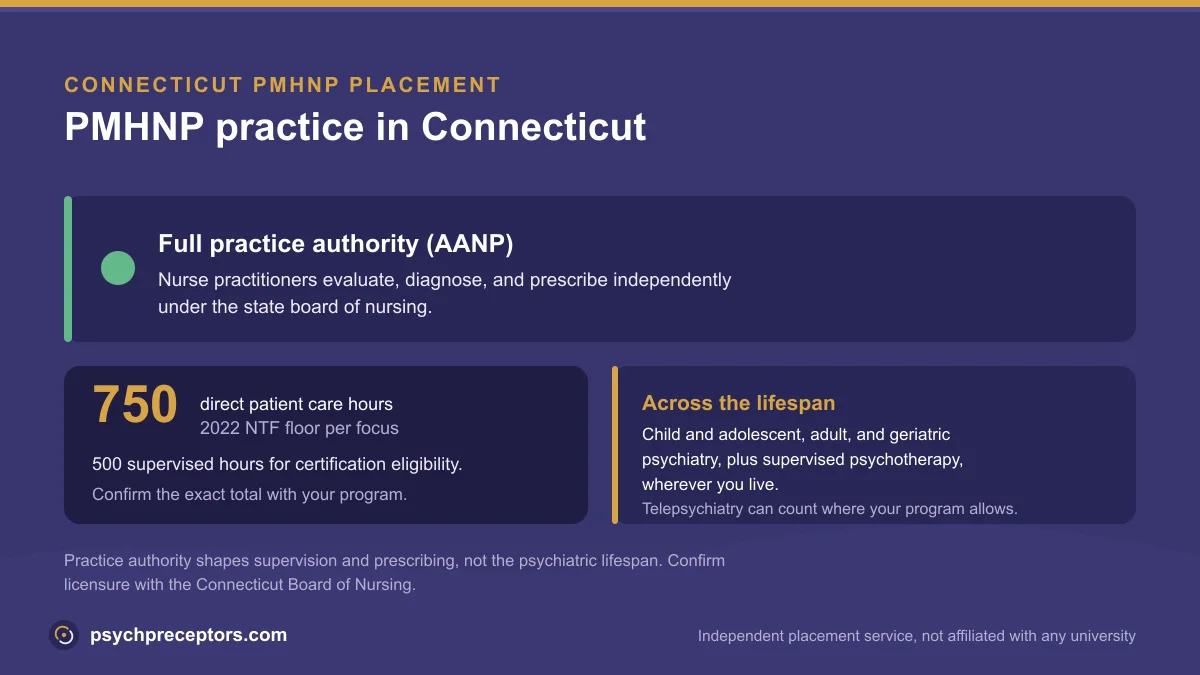
Connecticut is a full practice authority state, but with a runway. A nurse practitioner practices in collaboration with a physician for the first three years and at least 2,000 hours after initial licensure, then may practice and prescribe independently once that threshold is met and documented. An experienced PMHNP past that mark holds independent prescriptive authority, including for controlled psychiatric medications, and can precept you on that basis.
A newer PMHNP may still be inside the collaborative window, which can affect the prescriptive arrangement but not the ability to teach. A preceptor here is generally a board-certified PMHNP or a board-certified psychiatrist, and a DEA registration is required to prescribe controlled substances. Licensing runs through the Connecticut Board of Examiners for Nursing under the Department of Public Health. See preceptor requirements.
Lifespan rotations, and where the gaps are
Your hours have to cover child and adolescent, adult, and geriatric psychiatry with supervised psychotherapy in at least two modalities. Adult outpatient and inpatient work is well represented across the corridor.
Child and adolescent psychiatry is the scarce one, concentrated in New Haven and Hartford academic and children's hospital programs; if you need it, ask first. Geriatric psychiatry tends to sit in long-term-care and consultation roles. Because the state is compact, students often combine a city-based rotation with a telehealth block reaching the rural east.
Geriatric placements tend to turn up in the older shoreline suburbs and in consultation-liaison work inside general hospitals, so it helps to plan those alongside the adult blocks rather than leaving them for last.
Telepsychiatry and your hours
Telepsychiatry has become a normal part of Connecticut care, both for reaching the Quiet Corner and for private groups serving busy suburban patients. For a Connecticut rotation, the current program decides whether telehealth or simulation is permitted and how either is classified, supervised, documented, and applied. Confirm the current program rule and any applicable state requirements before relying on either format.
The 2022 NTF Standards recommend at least 750 direct patient care hours per nurse practitioner population focus. ANCC and AANPCB eligibility sources separately use at least 500 faculty-supervised clinical hours. These figures serve different purposes and do not form a typical program range. Named programs vary and control the exact total and distribution, so confirm current requirements with your program. See PMHNP clinical hours for source context.
Getting matched in Connecticut
Give us your town, your school's hour requirement, and the rotations you still owe, and we look through our Connecticut contacts for a board-certified psychiatric preceptor with room. You take the match to your faculty for approval; we do the searching, not the guaranteeing.
Start at the match form or contact us, and read how it works.
Good to know
Is Connecticut a full practice authority state for PMHNPs?
Yes, after a transition. A nurse practitioner collaborates with a physician for the first three years and 2,000 hours, then can practice and prescribe independently. An experienced PMHNP who has cleared that period can precept with independent prescriptive authority. Confirm current rules with the state board.
Will you find my preceptor for me?
We try to. Many Connecticut programs expect students to source their own sites, so we search our psychiatric contacts across the state and hand you a match to run past your school. Final approval of the site and preceptor stays with your program.
How hard is a child and adolescent rotation in Connecticut?
It is the toughest to secure, since pediatric psychiatry concentrates in the New Haven and Hartford academic and children's settings. Tell us early and we prioritize child, adolescent, and geriatric placements, which fill more slowly than adult rotations.
Do telehealth hours count toward my requirement?
Your current program decides whether telehealth or simulation is permitted and how either is classified, supervised, documented, and applied. Confirm the current program rule and any applicable state requirements before relying on either format. Your program sets the final rule, so verify before you commit.
How many hours does a Connecticut PMHNP program require?
The 2022 NTF Standards recommend at least 750 direct patient care hours per nurse practitioner population focus. ANCC and AANPCB eligibility sources separately use at least 500 faculty-supervised clinical hours. These figures serve different purposes and do not form a typical program range. Named programs vary and control the exact total and distribution, so confirm current requirements with your program.
Sources: AANP: State Practice Environment; Connecticut Board of Examiners for Nursing (DPH APRN Practice); Connecticut DMHAS Local Mental Health Authorities; Connecticut Valley Hospital (DMHAS); Whiting Forensic Hospital (DMHAS); ANCC PMHNP-BC certification; 2022 NTF Standards for Quality NP Education (AACN)
Related
Cover every rotation, not just the easy ones
Tell us your PMHNP program, your city, and the rotations you still need. We will come back with a plan for the full psych lifespan and a realistic path to placed.