PMHNP preceptor placement in Wisconsin
Wisconsin runs much of its public psychiatric care through county systems, concentrates specialty capacity in Milwaukee and Madison, and is about to change its practice rules, with a new law opening independent practice for qualifying nurse practitioners on September 1, 2026. This page maps where psychiatric-mental-health nurse practitioner students rotate across the state, which settings host them, and how the shifting rules affect your preceptor. We place students from any university, so the focus is Wisconsin's real supply rather than any one program.
How psychiatric care is organized across Wisconsin
Wisconsin's public mental health has long been county-administered, so counties and their community programs are central to where students train. The two largest markets are Milwaukee, with the deepest concentration of hospital and community psychiatry, and Madison, an academic center anchored by the state's flagship university health system. Together they hold most of the specialty capacity.
Regional centers extend the map: the Fox Valley around Appleton and Oshkosh, Green Bay in the northeast, Eau Claire and La Crosse to the west, Kenosha and Racine to the south, and Wausau in the center. The northern third of the state and the rural Driftless Area in the southwest are the thinnest, and depend heavily on telepsychiatry.
The state also operates two mental health institutes, near Madison and near Oshkosh, which provide inpatient and forensic care and can offer acute exposure.
Settings that host PMHNP rotations
Clinical placements in Wisconsin usually sit in these settings:
- County community mental health programs, including comprehensive community services and community support programs
- Certified community behavioral health clinics, which the state has been expanding
- Academic and hospital psychiatry in Milwaukee and Madison
- The two state mental health institutes for inpatient and forensic exposure
- Addiction and medication-assisted treatment programs
- Veterans Affairs mental health, including the Milwaukee, Madison, and Tomah systems
- Telepsychiatry groups serving the rural north and west
- Crisis services and campus counseling across the university system
Most students build a core of outpatient hours and add inpatient or medication-management blocks for breadth.
Practice rules today, and a change arriving September 1, 2026
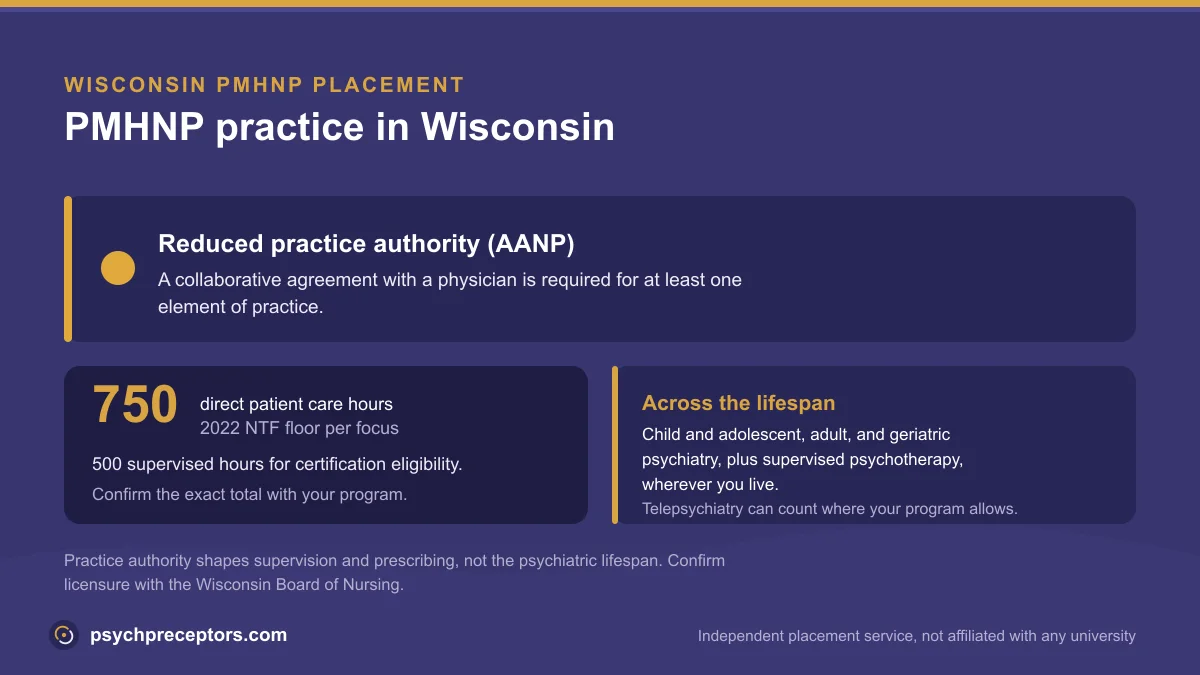
Today the AANP lists Wisconsin as a reduced-practice state. Nurse practitioners hold the state's advanced practice nurse prescriber credential and prescribe in a collaborative relationship with a physician or dentist. That is the rule in force as this page is updated.
A new law changes the structure. Wisconsin's APRN Modernization Act takes effect September 1, 2026, creating an APRN license and letting qualifying nurse practitioners practice independently once they complete the required post-licensure clinical hours in collaboration. New graduates still practice collaboratively until they reach that threshold.
For you as a student, the day-to-day is steady through the transition. Your preceptor is a board-certified PMHNP or a psychiatrist licensed in Wisconsin and practicing in psychiatry. An experienced PMHNP may precept and prescribe independently, including controlled substances with a DEA registration; a newer one works with a collaborating physician. Our preceptor requirements page has the full standard.
Lifespan rotations and the child-psychiatry shortage
Your supervised hours must reach child and adolescent, adult, and geriatric psychiatry, plus supervised psychotherapy in at least two modalities. Adult hours are available across the larger markets. Child and adolescent psychiatry is the scarce rotation, concentrated in the children's and academic programs in Milwaukee and Madison; the state runs a child psychiatry consultation program precisely because prescribers who see youth are in short supply.
Outside the two big metros, a child rotation often runs partly by telehealth. Geriatric psychiatry is thin as well and frequently comes through long-term-care consultation and memory clinics. Because the youth block bottlenecks most often, we schedule the child and adolescent rotation first.
Telepsychiatry and your hours
The rural north, the Driftless Area, and many small towns reach a psychiatrist mainly by video, so telepsychiatry is a real part of Wisconsin training. For a Wisconsin rotation, the current program decides whether telehealth or simulation is permitted and how either is classified, supervised, documented, and applied. Confirm the current program rule and any applicable state requirements before relying on either format.
It also helps with distance. A student in Superior, Rhinelander, or the Driftless can train with a Milwaukee or Madison preceptor by video when licensure and your program's rules allow, which we verify before a match is set.
Hours and the PMHNP-BC credential
The 2022 NTF Standards recommend at least 750 direct patient care hours per nurse practitioner population focus. ANCC and AANPCB eligibility sources separately use at least 500 faculty-supervised clinical hours. These figures serve different purposes and do not form a typical program range. Named programs vary and control the exact total and distribution, so confirm current requirements with your program.
The credential is ANCC PMHNP-BC. Cover the lifespan, log your psychotherapy hours in at least two modalities, and track your clinical hours as you accrue them.
Getting matched in Wisconsin
Give us your region, your program's hour requirement, and the rotations you still need. We work Wisconsin's real supply, the county community programs, the certified community clinics, the Milwaukee and Madison academic centers, and the telepsychiatry groups, to line up a qualified preceptor, and we track the practice-rule change so your match stays current. We help with placement and are honest about hard-to-source rotations; we do not guarantee your school's approval of a site. Start at the match form or see how it works.
Good to know
Is Wisconsin a full-practice state for nurse practitioners?
Not yet, but it is changing. As this page is updated, the AANP lists Wisconsin as reduced practice, with prescribing under a collaborative relationship. The APRN Modernization Act takes effect September 1, 2026 and lets qualifying nurse practitioners practice independently after they complete the required post-licensure hours. Confirm current status with the Wisconsin Board of Nursing.
How does the county-based system affect where I rotate?
Counties administer much of Wisconsin's public mental health, so community programs are a common training ground, especially outside the metros. Milwaukee and Madison hold most of the hospital and academic psychiatry and the deepest specialty capacity, while the rural north and Driftless Area lean on telepsychiatry. We match to your region and fill gaps by video.
Where can I find a child and adolescent psychiatry rotation?
Mostly in the children's and academic programs in Milwaukee and Madison, since prescribers who see youth are in short supply statewide, which is why the state runs a child psychiatry consultation program. Elsewhere, a child rotation often runs partly by telehealth. We secure this scarce rotation first so it does not delay you.
Do telehealth hours count toward my Wisconsin requirement?
Your current program decides whether telehealth or simulation is permitted and how either is classified, supervised, documented, and applied. Confirm the current program rule and any applicable state requirements before relying on either format. Always confirm modality and site rules with your own program, since they vary by school.
Cover every rotation, not just the easy ones
Tell us your PMHNP program, your city, and the rotations you still need. We will come back with a plan for the full psych lifespan and a realistic path to placed.