PMHNP preceptor placement across Virginia
Virginia keeps most of its psychiatric capacity in a few dense corridors while wide rural stretches lean on telehealth, and that shapes where a PMHNP student actually rotates. This page maps the settings that host psychiatric-mental-health nurse practitioner students across the Commonwealth, the regions where child, adult, and geriatric hours are realistic to find, and how the state's practice rules affect who can serve as your preceptor. We place students at any university, so the focus is Virginia's ground truth, not one school's checklist.
Where PMHNP students train across Virginia
Three population centers hold the bulk of psychiatric services. Northern Virginia, the suburban arc of Fairfax, Arlington, Alexandria, Prince William, and Loudoun, runs the largest concentration of outpatient practices, group telepsychiatry, and hospital psychiatry. The Richmond region anchors central Virginia with academic and public psychiatry. Hampton Roads, spanning Norfolk, Virginia Beach, Portsmouth, and Newport News, adds military-connected care, inpatient units, and community programs.
Outside those hubs the map thins quickly. Roanoke and the New River Valley serve the southwest, Charlottesville is a compact academic center, and the Shenandoah Valley towns of Harrisonburg, Staunton, and Winchester cover the north-central corridor. The coalfield counties of far southwest Virginia and the Eastern Shore are among the most underserved, and much of their psychiatric access arrives by video.
Public behavioral health runs through the Commonwealth's roughly forty community services boards, the local agencies that deliver outpatient care, case management, crisis response, and increasingly certified community behavioral health services. For students, these boards are one of the most reliable places to build supervised hours across a mixed caseload.
The settings that host psychiatric rotations here
The clinical sites that take PMHNP students in Virginia fall into a handful of recognizable types:
- Community services boards and certified community behavioral health clinics for outpatient adult and youth care
- Inpatient and acute psychiatric units in the state hospital system and in academic and private hospitals
- Addiction and substance-use programs, including office-based buprenorphine and opioid treatment programs
- Private and group psychiatric practices, many of them running telepsychiatry statewide
- Veterans Affairs mental health in the Richmond, Hampton, and Salem systems
- Correctional and forensic psychiatry, including secure state hospital services
- Assertive community treatment teams, mobile crisis, and crisis receiving centers
- College and university counseling and campus psychiatry
No single site guarantees the full range a program wants, so most students assemble their hours from two or three of these across a year. An outpatient psychiatry rotation usually forms the backbone, with inpatient or addiction blocks added for breadth.
Covering the lifespan, and the child-psychiatry bottleneck
The PMHNP credential is trained across the lifespan, so your supervised hours must reach child and adolescent, adult, and geriatric psychiatry, plus supervised psychotherapy in at least two modalities. Adult hours are the easiest to arrange almost anywhere in Virginia. The hard rotation, as in most states, is child and adolescent psychiatry.
Virginia has very few dedicated child psychiatric beds and a short supply of prescribers who see youth, so pediatric psychiatry clusters in academic and children's programs around Charlottesville, Richmond, and Hampton Roads. Families in rural counties often reach a child psychiatrist only through university-run telepsychiatry. Geriatric psychiatry is thin outside the metros too, though long-term-care consultation and memory clinics open some doors. We plan the child and adolescent block early because it is the one most likely to bottleneck.
Telepsychiatry and the hours it earns
Telepsychiatry is not a side note in Virginia, it is how a large share of the state gets seen. Every community services board has telehealth capacity, and university psychiatry departments have run child and rural telepsychiatry services for years. For a Virginia rotation, the current program decides whether telehealth or simulation is permitted and how either is classified, supervised, documented, and applied. Confirm the current program rule and any applicable state requirements before relying on either format.
A telepsychiatry placement can also solve a geography problem. A student in the Roanoke area or on the Eastern Shore can train under a preceptor who practices from Richmond or Northern Virginia, as long as licensure and your program's site rules are satisfied. We confirm those details before a match is final.
How Virginia's practice rules shape your preceptor
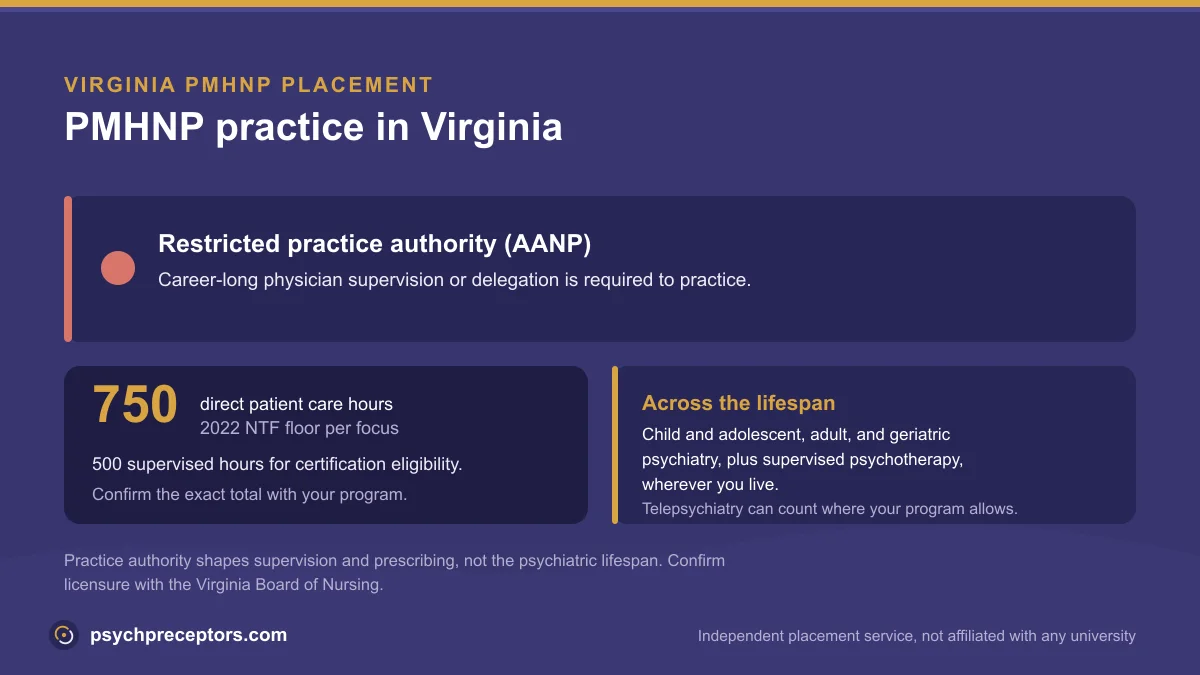
The AANP lists Virginia as a restricted-practice state, and that label describes the prescribing arrangement more than it limits your training. New nurse practitioners work under a written practice agreement with a patient care team physician. After a documented period of full-time clinical experience, a nurse practitioner can attest to the board and move to autonomous practice, dropping the agreement requirement.
For you as a student, the effect is straightforward. Your preceptor is a board-certified PMHNP or a psychiatrist licensed in Virginia and practicing in psychiatry. An autonomous PMHNP can hold independent prescriptive and controlled-substance authority; a preceptor earlier in their career practices with a collaborating physician, which is common in psychiatric settings anyway. Anyone prescribing controlled psychiatric medications holds a DEA registration. See our preceptor requirements for the full picture.
Hours, certification, and confirming your own number
The 2022 NTF Standards recommend at least 750 direct patient care hours per nurse practitioner population focus. ANCC and AANPCB eligibility sources separately use at least 500 faculty-supervised clinical hours. These figures serve different purposes and do not form a typical program range. Named programs vary and control the exact total and distribution, so confirm current requirements with your program.
The psychiatric-mental-health credential is ANCC PMHNP-BC. Your hours should span the lifespan and include supervised psychotherapy and medication management. If you want a second opinion on how your Virginia sites add up, our team can sanity-check the plan.
Getting matched in Virginia
Tell us your region, your program's required hours, and which rotations you still need, and we work Virginia's real supply, the community services boards, the outpatient and telepsychiatry groups, and the inpatient and addiction settings, to line up a qualified preceptor. We assist with placement, we do not guarantee a school's approval of any site, and we are honest when a rotation like child psychiatry will take longer to secure. Start at the match form or read how it works.
Good to know
Is Virginia a good state to find a PMHNP preceptor?
It depends on where you are. The Northern Virginia, Richmond, and Hampton Roads corridors have real depth in outpatient, inpatient, and addiction psychiatry, so adult and much of the lifespan is workable. Rural southwest Virginia and the Eastern Shore are harder and lean on telepsychiatry. We match to your region and fill gaps by video where your program allows.
Can telepsychiatry hours count toward my Virginia clinical requirement?
Your current program decides whether telehealth or simulation is permitted and how either is classified, supervised, documented, and applied. Confirm the current program rule and any applicable state requirements before relying on either format. Always confirm the specifics with your own program, since site and modality rules vary by school.
How does restricted practice affect who can precept me?
It shapes the prescribing arrangement, not your preceptor's core qualifications. Your preceptor is a Virginia-licensed, board-certified PMHNP or a psychiatrist. An autonomous PMHNP can prescribe independently, including controlled substances with a DEA registration; a newer nurse practitioner practices under a physician agreement. Either can teach you psychiatric assessment, medication management, and therapy.
Which rotation should I lock in first?
Child and adolescent psychiatry. It is the scarcest rotation in Virginia and clusters in a few academic and children's programs, so it is the one most likely to delay your timeline if you wait. Adult and geriatric hours and psychotherapy are usually easier to schedule around it.
Do you only work with students from certain universities?
No. We are independent and place PMHNP students from any university. We do not represent a school, and we never guarantee that your program will approve a given preceptor or site. We help you find qualified options and confirm the details before you commit.
Cover every rotation, not just the easy ones
Tell us your PMHNP program, your city, and the rotations you still need. We will come back with a plan for the full psych lifespan and a realistic path to placed.