PMHNP preceptor planning for University of San Francisco
A current official University of San Francisco source names a Psychiatric-Mental Health Nurse Practitioner pathway. That evidence supports this page, while all operating details remain with the program. When University of San Francisco permits or requires a student-proposed candidate for the current course, we can help identify and document one for program review without claiming affiliation or approval authority.
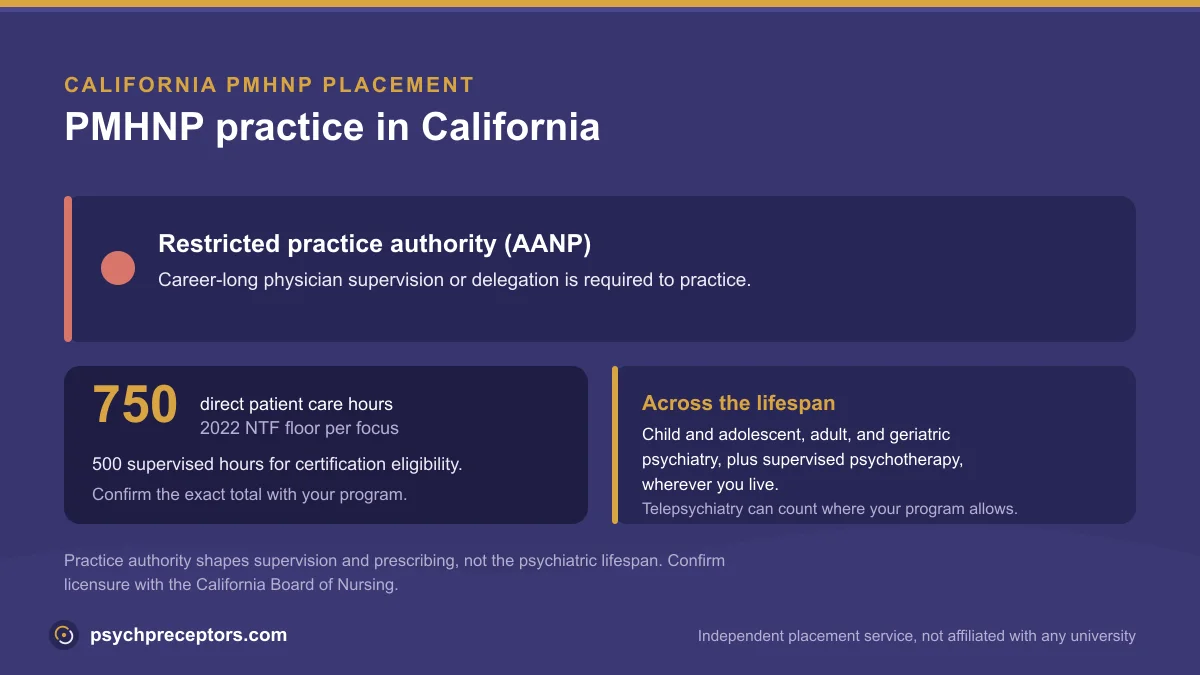
What PMHNP pathway does University of San Francisco currently list?
- Program: Psychiatric-Mental Health Nurse Practitioner (PMHNP)
- School: University of San Francisco
- Directory identity: San Francisco, California (CA)
- Evidence-bound pathways: Post-Graduate Certificate
- Evidence checked: July 21, 2026
- Approval authority: University of San Francisco
- Post-Graduate Certificate: official University of San Francisco source
The compact record supports Post-Graduate Certificate. Each label is tied to a visible official program URL below and was checked on July 21, 2026. The source proves only the named pathway at that time. It does not prove current modality, campus attendance, admission criteria, tuition, deadlines, course sequence, state availability, total clinical hours, or placement responsibility.
Confirm every unrecorded requirement with the current program. The current program makes every approval decision.
When can independent PMHNP placement support apply?
The first operational question is not who might precept. It is whether the active University of San Francisco course allows the student to propose anyone. Confirm the placement route, submission method, geography, timing, and required documents directly with the program. Independent sourcing begins only inside that confirmed boundary and never replaces school coordination.
Before sourcing, create a course-specific checklist from the active handbook and instructions. It should identify objectives, patient population, schedule, geography, candidate credentials, setting constraints, supervision, affiliation language, compliance needs, forms, and program contacts. This makes the candidate search precise while leaving every unresolved requirement with University of San Francisco.
Who approves a PMHNP preceptor and clinical site?
Candidate interest does not equal program acceptance. University of San Francisco reviews the clinician and site against its current academic, credential, population, supervision, geography, compliance, and affiliation standards. Site participation may involve a separate review. Until every required approval is complete, describe the person and location as proposed rather than placed or approved.
The appropriate clinician depends on current course rules. A board-certified PMHNP or psychiatrist with a relevant psychiatric caseload may be worth evaluating, while another behavioral health professional should enter the plan only with explicit program permission. University of San Francisco must review the person's role, credentials, practice, population, and proposed supervision.
How should students plan psychiatric care across the lifespan?
A strong planning map looks across child and adolescent psychiatry, adult care, and older-adult care rather than treating PMHNP as one undifferentiated block. Psychotherapy, prescribing and medication management, substance-use treatment, acute care, outpatient practice, and community behavioral health may also matter when the current University of San Francisco course requires them. Confirm the exact mix with the program.
Possible settings can include psychiatric clinics, hospitals, private practices, community programs, substance-use services, integrated care, and telepsychiatry organizations. Listing a category does not mean University of San Francisco accepts it or that work there will count. The program must verify the setting, population, activities, supervision, location, site participation, and documentation before any experience begins.
These are planning categories: child and adolescent, adult, and older-adult psychiatric care, plus psychotherapy, medication management, substance-use care, inpatient or acute care, outpatient care, and community behavioral health. They are not a claim that every school uses the same requirements, sequence, or distribution.
How should University of San Francisco students confirm clinical hours?
The official pathway evidence does not establish clinical hours. The student needs University of San Francisco's current requirement for the exact pathway and course, including how the total is distributed and recorded. Avoid estimates drawn from another program, credential, or catalog year. A search brief should use only the figures and categories the active program confirms.
How does location affect a PMHNP proposal in California?
Use San Francisco, California to distinguish the institution, not to infer where courses or clinical experiences occur. The active program should verify permitted geography and all related licensure, supervision, site, and agreement requirements. Our PMHNP planning page for California offers state context while leaving school rules to University of San Francisco.
What belongs in an approval-ready candidate file?
Give the program a proposal it can evaluate. Organize the clinician's license, certification, scope, experience, patient mix, site, schedule, supervision, relationship to the student, and course alignment. Pair that record with the organization's contacts, location, agreements, compliance information, and current school forms. Missing facts should remain questions, never marketing claims.
How can Psych Preceptors support University of San Francisco students?
Independent support begins after proposal permission and requirements are verified. Through the placement workflow, we search against the program's actual population, role, setting, location, schedule, and document criteria. A candidate remains proposed until the school and site finish review. Start at the request form with the current instructions.
Nothing here is issued by University of San Francisco. Our role is limited to independent candidate sourcing and documentation when current instructions allow it. We work independently of the institution, cannot decide eligibility, and do not guarantee a match, approval, affiliation, hours, course completion, graduation, certification, licensure, or another result.
Good to know
When can independent PMHNP placement support apply to University of San Francisco students?
Only when the student's current PMHNP program permits or requires a student-proposed preceptor or clinical site. Psych Preceptors can identify and document a possible candidate for program review, while University of San Francisco makes every approval decision.
Which PMHNP pathways are verified for University of San Francisco?
The current compact evidence supports Post-Graduate Certificate. Follow the visible official source links and confirm the active award, pathway, and requirements directly with the program.
How many PMHNP clinical hours does University of San Francisco require?
This page does not assign a total. Confirm the exact current requirement, course distribution, populations, activities, supervision, and documentation with the program's handbook, degree audit, course instructions, and placement office.
Does a PMHNP or psychiatrist automatically qualify as a preceptor?
No. A title or license alone does not establish eligibility. The program must approve the clinician, practice, patient population, setting, location, supervision plan, affiliation documents, compliance items, and paperwork.
Is Psych Preceptors affiliated with University of San Francisco?
No. Psych Preceptors is an independent service that works separately from, endorsed by, approved by, or acting for University of San Francisco. It does not guarantee a match, approval, hours, course completion, certification, licensure, graduation, or another outcome.
Cover every rotation, not just the easy ones
Tell us your PMHNP program, your city, and the rotations you still need. We will come back with a plan for the full psych lifespan and a realistic path to placed.