Placing PMHNP students across Maryland, Baltimore to the shore
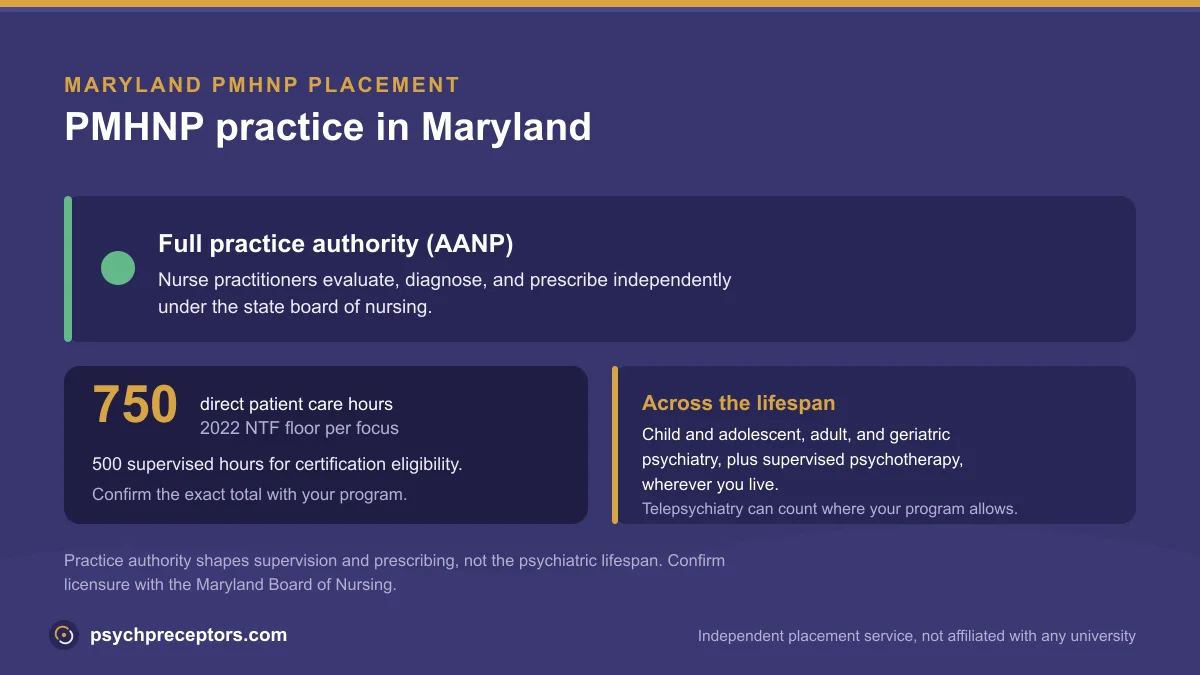
Maryland gives nurse practitioners full practice authority, so an experienced psychiatric-mental health nurse practitioner can precept you and prescribe independently without a physician written into the arrangement. Maryland is also unusual for how much psychiatric capacity it packs into a small area: the Baltimore corridor holds one of the country's largest private psychiatric systems, academic centers, and several state hospitals, while the Eastern Shore and the western panhandle run short and lean on telehealth.
The Baltimore corridor is a psychiatric hub
For PMHNP students, the Baltimore area is one of the richest training grounds in the country. Sheppard Pratt, based in Towson, is one of the largest private psychiatric systems in the nation and runs the full range of services: adult inpatient, a child and adolescent service, geriatric psychiatry, chemical dependency, and a Certified Community Behavioral Health Clinic. Academic medical centers in Baltimore add teaching psychiatry and specialty clinics.
That density means the settings your program asks for, medication management, therapy, inpatient, and specialty care, exist within a short radius. It also means competition, since several nursing, medical, and psychiatry programs draw on the same institutions, so we start Baltimore-area requests early. See outpatient and inpatient rotations.
- A large private psychiatric system and academic centers around Baltimore.
- A state psychiatric hospital network, including forensic care.
- Community behavioral health and CCBHC services.
- Telepsychiatry serving the Eastern Shore and Western Maryland.
The Washington suburbs, and the two rural edges
South and west of Baltimore, Montgomery and Prince George's counties in the Washington suburbs carry heavy volume and their own private and hospital psychiatry, along with Frederick and Annapolis. These are productive for adult and outpatient hours.
The two edges of the state are the shortage areas. The Eastern Shore, from Salisbury to Cambridge, and Western Maryland around Hagerstown and Cumberland are federally designated mental health shortage areas where local prescribers are few and telepsychiatry does much of the work. If you live on either edge, we plan around community clinics and telehealth rather than assume a nearby private practice.
Child, adolescent, and geriatric psych
PMHNP is an across-the-lifespan credential, so your hours must span child and adolescent, adult, and geriatric psychiatry. Child and adolescent psychiatry is the scarcest rotation, and in Maryland it concentrates in the Baltimore academic centers, the child and adolescent service at Sheppard Pratt, and the state's regional institutes for children and adolescents, with telehealth reaching the rural counties. Geriatric psychiatry is more available here than in many states, seen through hospital services, long-term care, and dedicated clinics. Book the child block first; see the child and adolescent rotation.
Inpatient hours and the state hospital system
Beyond the private systems, Maryland runs a state psychiatric hospital network: Spring Grove in Catonsville and Springfield in Sykesville handle general adult and some adolescent inpatient care, Clifton T. Perkins in Jessup is the state's maximum security forensic hospital, and Eastern Shore Hospital Center in Cambridge serves the shore. Community hospital psychiatric units across the metros carry most shorter admissions.
Inpatient and forensic settings give you the acute exposure programs value, though they are competitive and need lead time for onboarding and clearances. If your program requires a dedicated inpatient block, we start that search well ahead.
Full practice authority, prescribing, and psychotherapy
The AANP State Practice Environment lists Maryland as full practice, under the 2015 law that lets certified nurse practitioners diagnose, treat, and prescribe without a physician collaboration agreement, under the authority of the Maryland Board of Nursing. In psychiatry that means an experienced, board-certified PMHNP can precept you and hold independent prescriptive and controlled-substance authority, so a supervising psychiatrist does not have to sit behind every rotation. A DEA registration is still required for controlled substances.
Maryland also recognizes psychotherapy formally in nursing: the Board certifies a nurse psychotherapist category alongside its nurse practitioner certificate. Your PMHNP program requires supervised psychotherapy hours with training in at least two modalities, and Maryland's mix of academic and private practice makes those hours easier to arrange than in thinner states. See psychotherapy hours and preceptor requirements.
Your hours, and how we help
The 2022 NTF Standards recommend at least 750 direct patient care hours per nurse practitioner population focus. ANCC and AANPCB eligibility sources separately use at least 500 faculty-supervised clinical hours. These figures serve different purposes and do not form a typical program range. Named programs vary and control the exact total and distribution, so confirm current requirements with your program. See PMHNP clinical hours for source context.
We are an independent placement service for PMHNP students at any university, so our outreach is not tied to one school's approved list. Tell us your program, your county, and the rotations you still need, and we will map a route across the lifespan, drawing on the Baltimore hub for the scarce blocks and telehealth for the shore and the panhandle. Use the form at #match or reach us through contact. We assist with placement and cannot guarantee a match or your school's approval. Planning hours elsewhere? Start from the states index.
Good to know
Is Maryland a full practice state for PMHNPs?
Yes. Under Maryland's 2015 full practice law, certified nurse practitioners diagnose, treat, and prescribe without a physician collaboration agreement, under the Maryland Board of Nursing. An experienced, board-certified PMHNP can precept you and hold independent prescriptive authority, including controlled substances with a DEA registration. Your program still sets its own preceptor rules.
Where is the best place to train as a PMHNP student in Maryland?
The Baltimore corridor holds the deepest capacity, including one of the country's largest private psychiatric systems, academic centers, and state hospitals, so most rotations exist within a short radius. It is also competitive, so we start those requests early. The Washington suburbs add adult and outpatient volume.
Which psychiatric rotation is hardest to find in Maryland?
Child and adolescent psychiatry, which concentrates in the Baltimore academic centers and specialty services, with telehealth reaching the rural counties. Geriatric psychiatry is more available here than in many states. On the Eastern Shore and in Western Maryland, telepsychiatry carries much of the care. We book the scarce blocks first.
How do I get psychotherapy hours for my PMHNP program in Maryland?
Your program requires supervised psychotherapy with training in at least two modalities. Maryland's mix of academic and private practice makes those hours easier to arrange than in thinner states, and the Board even certifies a nurse psychotherapist category. We line up preceptors who can supervise the therapy component alongside medication management.
How many clinical hours will my PMHNP program require?
The 2022 NTF Standards recommend at least 750 direct patient care hours per nurse practitioner population focus. ANCC and AANPCB eligibility sources separately use at least 500 faculty-supervised clinical hours. These figures serve different purposes and do not form a typical program range. Named programs vary and control the exact total and distribution, so confirm current requirements with your program.
Cover every rotation, not just the easy ones
Tell us your PMHNP program, your city, and the rotations you still need. We will come back with a plan for the full psych lifespan and a realistic path to placed.